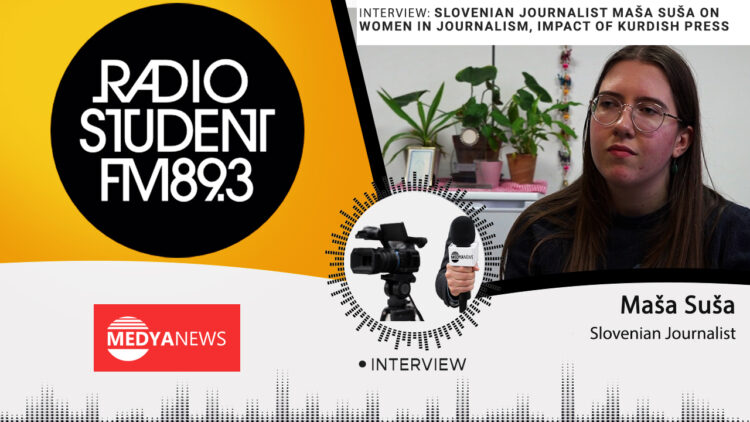
In an exclusive interview with Medya News, recorded on 1 December, Slovenian journalist Maša Suša introduces her work at the alternative Slovenian Radio Student, the oldest student radio in Europe, and how they strive to produce critical journalism.
Suša reflects on gender roles in journalism, talks about the history and tradition of Radio Student and the inspiration she gained from being part of a delegation of Slovenian journalists visiting different Kurdish press institutions, such as the all-female Jin TV (Women’s TV) and Newaya Jin (Women’s Newspaper).
Read the full interview, slightly edited for clarity, below:
Could you introduce yourself?
Sure, so I’m Maša Suša. I’m from Slovenia and I come here on a Slovenian delegation with the Kurdish women journalists. I work for Radio Student. This is actually the oldest student radio in the whole of Europe. I think we’re 55 years old and I come specifically from the university desk which covers topics on education and student problems. So I come here as a journalist but I also come here with a lot of interest in the Kurdish women movement and other topics that we’re covering today.
Can you tell us a bit more about the tradition of the alternative press in Slovenia and the tradition of the Radio Student?
Yeah, so Radio Student actually began its broadcasting in 1969 after the student protests in Europe started in 1968. It has a very long tradition. And it’s currently, we would say, one of the very few alternative media forms. We’re independent and non-commercial. This extends from the music we play, which is mainly alternative music, and we also don’t do commercials for big corporations or anything like that.
We also pride ourselves in the fact that we do critical journalism. So we try to be very critical about what’s going on in society and specifically which translates to me, to my desk, we cover topics like education and also student movements. So especially progressive student movements throughout the world.
You as a young woman take part in journalistic works, including radio works. Could you tell us about your personal experience as a young woman working in media works?
So this is obviously my first experience working in media. I would say Radio Student is an environment where I as a woman journalist am part of an all-female university desk. I feel it’s a good environment for me. But even our radio hasn’t always been this way. So, for example, we were talking, we talk a lot about the fact that there used to be more male editors. Now that’s changing. So also women journalists also take the positions of editors or of the political redaction, which used to be like traditionally more male journalists. So there’s positive changes also in our radio.
For the last days, you took part in a delegation of Slovenian women to different Kurdish press institutions. You saw the women’s television, Jin TV, also the women’s newspaper, Newaya Jin. And now you also saw the Kurdish TV channels Stêrk TV and Medya Haber. What would you say is something that inspired or surprised you the most when you visited these press institutions?
When I visited Jin TV, I was very impressed by the fact that women really do everything. And many women can also do multiple things. So they know how to use a camera, but they also know how to write an article and so on. So they have many different knowledges, which some are traditionally in the media sector seen as more male and where women are usually less present. So this was really impressive to me. Besides, the whole studio in Jin TV was also very impressive to me. And we also heard about the women’s newspaper Newaya Jin, which was also very impressive to me. And today we visited these TV studios here [at Stêrk TV and Medya Haber]. I’m actually very impressed by the fact that in Jin TV, I think they have 24-7 live broadcasting, if I’m correct, which must be a lot of work. And I also see that a lot of people here are busy all the time, so I’m very impressed by the amount of work that is put in this.
As a last question, what inspiration did you take from these Kurdish press institutions for your own press work in Slovenia?
I have a lot to reflect upon still but I think what probably will stay with me is the comfortableness in all female spaces, I think especially because I have this experience as a journalist and radio student at my radio desk. I think it’s just important that we are able to be in these spaces and feel that we can do all the work that is required.