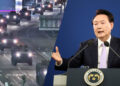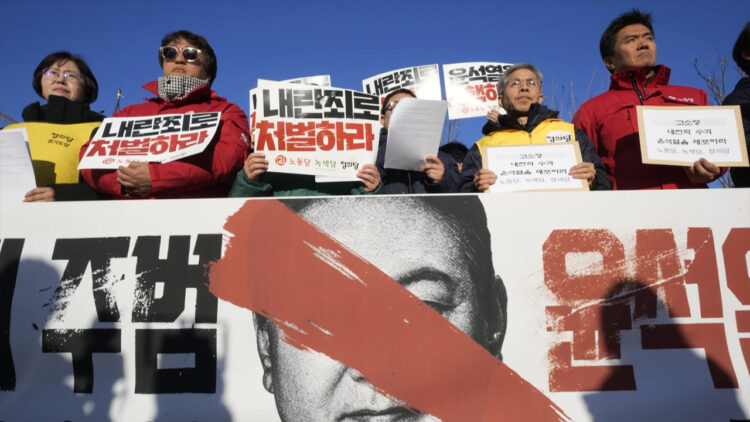
South Korea’s political crisis deepened on Wednesday as opposition parties submitted a motion to impeach President Yoon Suk Yeol following his unprecedented and short-lived declaration of martial law. The controversial move, the first such attempt in over four decades, has plunged the nation into its gravest democratic turmoil since the 1980s, sparking nationwide protests and sharp condemnation from international allies.
Opposition lawmakers, led by the Democratic Party, accused Yoon of violating the constitution and labelled his actions a betrayal of South Korea’s democratic principles. “President Yoon’s martial law declaration was a clear violation of the constitution. It was invalid from the start and constitutes an act of rebellion,” the party said in a statement, calling for his immediate resignation. The impeachment motion, submitted by a coalition of six opposition parties, could be brought to a vote as early as Friday.
The declaration of martial law, announced late on Tuesday, cited alleged threats from North Korea and “anti-state forces” within South Korea. In a televised address, Yoon claimed he was acting to protect the nation’s freedoms and constitutional order. “Our national assembly has become a den of legislative dictatorship,” he said, accusing opposition lawmakers of conspiring to paralyse government functions. However, the move was swiftly rejected by parliament, where opposition parties hold a majority, and faced fierce resistance from civil society groups and protesters who gathered outside the National Assembly in Seoul.
Hours after the martial law announcement, opposition lawmakers convened an emergency session and voted to overturn the decree, prompting Yoon to withdraw the order early Wednesday morning. In a live broadcast, he said, “We will accept the National Assembly’s request and lift the martial law through a cabinet meeting.” The reversal came as thousands of demonstrators, braving freezing temperatures, celebrated the announcement by waving flags and chanting slogans demanding Yoon’s impeachment.
International reactions reflected the gravity of the situation. The United States, South Korea’s key ally, expressed deep concern but welcomed the swift reversal. “We are relieved President Yoon has respected the National Assembly’s vote to end martial law,” a White House spokesperson said, emphasising the importance of democracy in the US-South Korea alliance. China, meanwhile, urged calm, and Japan described the developments as “alarming”. The US postponed joint military exercises with South Korea, further underlining the strain on diplomatic relations.
The declaration also drew scathing criticism from domestic institutions and media. The conservative Chosun Ilbo newspaper described Yoon’s actions as a “national embarrassment”, accusing him of undermining South Korea’s reputation as a top 10 global democracy. The left-leaning Hankyoreh called it a “betrayal of the people” and likened his rhetoric to that of the military junta that ruled South Korea decades ago. Civil society groups and unions, including the Korean Confederation of Trade Unions, announced plans for general strikes, demanding Yoon step down.
The fallout has thrown Yoon’s presidency into jeopardy, with impeachment now looming. To succeed, the motion would require a two-thirds majority in the 300-seat parliament before being reviewed by the Constitutional Court. If removed, Yoon would become only the second president in South Korean history to face such a fate, after Park Geun-hye in 2017—a corruption case ironically prosecuted by Yoon himself during his tenure as prosecutor general.
Critics argue Yoon’s move to declare martial law was a desperate attempt to consolidate power amid plummeting approval ratings. Recent polls placed his popularity at a dismal 19%, driven by dissatisfaction over economic policies and scandals involving his administration. Observers have called his martial law gambit an overreach with irreversible consequences. “This was an attempt to wind history back,” said Vladimir Tikhonov, a Korea studies professor, adding that civil society may no longer recognise Yoon’s legitimacy as president.
As South Korea reckons with its most significant political crisis in decades, questions linger over the stability of its democratic institutions. While Yoon remains defiant, his presidency now hinges on the outcome of a bitterly divided parliament and an enraged public unwilling to accept what they see as an assault on their hard-won freedoms.