As violent clashes between Islamist militias, forces of the Syrian regime and Kurdish-led forces escalate in northern Syria, and a new wave of Turkish attacks invades areas under the control of the Autonomous Administration of North and East Syria (AANES), the developments are being covered by many different media outlets and agencies.
Much varied and sometimes contradictory information is being disseminated through these different media channels, making it vital to listen to the voices of those reporting from the ground.
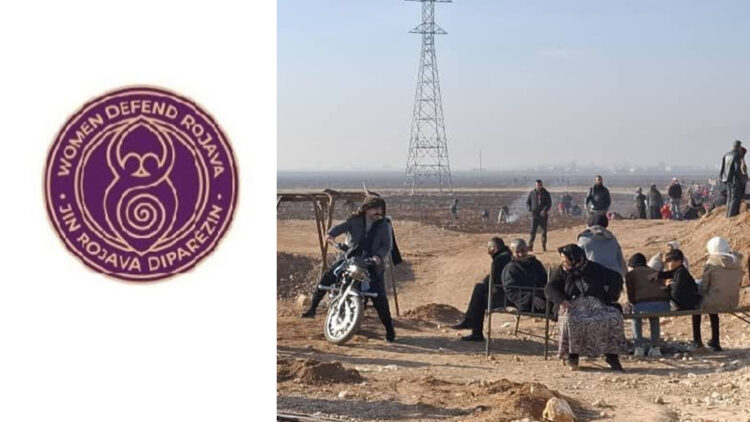
Here, we share the transcript of an audio statement by an activist based in northeast Syria, speaking on behalf of Women Defend Rojava, a campaign that aims to coordinate international resistance in solidarity with the people of North and East Syria (Rojava) and against the military attacks of the Turkish state and its allied Islamist mercenaries.
Her statement provides an insight into developments over the past few days and background on the various actors involved in the recent clashes.
Transcript of audio statement shared by an activist from Woman Defend Rojava:
“Dear comrades, dear friends and families, we send you warm greetings from Rojava, the heart of the Women’s Revolution, where we participate as internationalists in the various activities of the Autonomous Administration [AANES] and the political structures on the ground, that are building a radical democratic project. As you will have heard in the media, a new phase of attacks has begun against this unique project in the Middle East. Since 26 November, many battles have taken place in the west of Syria, and on 29 November, Aleppo [Heleb] was occupied by jihadist groups.
So it is these territorial fights that we have observed in recent days, but there has also been a fight for information. So we want to share some information with you. And first of all, it’s important to understand the meaning of Sheikh Maqsoud [Şêxmeqsûd], Tel Rifaat [Til Refat] and Shahba [Şehba]. These are regions in western Syria which, like Rojava, organise themselves according to the new paradigm of the Kurdish freedom movement, based on ecology, women’s liberation and radical democracy.
And these places have become the last enclaves where people find refuge from the jihadist and Islamist rebels that are now attacking the Syrian state and who want to gain more territory under their control. So the situation right now is that there are heavy clashes on the ground, but also international forces like Russia contributing to this battle by attacking from the air. And once again it is important to understand that these jihadist groups on the ground, namely the Hay’at Tahrir al-Sham Front [HTS], which came out of the Syrian [branch of] al-Qaeda, are backed by the Turkish state. They are jihadist gangs. And they are spreading fear through the people.
And on the other hand, coming more from the north of Syria, from the territories that have been occupied by the Turkish state, we see the formation of the so-called Syrian National Army [SNA], which is [made up of] Turkish militias that have been running […] or controlling the Turkish occupied territories in recent years. So we see the SNA attacking more from the north and Hayat Tahrir al-Sham more from the west, from Idlib, where they have been able to reorganise and take control in recent years. And now, yes, the people in many places are in fear, especially Kurdish people, but also Christians, who know that the jihadist groups want to destroy them.
It’s part of a genocidal policy that is backed by the Turkish state, but also by fundamentalist Islamistic thoughts, which leave no perspective for a diverse society, a society where women have rights and a society where people can live the life according to their needs. So we saw also around us, many friends are in great fear. Because they have relatives in these areas.
And what is very sad and is making us also very angry is that these places, like Sheikh Maqsoud, and Shahba in particular, these are places where people sought refuge after they were displaced when they were forced previously to flee from Afrin (Efrîn), originally a region with a mainly Kurdish population. And now, these people have to flee again. It’s a very emotional situation.
Yes, especially because now in this new phase, we again see heavy clashes on the ground between these jihadist rebels and the defence forces of North and East Syria, namely the Syrian Democratic Forces (SDF) and also the People’s and Women’s Protection Units, YPG and YPJ. And what the SDF and the YPG and YPJ are trying to do at this time is to make a corridor through which the people can flee to North and East Syria to find refuge. But it’s very difficult. There was the hope that the corridor could be opened, but right now it’s difficult because of the activities of the marauding jihadist militias.
And we think also this is where internationalist and international support is needed, to once again make clear who the forces are who can bring peace and who are building democracy in this region. So the SDF, the YPG, the YPJ, and the Autonomous Administration of North and East Syria (AANES) in particular, need support and international recognition.
They are the hope for peace in this region, and they are also the ones who represent the philosophy of Jin, Jiyan, Azadî (Woman, Life, Freedom) here in Syria. So all those who feel like spreading the philosophy of Jin, Jiyan, Azadî, all those who were attracted by this slogan in recent years, should support the democratic forces of the SDF, the YPG, the YPJ and the Autonomous Administration of North & East Syria.”