

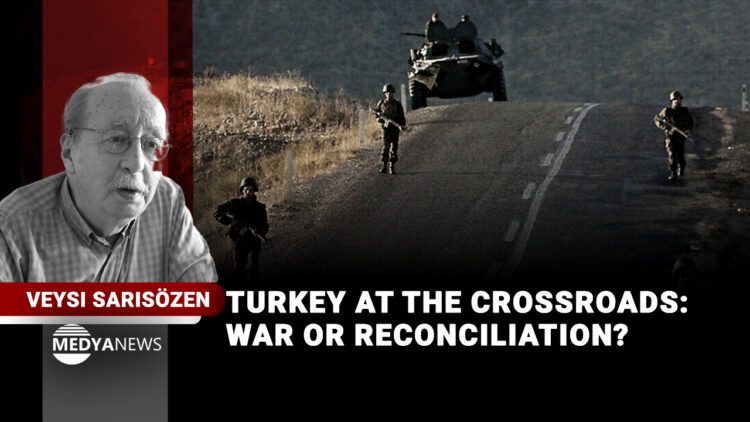
Veysi Sarısözen
Last Saturday, Foreign Minister Hakan Fidan, and on Sunday, MHP (Nationalist Movement Party) Deputy Chairman Semih Yalçın, made consecutive, highly significant statements. It is abundantly clear that Fidan was speaking on behalf of the Republic of Turkey. As for Yalçın, we know that he was speaking on behalf of Devlet Bahçeli. Both statements lead to the same conclusion.
These declarations have definitively clarified the political developments that have unfolded since 1 October.
At the press conference, Fidan reiterated his warnings about the “risk of nuclear war” and further remarked that “Israel’s attack on Lebanon” had elevated the Third World War to a “new dimension”, which in turn created the “risk of war with Iran”. These observations align with analyses we have also been expressing for quite some time. However, the most crucial element of Fidan’s remarks was what he said regarding the US elections.
While Fidan initially seemed to suggest that Trump’s actions were “uncertain”, he effectively admitted the “danger” facing the Turkish state, albeit in a diplomatic language he has yet to fully master. By stating that “we will need to see how much Trump’s stance will work in our favour” regarding the Russia-Ukraine war and the war in Gaza, he acknowledged the likelihood that developments may work “against” Turkey. Fidan interpreted the overwhelming pro-Israel stance within Trump’s cabinet as an indication that it would “support all of Netanyahu’s expansionist ambitions”.
Considering Erdoğan’s history of “militant opposition to Israel”, Fidan’s assessment can be seen as sounding the “alarm bells”.
What is the danger facing the Turkish state?
When stripped of diplomatic phrasing, Fidan appears to have recognised the strong likelihood of an Israel-Iran war and understood that Turkey will not be able to remain uninvolved. At the same time, given his in-depth knowledge of all regions of Kurdistan, Fidan must also foresee that if Turkey is drawn into such a conflict, it may not be able to protect its borders.
Although Fidan did not address Bahçeli’s comments regarding Öcalan, Semih Yalçın, in his speech on Sunday, echoed all of Fidan’s observations and the dangers he highlighted in his typically blunt style. Furthermore, Yalçın strongly defended Bahçeli’s earlier remarks about Öcalan. In fact, Yalçın, albeit in an inelegant manner, articulated the necessity of reaching an understanding with Öcalan as a response to the danger Turkey faces during this stage of global war. He stated:
“This is no laughing matter. The fact that our esteemed Chairman could step forward in a group meeting one day and propose something no one else could dare to put to the Turkish public stems from very serious issues. I particularly address those who ignore or dismiss this reality: everyone should act cautiously. If the People’s Alliance accomplishes this initiative in the current trajectory, the fight against terrorism will completely end after 40 years (referring to the 40-year-long conflict), the economy will improve, jobs will be created for the unemployed. It will mean an increase in wages for both retirees and workers. And we could list many more examples.”
One “example” he deliberately avoided mentioning is the notion that the Turkish state may only be able to safeguard its borders by pursuing this approach.
In summary, both Fidan’s and Yalçın’s statements indicate that the end of the road has been reached for the Turkish government.
At this juncture, there are two paths available for the government on this rugged terrain. One is indicated by the United States and Israel: the path of war and destruction. The other is pointed out by Öcalan: the path of internal resolution and external peace.
There is no need to elaborate on what the first path entails. Simply examining the Iran-Iraq war suffices to grasp the scale of devastation. This time, neither Turkey nor Iran will escape being diminished. The imperialists who created nation-states in the Middle East, each containing a part of Kurdistan, will now reclaim those parts under the pretext of “you cannot manage these regions, and therefore we cannot dominate the region.” They will seize the region’s oil, gas, and water resources, gain supremacy over rival global powers, and redraw the map of the region.
The second path offers an alternative: replacing the “nation-state, single-nation, totalitarian republic” with a “Democratic Republic” and pursuing peace with the peoples and organisations of Rojava, Başur, and Rojhilat. This path would protect Turkey from the devastation of war by establishing a “security corridor” stretching from the Mediterranean to Georgia. To those who complain about a “terror corridor”, let me remind you that transforming it into a “security corridor” is entirely in their hands. We are talking about a population of fifty million spread across four states and its formidable self-defence forces.
In essence, the state has sensed the danger. The necessity of “reconciliation” with the Kurdish freedom movement is becoming increasingly apparent. However, the nationalist hysteria that the state itself has fuelled over the past forty years now shackles them. It has taken them captive. They stand paralysed at the crossroads of “war and peace”. On the one hand, they prepare for war with trustee appointments and state terror, seemingly resigned to their fate. On the other, they desperately attempt to familiarise the public with the idea of “reconciliation” as a means of escaping destruction.
This is a transitional period and will not last long.


