

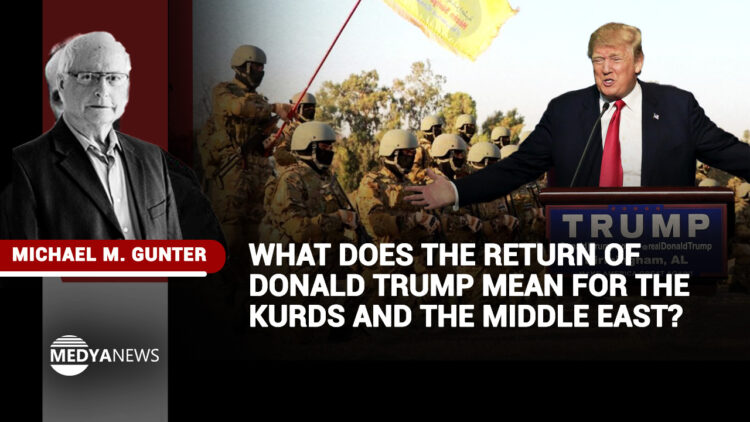
Professor Michael M. Gunter
Tennessee Tech University
For only the second time in US history, a defeated president will return victoriously to office. In Donald J. Trump’s case, it also means that he will not face any more legal prosecutions for some of his past actions such as encouraging a rightwing mob to storm the US capitol building on 6 January 2021, among others. He now is protected by presidential immunity, at least until his new second term is finished. Four years is a long time in politics, and he has promised to do a lot. What might this mean for the Kurds and the Middle East?
Before trying to speculate, I must remind my readers that as by far the most powerful and important state on earth, US foreign policy surveys an enormous number of topics. The Kurds are only a very minor one eclipsed even in their own backyard of the Middle East by the much more important US NATO ally Turkey. Iraq’s continuing territorial integrity also remains important given the sacrifices the US made in its two wars against Saddam Hussein, although these wars did result in the birth of the Kurdistan Regional Government (KRG). Syria also holds a keen interest for the US given the challenges presented there by Iran and its proxies like Hezbollah, Turkey, Russia, and the remnants of ISIS, among others.
Also remember that the US still officially classifies the PKK as a terrorist organisation and strongly opposes independence for the KRG or even too much support for the Autonomous Administration of North and East Syria (AANES), formerly known in Kurdish as Rojava. This is because of the threat these last two entities theoretically present to the continuing territorial integrity of existing states, whose demise the US believes would lead to great instability and the danger of war in the Middle East. Finally, the US has a very strong record of deserting the Kurds after using them for the interests of US foreign policy. As former US secretary of state Henry Kissinger once cynically explained, “covert action should not be confused with missionary work.”
One of the most recent examples of the US deserting the Kurds occurred in October 2019 when still in this first term of office, President Trump suddenly pulled US troops supporting the Syrian Kurds against ISIS out of Syria. This then allowed Turkey to intervene against the Syrian Kurds and also on several subsequent cases. These Turkish interventions have killed hundreds, while displacing thousands of civilians. Only because of the willingness of many others in the US government did it manage to maintain a token force in Syria to protect its interests and, as a secondary effect, that of the Syrian Kurds, who were still useful to combat a resurgence of ISIS.
At the time, Trump crudely explained himself by asking “why would I give a f***” about the Kurdish fate in Syria? When queried why he was taking such an attitude, Trump ignorantly explained that the Kurds “didn’t help us in the second world war – they didn’t help us with Normandy as an example – they weren’t there.” With such a distorted view of history, what good can the Kurds expect from the second coming of Trump? Of course, the Kurds have not done much better while Trump’s temporary successor Joe Biden was in the White House. Again, the reason remains that Turkey and other problems like Israel and the Palestinians, Ukraine and Russia, China, and a host of others throughout the world trump the Kurds for importance in the eyes of US foreign policy.
For background insight on all this, one might turn to “Project 2025,” the America First manifesto for a second Trump administration. This document calls for a neo-isolationist pullback of US influence in the Middle East, a new security pact for Israel, and continuing support for the Abraham Accords to bring peace between Israel, Saudi Arabia, and the Gulf states, among others. There is no place for the Kurds in this document. Moreover, how Trump can think he might be able to revive his former ‘Peace to Prosperity” plan for a two-state solution for the Israeli-Palestinian problem is a total mystery given his appointment of former Arkansas governor Michael Huckabee to be the new US ambassador to Israel. This is a man who promptly explained that there were no Palestinians and their putative West Bank homeland was really Judea and Samaria, the property of Israel. With biased views like this, there obviously can be no peace.
Huckabee’s sorry appointment to be the new US ambassador to Israel illustrates another striking problem for US foreign policy Trump’s return presents: Several high-level appointments of totally unqualified, even dangerous persons. Moreover, these appointments have been made without being vetted by the FBI for security clearances. Trump is even talking about doing this though recess appointments that ignore constitutional requirements of senatorial approval. Chief among these proposed Trump appointees are Tulsi Gabbard, Pete Hegseth, and, until recently, Matt Gaetz. Apparently, these appointments were made due to Trump’s eagerness to strike back at government agencies he believes have harmed or blocked him in the past. By doing this, Trump hopes to have more positions held by total loyalists who will do his bidding without question.
Tulsi Gabbard is a former Democratic party congresswoman turned conservative Republican whom Trump wants as his director of national intelligence. This is the new position created after the 911 al-Qaeda attacks in 2001 to coordinate the 18 different US intelligence agencies, chief among being the CIA for foreign intelligence, FBI for domestic intelligence, and NSA for code breaking. Certainly the director of national intelligence should be someone well versed in intelligence matters whose allegiance to US intelligence and security interests should be unquestioned. However, given Trump’s earlier display of saying he trusted Russia’s Vladimir Putin more than his own intelligence agencies—(Yes, Trump actually once said this!)—one may legitimately question Gabbard’s fitness for the position. For example, here is a person who knows almost nothing about intelligence matters but has strongly criticized their performance, met with Syrian dictator Bashar al-Assad in 2017 where she voiced bizarre conspiracy theories supporting him, and has regurgitated Russian propaganda regarding Ukraine and Venezuela. The only thing this pathetic potential national security risk offers is total loyalty to Trump.
Matt Gaetz’s appointment to be the new attorney general or head law enforcement officer in the US was like placing the fox as the guardian of the chicken pen. Until his resignation from Congress, Gaetz was actively under investigation for a long list of abuses which he denied, including child sex-trafficking, statutory rape, illegal drug use, converting campaign funds to personal use, and accepting impermissible gifts, among others. If confirmed, he would have been the head of the US Justice Department (DOJ) that would have been in a position to investigate and bring formal charges against him. Fortunately, even as I was writing this article, Gaetz withdrew his nomination as it had become clear that it faced too much opposition even among Trump’s usually compliant supporters. Nevertheless, his initial appointment as the top law enforcement officer in the US did Trump no credit.
Pete Hegseth’s appointment to be the next secretary of defence also has run into considerable controversy as his qualifications to head the US military are meagre. At the most, Hegseth is only a former National Guard officer, and conservative Fox TV News talking head with no serious managerial experience, who is best known for publicly defending reputed war criminals. He also has been accused of serious sexual assault claims, which to be fair he has strongly denied.
On the other hand, all is not lost because Trump has nominated Marco Rubio—a senior US senator from Florida and former Trump opponent for the Republican presidential nomination in 2016—as his secretary of state. This, of course, is the position equivalent to being foreign secretary of the US. While I personally do not agree with many of Rubio’s political positions, he is eminently qualified for the position traditionally viewed as first in the president’s cabinet and recognised as such by being fifth in line of succession for the presidency itself. Rubio will bring experience and responsibility to US foreign policy and at least educated opinion to the Kurdish issue.
The only question is how long such a man can or for that matter anyone can remain in office given Trump’s track record of firing his associates when they do not agree with him? For example, where is Trump’s former vice president Mike Pence, whom Trump notoriously broke with when Pence refused to obey him and instead, as his constitutional duty, certified Biden as the winner of the presidency back in 2021? Indeed, it is striking how many of Trump’s highest appointments in his first administration have so prominently called him unfit for a second term. Hopefully, they are not entirely correct and this article is too critical of the new American president. The world demands a competent American president. Only time will tell what we are soon to have.
Michael M. Gunter is a professor of political science at Tennessee Tech University in the USA. He recently published Erdogan’s Path to Authoritarianism: The Continuing Journey (Lanham, MD: Lexington Books, 2024).


