

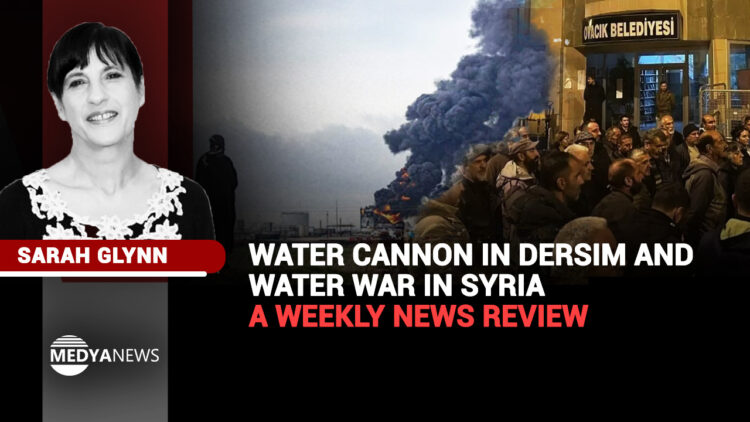
Sarah Glynn
As I write this on Friday night, thousands of people are on the streets of Tunceli (Dersim) protesting the Turkish Government’s takeover of yet another municipality, and being attacked by hundreds of police with water cannon and tear gas. I am going to go back to Tunceli later in the article, but I will start in Syria, as I had planned to do before this evening’s events.
Turkey’s water war in Syria
On Tuesday, the BBC broadcast the latest episode in their climate change series, Life at 50o. It is a harrowing depiction of life in a city without water – the city of Hasakah in the Autonomous Administration of North and East Syria. But, as the programme itself explains, heat and a four-year drought are only part of the problem. Since the Turkish invasion and occupation of Ras al-Ayn (Serê Kaniyê) in 2019, the Alouk pumping station, which supplied water to the city, has been largely cut off by the Turkish occupiers. This has left a million people to rely on uneven delivery by tanker from diminishing wells some distance away. The film follows the desperate officials searching for reliable supplies as they field a barrage of urgent phone calls; a tanker driver – himself a refugee from Turkey’s invasion who lives with his family in a squalid school building – working all hours to deliver water; and frantic families waiting for a delivery and fighting for their share of the meagre supply, hassling the tanker driver and the authorities in their desperation.
It shows how the situation has been further compounded by Turkey’s attacks on the region’s infrastructure, including the destruction of the Swadiyah power station, which eliminated the power supply needed for water pumps, as well as for everything else. And it explains that diesel generators are not enough, and that they suffer, in their turn, from Turkey’s attacks on the oil fields, which have pushed up the price of diesel.
The producers spoke to lawyers who told them that Turkey’s attacks on energy infrastructure “could constitute a severe violation of international law”; and they quote an independent United Nations enquiry that found no evidence of military targets near Swadiyah, and concluded that Turkey’s attacks on electrical infrastructure and disruption of electricity to water pumping stations “may amount to war crimes”.
They showed how the Autonomous Administration’s attempt to establish a new water supply from deep wells in Amude is thwarted through lack of the money needed to build a pipeline to Hasakah, or even to pay the contractors digging the wells.
The male co-director of the water board told them “North-east Syria is facing a humanitarian catastrophe”, and his female counterpart explained, “Turkey wants to put pressure on the local authorities to provoke people, get them on the streets protesting.” The head of water quality testing observed, “The Kurdish people defeated the ISIS fighters… We have made so many sacrifices – so many of us died in conflict. But nobody comes to our rescue. All we are asking for is water to drink.” While his wife said simply “They’re slowly killing people by cutting off the water.”
The poverty and the seriousness of the situation are stark, and the focus on Turkey’s role is rare and welcome, but the extent of Turkey’s complicity is even greater than the film admits. We are shown at the beginning how the River Khabur, which flowed through the city, has been reduced to a seasonal stream. What we are not told, and what is hardly ever mentioned, is that Turkey has been consistently holding back river water from entering Syria, in clear breach of international agreements. There have long been disputes over the river water in the Euphrates and the Tigris, and Turkey, as the upstream power, has been weaponising their control as a way of wearing down the Autonomous Administration. In May 2021, the Syria Observatory for Human Rights reported that pro-Turkish militias in control of the area occupied by Turkey were also damning the Khabur river in order to retain the water for the occupied region and prevent it flowing into the area run by the Autonomous Administration. Turkey has also carried out another round of attacks on the region’s infrastructure and oil wells since the film was made. All these blatant attacks on Syria’s people deserve to be much better known.
This report – though groundbreaking from the BBC – examines ongoing rather than recent news; however, it provides a clear depiction of Turkey’s relentless war of attrition against the Kurds, and so a framework for understanding recent events, and interpreting current debates about the prospects for peace.
Military attacks
Turkey’s war against North and East Syria is also being pursued militarily, despite the 2019 ceasefires, which are supposed to be guaranteed by Russia and America. As I was writing the above account on Thursday evening, Turkey and their mercenaries were attempting to attack a border village west of Tell Abyad (Girê Spî), where explosions were lighting up the night sky. The Autonomous Administration’s Syrian Democratic Forces (SDF) claim that they have inflicted many casualties among their attackers, and also that they killed five attacking mercenaries in an ambush on Monday night, but, on Tuesday, a civilian was fatally wounded by a Turkish attack on his village. The insecurity generated by such attacks allows ISIS to thrive and recruit, and Monday also saw a suicide bomb attack by an ISIS motorcyclist, which wounded three SDF soldiers.
With the geopolitics of the Middle East undergoing continuous, and potentially massive, upheavals, there have been suggestions that the Syrian Regime may be distancing itself from Iran, but I am not going to try and predict the implications of this, or what it might mean for Turkey’s efforts to rebuild relations with Syria’s President Assad.
Lawfare in Turkey
The Turkish Government is also continuing their internal war against the Kurds, and especially against pro-Kurdish mayors. On Wednesday, two mayors were each sentenced to six years and three months for “membership of an illegal organisation”. Cevdet Konak is the co-mayor of Tunceli and a member of the pro-Kurdish leftist DEM Party, and Mustafa Sarıgül is mayor of the small district of Ovacık (Pulur) in Tunceli province, and a member of the main opposition Republican People’s Party (CHP). The case against them, which they were not allowed to properly defend and which they will appeal, was started ten years ago. It did not prevent them from being accepted as mayoral candidates.
Neither man was detained, and they announced their intention to be at work the next day, but there was a general expectation that the government would use their powers to replace them with trustees. Tunceli’s co-mayors and their supporters launched a sit-in in the municipal buildings to prevent the anticipated take over. Co-mayor Birsen Orhan announced, “You will lose to the Dersim alliance, to the Kurds, to the Alevis, to women… We came through elections, and we will not leave through your trustees.” Yesterday evening the imposition of trustees was announced, and citizens attempting to keep watch were dragged outside. Local people gathered in front of the municipality, breaking down police barricades, and the authorities brought in even more police.
Dersim, which the Turkish Government renamed as Tunceli, is famous for its resistance to Turkification and for the massacre of tens of thousands of Alevi Kurds by the Turkish military in 1937-38. Co-mayor Orhan, addressing the swelling crowd, pointed to the police saying, “These are invaders. Just as they occupied Dersim in 1938, they have occupied our municipalities today… Let us embrace our struggle and fight together.” As the protests continued, the authorities brought in water cannon and teargas.
In nearby Ovacık, Mayor Sarıgül and his administration have been removed from the municipal building which, as I write on Friday night, is being “protected” by hundreds of police officers, with angry crowds gathering outside calling for justice.
The week began with a police raid on the office of the DEM Party in Esenyurt, the municipality where the CHP mayor was ousted and imprisoned in October. Esenyurt’s DEM Party co-chairs were detained and then arrested. The DEM Party mayor of Hakkâri (Colemêrg), who was ousted and given a 19 ½ year sentence in June, was this week given an additional sentence of nine years.
In Batman (Êlih), where, together with Mardin (Mêrdîn) and Halfeti (Xelfêtî), a trustee was imposed on 4 November, the municipal offices have become like a colonial outpost. Firat News Agency has described the scene, with masses of police outside and in and a poster at the entrance reading “One state, one flag, one nation, one homeland”. All visitors must pass through a body search and x-ray scan, and at night a police helicopter hovers overhead. Three hundred municipal workers have been removed from their posts, with many replaced by wives of soldiers and police officers.
United opposition
Opposition politicians are united in rejecting the imposition of trustees. Bills to abolish the trustee system, which was brought in after the failed coup of 2016, have been submitted by nine opposition parties.
A delegation including the CHP mayor of Istanbul, Ekrem Imamoğlu, along with other mayors and CHP MPs, visited the ousted DEM Party Mayor of Mardin, Ahmet Türk. As well as condemning the undemocratic use of trustees, Imamoğlu criticised centralisation, and stressed the importance of local government for democracy. He observed that disquiet over the use of trustees extended into members of the ruling party.
All these trustee cases were raised yesterday in Paris City Council, which passed a resolution calling for the immediate release of Kurdish mayors detained under false charges, an end to the “trustee” system and the reinstatement of elected mayors, an immediate halt to the violent repression of Kurdish protests, and respect for the democratic process. We need other municipalities to follow their example and show their solidarity too.
Öcalan’s isolation
For millions of Kurds, their hopes for peace, dignity, and democracy are focussed through Abdullah Öcalan, whose acknowledged leadership makes him uniquely positioned to negotiate a better future. They demonstrated their commitment to his leadership, and to a political solution to the Kurdish Question, at mass rallies in Cologne (for the diaspora) last Saturday and Batman last Sunday. The biggest response at the Cologne rally was reserved for Öcalan’s nephew, DEM Party MP Omer Öcalan, who visited his uncle in prison last month and was able to bring Abdullah Öcalan’s greetings directly to the gathered crowd. Omer Öcalan’s visit was the first time that Abdullah Öcalan had been allowed contact with the world outside the prison for 43 months. There were hopes that it would be followed by a visit from his lawyers; but on Thursday they were informed that he had been given yet another six-month ban on visits. This legal farce is repeated every six months.
Prospects for peace
Despite everything that has happened, people have not given up hope of a new peace opening. This has been a major focus of discussion ever since Devlet Bahçeli, leader of the far-right National Movement Party, the junior partner in Turkey’s government, shook the hand of the co-chair of the DEM Party at the opening of Parliament on 1 October. No one thinks that Bahçeli or President Erdoğan has undergone a Damascene conversion, but there is an argument that they are looking for a way out of their current political and military dead end, spurred by the political uncertainty of the Middle East.
On Wednesday, former MP Ufuk Uras met with Bahçeli, and Uras’ comments on their discussion have encourage the belief that Bahçeli is serious in wanting to see an end to conflict with the Kurds. How Bahçeli sees this happening, and what games he is envisaging along the way, is another matter. Despite recognising the importance of Öcalan, he has attempted to stoke division with his claim that the PKK does not represent the Kurds; and the government has promoted the malicious rumour that Öcalan made a proposal that the PKK rejected – a rumour that the PKK categorically denies.
Bahçeli’s handshake and subsequent speeches have put the prospect of peace on the wider agenda, where it may acquire a momentum of its own. In recent meetings between the DEM Party and other opposition leaders, the Kurdish Question has been on the agenda, as well as the issue of trustees. DEVA Party leader, Ali Babacan, talked about the need for concrete action on the Kurdish Question and for moving beyond rhetoric. Future Party leader, and former Prime Minister, Ahmet Davutoğlu, also met with Ahmet Türk, with whom he discussed dialogues for peace, including relations with Kurds in Syria and Iraq. And Kurdish rights were discussed at the DEM Party meeting with the Islamist New Welfare Party.
In the diaspora
Links with other opposition parties always need a note of caution. This week, alarm bells were sounded by the revelation that the CHP has asked the Turkish Intelligence Service to help them vet overseas applications in order to avoid infiltration by “terrorist organisations”, including groups in Germany affiliated to the PKK. Further hostile surveillance is the last thing needed by Kurds in Germany, where the German Government is already accused of acting like an arm of the Turkish state. This week the German authorities raided the Kurdish Centre in Bremen, for a second time this year.
Before finishing with a few words about the Iraqi census, I want to note a story from Australia that has been interpreted as an example of deliberate trickery. On Wednesday night, cars in Sydney’s Jewish suburb were vandalised and sprayed with anti-Israel slogans in an indiscriminate attack that appeared to conflate all Jews with Israel. Some were also sprayed with the words “PKK coming”, presumably to link the PKK to the attack. Perhaps the perpetrators were trying to stymie the cynical attempts by Israel’s new Foreign Minister to build Kurdish support.
The Iraqi census
And finally, the Iraqi census, which took place over 20 and 21 November and has been a cause of speculation and concern in this ethnically divided country. This is the first census to cover the whole country since 1987, and is important for economic and social planning. Worries have concerned the distribution of ethnic groups, and how the pattern recorded in the census could restrict future change, and even affect the political future of areas where control is disputed between the Kurdistan Regional Government and the Iraqi Federal Government. People in the Kurdistan Region have been allowed to register at their family’s place of origin in the 1957 census, before the major population changes brought about by policies of Arabisation, and have been encouraged to travel to these areas for the count. Many Kurdish families have come back to Kirkuk, but many Yazidis have remained in their displacement camps and not returned to Sinjar (Şengal). Whatever happens in the future, it will not be possible to reverse history. Populations aren’t simply counters on a board, but people with complicated interlocking lives.
Sarah Glynn is a writer and activist – check her website and follow her on Twitter


