

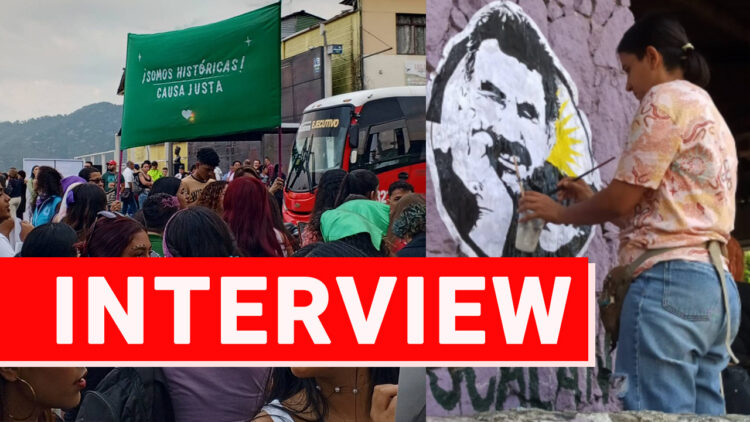
Ahead of the upcoming International Day for the Elimination of Violence against Women on 25 November, Medya News interviewed Ana Yimenez*, a young activist and member of the Kurdistan Solidarity Committee in Manizales, Colombia.
She provides exclusive insights into the situation of young women in Colombia, highlighting the alarming violence against women and the ways in which young women are building collective organising and self-defence structures against the violence they face.
Yimenez also talks about how she first became aware of the Kurdish women’s struggle and how she was inspired by reading books by the leader of the Kurdistan Workers’ Party (PKK), Abdullah Öcalan, whom she describes as the image of “a true companion in struggle”.
Read the full interview here:
Could you briefly introduce yourself and your organisation?
Over the last two years there is one question that has stayed with me and that is: What is freedom? This has led me to join groups posing that same question. I would say that I am a woman in search of freedom. As for the groups I am part of, one is an anti-patriarchal research laboratory from the south, made up of anthropologists and sociologists from the University of Caldas. Our interest is to challenge academia, which reproduces patriarchal and capitalist attitudes and mentalities. On the other hand, I am part or the Kurdistan Solidarity Committee in Manizales, in a bid to make the struggles of the people known, supported and disseminated.
What does your work within the Kurdistan Solidarity Committee in Manizales consist of?
This committee has been consolidated in Manizales for a year now. At the beginning, the comrade who opened the way in this city thought of it as a space where women’s collectives could learn from the revolutionary movement of women in Kurdistan, from their ideology as well as from their comradeship and actions. Currently, the work is the same, to spread the revolution of the women of Kurdistan as well as the whole paradigm that Rêber Apo [leader Abdullah Öcalan] has built together with the movement. For this, we have supported ourselves in presentations of the book Woman, Life, Freedom, as well as in writing spaces where we draw inspiration from this book.
What is the current situation in Colombia and what are the challenges you and your movement are facing?
Colombia has been going through a very severe armed conflict for a long time, especially affecting people in rural areas of the country. On the other hand, capitalism and all its neoliberal policies have increased the precariousness of the people, the lack of education, the privatisation of universities, the exploitation of labour, and individualism. In Colombia there is also alarming violence against women, trans-women and girls. The situation of sexual exploitation is also worrying, and personally makes me think that there is indeed a war against women, which makes us face hard trials.
In terms of collectivity, I have always felt that there is a great challenge in terms of the individualism and indifference of young women and society with regard to the problems that we face, which is why these processes of militancy are sometimes carried by one or two people. In the processes I have been involved in, I have come face to face with this situation, which has led me to reflect on our mental health and struggle. The burden of daily life overwhelms us and this in part also affects communication and organisation.
Without a doubt, collective organisation is at the heart of a militant political process. We realised that for collective organisation it is necessary to think about the distribution of work, not in an equitable way, but from a care perspective, it is better to distribute according to the time, health and emotional capacities of each comrade.
Another situation that deserves reflection is that collective work cannot continue to have the dynamic of one or two people working on behalf of a collective, it is an enormous overload and continuing with these dynamics does not contribute to the transformations that we aim for.
How did you come into contact with the Kurdish movement and the thought and philosophy of Abdullah Öcalan?
During the 8 March march this year in Manizales I got to know the Kurdish movement, especially the part about the women’s revolution in Rojava. The solidarity committee went out that day, and in a conversation told me very briefly about what is happening in Kurdistan. However, it was when I attended the presentation of the book ‘Mujer, Vida y Libertad’ [Women, Life, Freedom] that I became much more interested, and when I read the book completely, it helped me understand the importance of the Kurdistan liberation movement for the social transformation of this century and get much closer to the philosophy of Rêber Apo, although today I consider that I still need to go much deeper.
In reading Öcalan’s writings, what specifically caught your attention?
In the book ‘Mujer, Vida y Libertad’ [Women, Life, Freedom] they explain how Rêber Apo encouraged the women of Kurdistan to get to know each other, to create their own strength, will and thinking. When the first female commanders emerged, he supported them, inspired them to do it differently, to make them believe in their specific form of struggle as women. Beyond his writings, learning about his work in society, how Reber Apo accompanied the women – they debated, he showed them the importance of reading, of acquiring knowledge, of questioning – that work is what most strikes me about him. Also, it has a great impact on me because he is a person who stands with women and fights with them for the freedom of society, he is the image of men that women need, he is the image of a true companion in the struggle.
On the occasion of 25 November, International Day for the Elimination of Violence against Women, could you tell us about the situation of (young) women in Colombia?
I would talk about the loss of our power, recognising myself clearly reflected in this. We young women are losing ourselves in empty promises of the future. We are determining our value according to the money in our accounts, we are spending hours and hours giving our vitality to precarious jobs, our strength to create for society itself is forgotten, we are preoccupied with sustaining a beautiful image, this is further complicated by social networks, we need a better social critique of the world we inhabit, a profound questioning, as the Kurdistan movement teaches, profound in the sense of changing our individualistic and patriarchal thoughts and attitudes. Young women in Colombia are falling into the trap of success in capitalist terms, and we are losing our inner fire. In spite of this, there are young women in Colombia who strongly resist this domination of our bodies, our desires, our thoughts, our dreams, and we are committed to fight for a free life, without yet knowing what freedom is.

How do women organise themselves in your structures? What inspiration have you found in the Kurdish women’s movement?
Within the two collective processes in which I participate, our decisions are horizontal. We all participate in the proposed activities in the same way. In the Kurdish women’s movement, many of their proposals and actions are inspirational, one part is about the individual and the other part is about the collective. In terms of individuality, the need for constant self-observation to recognise individualistic, patriarchal and capitalist attitudes, actions and thinking is a super necessary and important proposal, as I agree that the transformation we seek as a society must first of all pass through our bodies and experiences.
On the other hand, as a collective and through anti-patriarchal research work, I am very inspired by the proposal of Jineoloji (science of life and women), it is very revealing because, of course, I understood that to seek and create a free life we must know our history and know why domination, oppression and violence have advanced so much in our societies. As part of the struggle we must also illuminate history, make our own science and know the past.
What are your expectations for the protests on 25 November this year?
Well, in Colombia the marches in the cities are always large and attract many women and sexual diversities. Bearing in mind that last year in the city of Bogotá the marches were repressed, I hope that this year they will be well attended and that women will be able to march safely and joyfully. I also hope that in smaller cities and towns the organisation and protests will be stronger.
*Name changed to protect anonymity


