

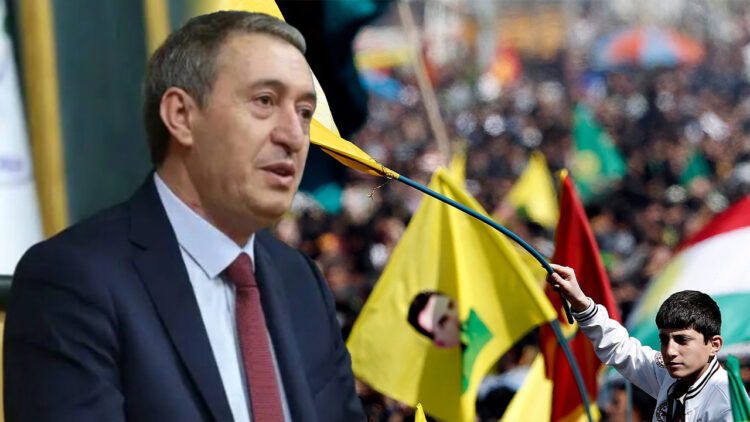
Tuncer Bakırhan, Co-Chair of the People’s Equality and Democracy (DEM) Party, has emphasised the urgency of engaging in dialogue with Abdullah Öcalan, the imprisoned leader of the Kurdistan Workers’ Party (PKK), to resolve Turkey’s long-standing Kurdish question.
“If the state is playing games, it is making a grave mistake,” Bakırhan warned, speaking to Selman Güzelyüz of Mezopotamya Agency (MA) on Tuesday. “There is a historic opportunity. If democratising the Republic is truly the goal for the second century, talks with Öcalan must begin immediately, and negotiations should commence.”
Abdullah Öcalan, detained in isolation on the Turkish high-security prison island of İmralı since 1999, was permitted an in-person visit on 23 October by his nephew Ömer Öcalan, a DEM Party MP, breaking 43 months of total incommunicado detention. Despite this rare visit, Öcalan said that the isolation policy persists but reiterated his readiness to lead the peace process. “If conditions allow, I have the theoretical and practical capacity to shift this process from conflict and violence to a legal and political framework,” he said.
Bakırhan underscored Öcalan’s central role in achieving peace, aligning with recent statements from the DEM Party’s Central Executive Board (MYK). The board urged the government to lift the isolation at İmralı immediately and called on society to unite in building peace, transcending divisive politics.
In his interview, Bakırhan responded to remarks by Nationalist Movement Party (MHP) leader Devlet Bahçeli, who recently acknowledged Öcalan’s significance in solving the Kurdish question. Bakırhan noted that while Bahçeli’s admission was surprising given his nationalist stance, it signalled a recognition of the issue’s magnitude. “The Kurdish question is not an abstract problem; it has blocked the country’s progress for decades,” he said. However, Bakırhan criticised both Bahçeli and the ruling AKP for lacking a concrete plan or programme for peace, adding, “If there is a genuine will for resolution, society deserves to know the specifics.”
Bakırhan emphasised that lifting Öcalan’s isolation would be the first meaningful step towards a solution. “Unlocking İmralı’s door is not just symbolic but a test of sincerity. Society is eagerly waiting to hear from Öcalan,” he said. Bakırhan highlighted the importance of inclusive dialogue involving civil society to strengthen the foundation for peace. He likened the process to the Algerian independence struggle, where French intellectuals and civil society played a pivotal role in advocating for peace, urging Turkish society to mobilise similarly.
Addressing the current political environment, Bakırhan warned that any insincerity in peace efforts would be detrimental. “For 100 years, tried-and-failed approaches have deepened the problem. Even the slightest glimmer of hope must be nurtured,” he said, reaffirming his party’s commitment to democratic solutions and honourable peace. Bakırhan also pointed to Öcalan’s recent message, where he declared readiness to contribute to a resolution, and statements from the Kurdistan Communities Union (KCK), which pledged to follow Öcalan’s lead.
Bakırhan called on the ruling coalition to clarify their stance. “If the Kurdish side is ready for peace, the same question applies to [President] Erdoğan and Bahçeli: Are you ready?” he asked. He urged the state to move beyond policies that perpetuate conflict, warning that failure to act would hinder Turkey’s democratic and economic development.
Furthermore, Bakırhan criticised President Recep Tayyip Erdoğan’s recent signals of a potential military operation in northern Syria, particularly targeting the Kurdish-led Rojava region. “Rojava is not a threat; it is humanity’s pride. Peace inside Turkey cannot exist without peace across the border,” he said, adding that hostility towards Rojava undermines the government’s rhetoric on unity.
Highlighting the interconnectedness of domestic and regional peace, Bakırhan stressed that genuine reconciliation requires a shift from antagonism to coexistence. “Rojava’s success demonstrates the potential for democratic governance and coexistence. Hostility only alienates potential allies and deepens divisions,” he said.
As Turkey enters its second century as a republic, Bakırhan’s call for dialogue with Öcalan resonates as a plea for transformative change. “With a clear solution framework and Öcalan’s readiness, the chance to solve this historic issue is within reach. There is nothing more valuable than going down in history as the one who resolved it,” Bakırhan concluded.


