The fifth and final volume of Abdullah Öcalan’s Manifesto for a Democratic Civilization lays out his vision for the Kurdish people and a new, democratic consensus in the Middle East and beyond.
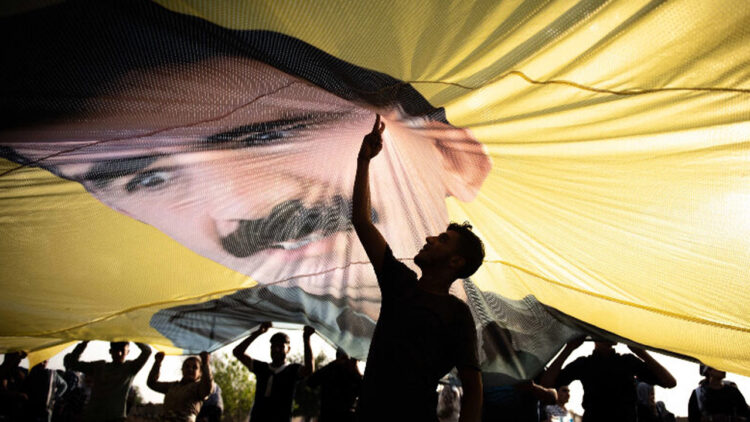
There are expectations growing that peace talks may resume between Kurdish leader Abdullah Öcalan and the Turkish government, after the Kurdistan Workers’ Party (PKK) chief was allowed to meet with a relative for the first time in nearly four years. For now, however, Öcalan remains held in conditions of severe isolation, and is unable to communicate freely with the outside world. As such, the Medya News editorial team have decided to publish this extract from the unpublished fifth volume of his ‘Manifesto for a Democratic Civilization’, translated into English for the first time. This text, published from Öcalan’s jail cell in lieu of his defence during his trials, offers the Kurdish political leader’s revolutionary perspective on the need for a new political paradigm in the Middle East.
In the fifth and final volume he particularly addresses the unresolved Kurdish question and his vision for a ‘Democratic Civilization’ in the Middle East and beyond. This extract is taken from the sixth section of the book, in which the Kurdish leader shares his vision for ‘Peace, a democratic solution, and the construction of a democratic nation’. It suggests concrete pathways to peace, including the role which the Kurdish umbrella organisation Kurdistan Communities Union (KCK) could play in this process.
Öcalan writes:
The PKK attempted to overcome its impasse in resolving the Kurdish question by critically analysing the concept of the nation-state. The influence of real socialist nation-state ideology was most evident in the ideological and political formation of the PKK, notably during its offensive of 15 August 1984, a peak moment in the people’s revolutionary struggle. This influence ultimately led to stagnation, signalling that progress would be difficult if it were not addressed.
The rapid dissolution of real socialism in the 1990s contributed to a clearer understanding of this underlying issue. What dismantled real socialism was the problematic nature of power and the real socialist nation-state; in other words, the failure to address issues of power and statehood impeded socialism. This issue had a significant impact on the global crisis of socialism. When the contradictions of power and statehood surrounding the Kurdish question converged with the global crisis of real socialism, a profound analysis of these concepts became unavoidable.
In my defence, I devoted a significant portion of my focus to analysing the concepts of power and the state throughout the history of civilization to address this. My primary focus was on exploring the transformation of these concepts within the dominant civilization of our time — capitalist modernity. I argued that the transformation of power into the nation-state formed the foundation of capitalism, a crucial thesis. My analysis suggested that without organising power in the model of the nation-state, capitalism could not have achieved hegemonic status. The nation-state served as the fundamental tool enabling capitalist hegemony. Consequently, as an anti-capitalist stance, I sought to demonstrate that socialism, presenting itself as a historical society, could not be constructed based on the same state model — that is, as a real socialist nation-state.
I argued that the belief, originating from Marx and Engels, that socialism could only be built upon central nation-states was a systemic flaw in scientific socialism. I proposed that building socialism by relying on the state, and particularly the nation-state, was untenable; persisting in this approach would lead to outcomes marked by capitalism’s most degraded forms, as evidenced by experiences like those of Russian and Chinese socialism, that actually existed. I exerted considerable effort to analyse the centralised civilization systems, the concept of power and the unique forms of power and state in our era — capitalist modernity — to substantiate this thesis. My fundamental conclusion is that socialists cannot base their principles on the nation-state, and that the core solution to national issues should be the democratic nation. The concrete expression of this idea is embodied in the experience of the KCK (Kurdistan Communities Union, an umbrella organisation incorporating the PKK).
The PKK’s second major adjustment concerning power relates to a more concrete issue. When examining Turkish-Kurdish relations within the context of ethnicity and statehood, it became evident that without taking into account the geopolitical and geostrategic links of Anatolia and Mesopotamia, it will not be possible to reach the right solutions. These regions, inhabited intensively by both societies, have historically experienced extensive cultural exchanges, shaping close geopolitical and geostrategic ties. These connections, which continue to shape the present, can only be accurately understood through a comprehensive approach.
The Kurdish hierarchical elite, who have frequently encountered the dilemmas of power and state, have historically attached their fate to the authority of more powerful states, always on the basis of relative autonomy. Kurdish society has not pursued independent systems of power or statehood. Due to historical and societal circumstances, any attempt to establish such structures did not align with its interests.
Kurdish history with the Turks over the past millennium has also been assessed on this basis. Voluntarily joining forces with the Seljuk Sultan Alparslan, the Kurds achieved victory in the Battle of Manzikert, establishing a new power and state-sharing arrangement in the lands of Anatolia and Mesopotamia based on Islamic principles. The geopolitical and geostrategic realities stemming from both regions necessitated a shared Islamic power and state between the elites of both peoples. Even though the people themselves had little benefit from this shared power structure, and frequently resisted living under the common framework of power and state, they continued to live together due to the demands of shared life and the religious and sectarian conflicts of the period. This partnership between the Turkish hierarchical elite and the Kurdish upper class was always based on mutual consent. In Turkish traditions of conquest, there is little notion of ‘the conquest of Kurdistan.’ Occasional military expeditions only occurred with the contributions of Kurdish leaders, and thus cannot be described as conquests.
This historical reality of Turkish-Kurdish relations must be fully understood in the context of resolving the Kurdish question today. Key historical crossroads in these relations include the Ottoman Empire’s eastward expansion policies under Sultan Selim I (1512-1521), the establishment of the Hamidian Regiments during Sultan Abdul Hamid’s reign (1876-1909), the Ottomans’ participation in World War I as a result of the impositions of the Committee of Union and Progress, and, most importantly, the modern National Liberation War led by Mustafa Kemal.
This reality was both a foundation and a decisive factor in each of these instances. With the conspiracy of 15 February 1925 — which signified the denial of the democratic foundation of the Republic — there was, for the first time, an attempt to terminate this historical and geographical framework of joint, voluntary representation in power and state. In the relevant sections, I discuss at length how the British Empire, the dominant capitalist power of the time, played a decisive role in this conspiracy, intending to divide the Republic along ethnic lines to secure control over the oil-rich region of Mosul and Kirkuk (Iraqi Kurdistan). Britain’s minimalist Republic or nation-state project succeeded in the Middle East, as it did globally, including in the territories of Anatolia and Mesopotamia. All cultural forces, communities and even states in the Middle East, which were divided socially and politically, lost significant strength due to this policy. Continuously fragmented and embroiled in conflict among themselves, they weakened, allowing British hegemony to flourish successfully.
The de-Kurdification of the Republic broke the traditional alliance, completely excluding Kurds from the system. The project presented to the Kurdish elite was founded on the principle that they could maintain their existence as individual Turkish citizens, but only if they renounced their Kurdish identity and heritage. Going even further, the path to gaining influence and rising within the system was conditioned on the suppression and erasure of Kurdishness, paired with the glorification and development of ‘White Turkishness’. This became the ‘iron law’ for establishing oneself in the Republic. Initial objections and resistance from the Kurdish elite were subdued into compliance through harsh ‘disciplinary and punitive’ actions by the state.
For perhaps the first time in Kurdish history, the elite chose to secure their own existence by sacrificing their community’s heritage and presence — exceptions to this rule were few. Their survival and advancement now depended on serving White Turkishness (a term I insist on using here, as it signifies a segment distinct from traditional Turkishness, crafted by Western hegemony through conspiratorial means and prepared both objectively and subjectively as an agent group. Levantines transformed into ardent Turkish nationalists, armed with intense aggression, is an extreme example). The elite would secure and develop their existence only to the extent that they served this White Turkishness.
Meanwhile, the Kurdish masses left without leadership became mere objects, reduced to possessions, and entirely vulnerable to policies of denial, destruction and assimilation. Even the slightest association with Kurdishness spelled death. Abandoning Kurdishness became the only path to survival. Kurdish identity was not only eradicated as a concept but was stripped away along with all its symbols and names. The covert cultural genocide project targeting Kurdishness (and, to a degree, other cultures, but primarily focusing on the Kurdish identity) was implemented day by day, step by step, throughout the history of the Republic. All domestic and foreign policy was designed to adhere to and support this ‘iron law’. Conducted largely in secret, these policies permeated the parties, civil society organisations, and realms of economy and politics developed without awareness, all aligning with this ‘iron law’. External organisations, including the UN, NATO and the EU, were also approached with the aim of serving this same ‘iron law’. The hand of this law was decisive in coups, conspiracies, assassinations and all forms of torture and imprisonment.
a- In the emergence of the PKK, awareness of these realities was limited. The cultural unity and geopolitical and geostrategic ties between Anatolia and Mesopotamia, and their impact on Kurdish-Turkish relations, were not fully understood. The minimalist nation-state policies of hegemonic powers like Britain and the United States, forces of capitalist modernity, influenced scientific socialism, as well as all social sciences. The PKK’s share in this was its own socialist nation-state model. It was this deviation towards nation-statism that was overcome through fundamental self-critique. Since this deviation has not been overcome within the global Left and the Turkish Left, disintegration has become inevitable. The primary reason for socialism’s ongoing crisis lies in this impasse.
b- The PKK, through its transformation, introduced a new model of resolution for national issues, particularly the Kurdish question, which is a democratic nation stripped of all forms of nation-statism. In capitalism, the construction of nations must serve the law of maximum profit, which is achieved through the nation-state as the new religion of modernity, driven by nationalism. Nationalism gives birth to the nation-state, and the nation-state fosters nationalism. During intense crises of capitalism, nationalism and the nation-state tend to lean towards fascism. Socialism can establish itself as an alternative and develop as a system only to the extent that it transcends the nationalism and resulting nation-statism of capitalism. The path to this is the democratic nation and a non-profit social market economy; this counters capitalism’s profit-driven industrialism with an ecological industry.
c- The KCK represents an effort to propose and implement the democratic nation, a model devoid of nation-statism, as a solution for the Kurdish question that applies not only to Kurds but to all ethnic and national communities. Throughout the history of capitalist modernity, nation-state solutions have been imposed as the only solution to national issues, turning history into a bloodbath. Nation-state solutions do not solve issues but instead deepen, intensify and escalate them, facilitating maximum profit and industrialism, ensuring their continuity. The KCK sees the path to peace and resolution as abandoning this triad of capitalist modernity (nation-state, maximum profit and industrialism) and providing an alternative through the pillars of democratic modernity (democratic nation, non-profit social market economy and ecological industry).
d- A peaceful and political approach to resolving the Kurdish question with the Turkish nation-state, as well as with the nation-states of Iran, Iraq, and Syria — and even the Kurdish Federal State — can only be achieved if these entities recognise the Kurdish people’s right to be a democratic nation (a right that applies to other peoples as well) and, as a natural consequence of this right, their status of democratic autonomous governance.
It is a positive and promising step that the EU, traditionally a stronghold of nation-state solutions, is now opening the door to a democratic nation-based resolution. To fully develop this solution, the EU must gradually reduce the scope of nation-statism and expand the space for democratic civil society. If Turkey, Iran, Iraq and Syria wish to free themselves from the Kurdish issue, they must take a path similar to that of the EU. The KCK’s position on this basis is conducive to peace and a political solution. The main obstacle to peace and political resolution lies in policies, practices and covert cultural genocide projects imposed on the Kurds by these states. Permanent peace and political resolution can only be achieved if they abandon these practices and embrace the fundamental elements of democratic modernity, including the democratic nation, a social market economy aimed at limiting profit, and ecological industry, and integrate these into their system with a formal status (democratic constitution).
e- The solution imposed by global capitalist hegemony on nation-states with cultural genocide policies under the Greater Middle East Initiative (GMEI) is being pursued on two fronts. The first front is the Erbil-centred formation of a Kurdish federal nation-state, seen as the first step towards a long-term nation-state-based solution. The second front is the Diyarbakır-centred solution to the Kurdish question based on ‘individual and cultural rights’. This project, particularly promoted by the EU and the US through the AKP (Justice and Development Party) government, is being implemented directly or indirectly in alignment with the Erbil-centred Kurdish Federal State. In exchange for neutralising and eliminating the PKK and, specifically, the democratic political solution embodied by the KCK, this twofold path is imposed upon nation-states with policies of cultural genocide. However, as this solution project lacks popular support, and its chances of success under global capitalist hegemony are low.
Kurdistan has already, in some respects, become the focal point of revolution and counter-revolution in the 21st century. It represents the weakest link in capitalist modernity. The national and societal issues of the Kurdish people have grown too severe to be obscured by liberal prescriptions or the rhetoric of individual and cultural rights. In the case of the Kurdish question, nation-statism, which has led to practices tantamount to cultural genocide, has become a source of problems rather than solutions, whether for dominant or for subjugated nations. Nation-statism, increasingly seen as a problem even within capitalist modernity, is beginning to disintegrate. More flexible, democratic national developments are becoming the primary transformative developments of the era. Democratic modernity represents both the theoretical framework and the practical steps for this shift. As the tangible expression of democratic national transformations in Kurdistan, the KCK illuminates the path for the democratic modernity solution in the Middle East.
f- Today, the KCK’s solution stands at a crossroads. The resolution of issues may be achieved through peace and democratic politics by way of a democratic constitution. In this scenario, the relevant nation-states would not only abandon policies of denial and destruction but also accept a realistic definition of the issue and seek its resolution within a universal democratic constitution, sharing both the content and method of this constitution with their counterparts. This solution, which would enable the integrity of these countries both as states and nations, requires radical democratic transformations.
Alternatively, if this preferred route is persistently blocked, the remaining path for the KCK would be to unilaterally and in a revolutionary manner establish and defend its own democratic authority. Numerous factors contribute to the potential success of this route: the ideological and political guidance of the PKK, which has over thirty years of experience; the tried and tested, strong support of the people through revolutionary struggle; the military capacity to exercise self-defence in every sphere; and the extensive network of internal and external relations, all of which enable the KCK to build, govern and protect a democratic nation. This path will no longer encounter the impasses experienced in the past. Since it aims for a democratic nation rather than state nationalism, it remains consistently inclined toward resolution and peace, open to dialogue and negotiation with nation-state powers. Should such efforts prove unsuccessful, the KCK is prepared to continue building, governing and defending a democratic nation independently on its original path, relying on its own intrinsic strength.