

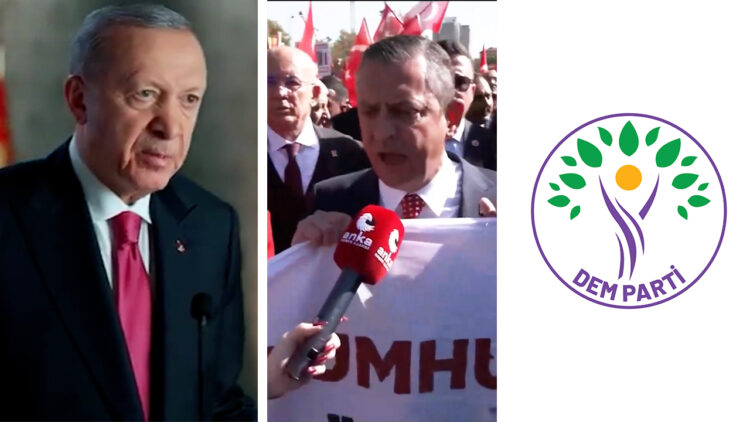
On 29 October, as Turkey celebrated its 101st Republic Day, statements from political leaders underscored the ongoing national conversation on the Kurdish issue and democratic reform. Pro-Kurdish Peoples’ Equality and Democracy (DEM) Party marked the day by issuing a statement calling for a “democratic republic” and urging Turkey to “turn a new page” toward justice, equality, and inclusivity.
The DEM Party’s statement advocated for “a democratic constitution” to guarantee “equality before the law and respecting the rights of all people”, emphasising that such measures are critical to sustainable peace and unity.
President Recep Tayyip Erdoğan, meanwhile, conveyed a markedly different focus. In his Republic Day address shared via the Presidency’s X account, he highlighted national security, asserting a commitment to end a “40-year scourge of terror”. Erdoğan asserted, “Terrorism must be consigned to history using every resource available to us.”
He also pledged to “strengthen our commitment to peace, security, and justice within our borders, across the region, and globally, in line with our civilisation’s values and ancient historical perspective.”
These statements follow recent developments around the Kurdish question, particularly after DEM Party MP Ömer Öcalan’s visit to İmralı Prison, where he met his uncle, Abdullah Öcalan, the leader of the Kurdistan Workers’ Party (PKK). The meeting on 23 October, lasting over an hour and a half, was Abdullah Öcalan’s first in-person contact with an outside representative in 43 months. Under continued isolation since his capture in 1999, Öcalan’s restricted contact has fuelled calls from Kurdish political figures and human rights advocates to bring him into the conversation for a peaceful resolution to the Kurdish issue.
On the same day, at a Republic Day march from the First Grand National Assembly to Anıtkabir in Ankara, Republican People’s Party (CHP) leader Özgür Özel addressed the Kurdish issue. “True unity,” he remarked, “comes from recognising our diverse voices, not suppressing them.” Özel highlighted the importance of inclusivity and reforms, arguing that Turkey’s future depends on policies that embrace all citizens, including historically marginalised groups.
Abdullah Öcalan’s isolation on İmralı Island has become a focal point of activism within Turkey and across Europe, with numerous rallies demanding an end to his solitary confinement. Supporters argue that Öcalan’s participation is essential for a comprehensive approach to the Kurdish question. His past involvement in peace dialogues, they claim, positions him as a potential key figure in efforts for a renewed peace process. Since 2019, Öcalan has had virtually no contact with the outside world, with activists arguing that a political dialogue involving him could open new avenues for peace.
With Turkey facing divergent paths on issues of unity and minority rights, the Republic Day messages illustrate the contrast between Erdoğan’s security-focused approach and opposition calls for a more inclusive and democratic republic. While Erdoğan’s message underscores strength and resilience, the DEM Party emphasise the need for a democratic constitution and social reforms addressing the Kurdish question, aiming to bring lasting peace and equality to Turkey.


