Amidst the genocide and ethnic cleansing being waged against the people of Palestine, the Palestinian struggle is being supported by a new generation of internationalists. A revitalised global movement has risen up in response to the Israeli state’s increasingly fascistic violence. From the occupying students across the US standing up to the riot cops, to the people blocking boatloads of weapons at ports as far flung as Spain, South Africa and Slovenia. From the UK anti-militarists who have sabotaged dozens of factories manufacturing weapons for the Israeli state, to the internationalists from many countries who travel to Palestine to show solidarity with the popular struggle against the occupation.
Palestinians resist the assault on the olive harvest
The eyes of the world have been drawn to the Palestinian olive harvest recently, as the news hit that an Israeli soldier murdered 59-year-old Hanan Abd Rahman Abu Salameh in the village of Faqqua near the West Bank city of Jenin as she tried to take in the annual harvest. Six hundred olive trees have been burnt by the army and settlers since the beginning of the harvest season, according to the United Nations Office for the Coordination of Humanitarian Affairs (OCHA).
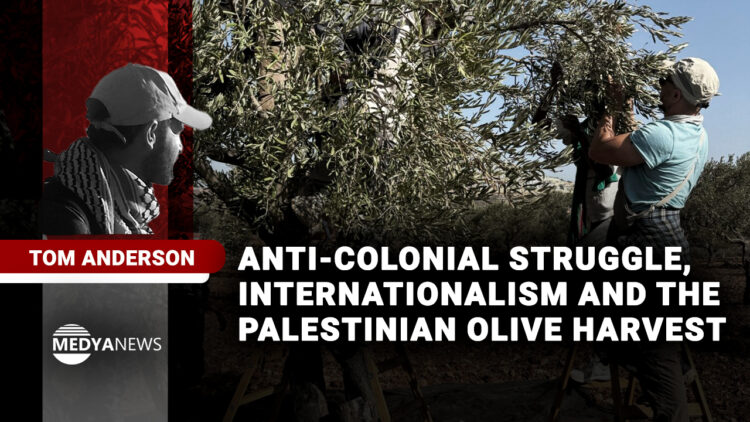
As with each year’s olive harvest in the West Bank, Palestinian communities have come together in an act of collective mutual aid. Local popular committees have organised a collective response to the attempts by the army and settlers to stop them from taking in their olives. As in previous years, people are going en-masse to their trees hoping that more numbers will bring more safety. International volunteers from the International Solidarity Movement (ISM) and Faz’aa, as well as networks of Israeli comrades, are organising to support them.
The attack on the olive harvest is part of a wider colonial assault by the occupation forces against livelihoods in rural Palestine. The occupation wants to seize Area C of the West Bank, which encompasses the majority of its agricultural land. The Israeli state made a formal attempt at annexing Area C back in 2020, hoping to get the green light from Donald Trump. Israeli colonists will be eagerly watching the results of the US elections, anticipating an opportunity to revive this plan.
But the attacks on the harvest are nothing new. Israeli settlers and the military have been working hand in hand for decades to prevent Palestinian farmers from reaching their trees. Each year, olive pickers are met by intimidation, brutality from Israeli settlers when they try to take in their crops, and violence which has often escalated to murder. Meanwhile, the Israeli ‘civil administration’ – a part of the military, established after the 1993 Oslo Accords – restricts Palestinian communities to picking their olives on a handful of days during the season. The Israeli military enforces these restrictions with tear gas and bullets.
I have been involved in grassroots solidarity movements with the Palestinian anti-colonial struggle now for over 20 years. I first joined ISM in 2002, at another moment of outpouring of international support for the Palestinian cause, at the beginning of the Second Palestinian Intifada (or uprising). One of my first experiences was in supporting the olive harvest. I remember joining Palestinians in the village of Jinsafut near Tulkarem. Local organisers brought a mass of people to harvest their trees, alongside international and Israeli comrades. As we picked olives on a hill above the village, a group of armed settlers from the nearby colony came to provoke us. As Palestinian youth with stones clashed with colonists armed with rifles, the army arrived at the scene and dispersed the farmers with tear gas and rubber bullets. The olives that had been collected were confiscated, as the satisfied settlers looked on.
That same year, a 22-year-old man named Hani Bani Maniyah from the village of Yanun near Nablus was shot dead by settlers as he tried to collect his crop. The murder almost achieved its aim of displacing the people of Yanun completely, but the villagers were able to return after a long-term presence by international and Israeli comrades was established there.
Stopping Palestinian farmers from accessing their fields has a strategic purpose for the occupation forces. Colonial laws developed from the early 20th century British Mandate in Palestine allows the state to expropriate land from absentee farmers. This means that all the settlers and army need to do is to use violence and intimidation to prevent Palestinian communities from reaching their land, and eventually they will be able to use the absentee law to take it.
An attack on Palestinian livelihoods
The occupation wants to take away Palestinian communities’ ability to support themselves. This policy has been shown in its full brutality in Gaza over the past 14 years of Israeli siege, which left Gazans reliant on food aid, as farmers in the border regions were targeted by snipers and fisherfolk were fired on by gunboats and drones. After 7 October 2024, as the siege progressed into genocide, the Israeli state targeted the United Nations Relief Works Agency (UNWRA), who provide aid to 75% of Palestinian refugees in Gaza, roughly one million people. Israel’s allies in the US’ Biden administration pulled the funding from UNRWA, hastening the onset of starvation in Gaza. In the past months, Israel has turned its anger against the UN as a whole, hoping to strip Palestinians of the organisation’s limited support. Prime Minister Benjamin Netanyahu recently accused the UN of anti-Israel bias, announcing that Secretary General Antonio Guterres is not welcome in the country.
This policy of deliberately targeting livelihoods is just as present in the West Bank, although not yet quite at the same genocidal level. After 7 October, Palestinian communities were largely unable to take in their harvest, as settlers across the West Bank went on a deadly rampage. In the southern West Bank region of Masafer Yatta, where I have volunteered with ISM over the past two years, settlers have killed Palestinian livestock, and attacked farmers who dare to go to graze.
ISM joins Palestinian shepherds in continuing their livelihood, despite the pressure of these daily attacks. For many months after 7 October, a military order prevented Palestinians from accessing their lands. I have seen shepherds beaten with clubs and threatened with automatic weapons as they try to graze their flocks, and families arrested for trying to irrigate their gardens. Villagers are becoming increasingly reliant on buying food from the city for themselves and their animals. Many communities – 19 since 7 October 2023 – have been forced to leave their land entirely.
Steadfastness
But there is a spirit of resistance that carries people forward during these terrible times. Palestinians use the word ‘samud’, or ‘steadfastness’ to describe their anti-colonial struggle, it is a mindset that links together people in cities and isolated rural communities across Palestine, a refusal to give another inch to the occupier.
This year, I visited the hamlet of Um Dhorit in Masafer Yatta. Colonists are trying their best to erase Um Dhorit, which is inhabited by just one extended family, from the map. Settler soldiers, colonists who have been armed and drafted into the reserve army after 7 October, harass the family daily. Their home is frequently attacked at night, with crops destroyed, wells poisoned and vehicles and structures burned. I joined ISM in maintaining a 24 hour watch at Um Dhorit, hoping that our presence might deter a further escalation. One evening, as we kept watch on the family’ porch, I spoke to a member of the family about what keeps them going. Living, as they are, in a state of virtual siege. He answered simply: “we are steadfast”.
International Solidarity Movement are calling for volunteers to join them in Palestine. Click here to learn more about their work. You can read their reports from this year’s olive harvest at: www.palsolidarity.org
Tom Anderson is an anarchist organiser and writer from the UK. He is part of the Shoal Collective cooperative of radical writers.