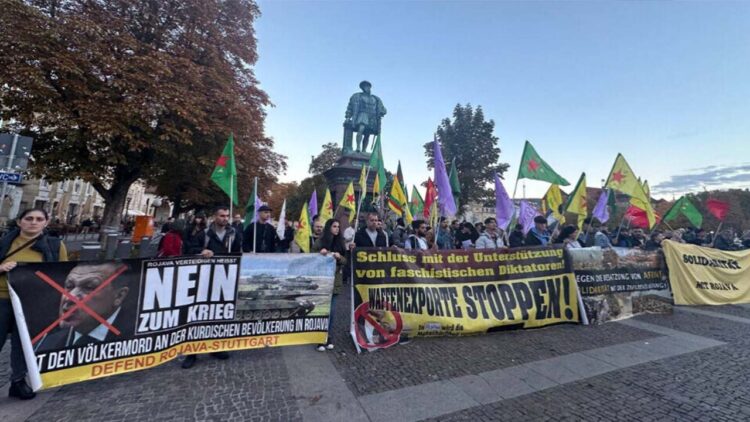
Since the night of 23 October, massive Turkish military attacks have continued in northeastern Syria, mainly targeting civilian areas and infrastructure, leaving 27 people dead and at least 40 injured. In response to these attacks, thousands of people took to the streets in northeastern Syria and Europe to condemn the attacks.
The Turkish army is carrying out these attacks against areas in northeastern Syria that are under the control of the Autonomous Administration of North and East Syria (AANES), also known as Rojava, where Kurdish, Armenian, Arab and Assyrian people are reorganising their society on the basis of Democratic Confederalism, a model developed by the imprisoned Kurdish leader Abdullah Öcalan. This model proposes a peaceful coexistence of the different peoples and religions of the region based on women’s liberation, ecology and grassroots liberation.
North and East Syria
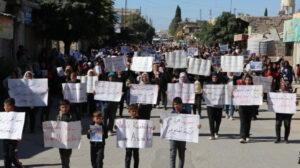
People joined protest marches across northeastern Syria to condemn the ongoing Turkish military attacks on the region and reaffirm their will to resist against the attacks on their homeland. Demonstrations took place in Shahba (Şehba), Deir ez-Zor (Dêrazor), Tabqa (Tebqa), Raqqa (Reqa), Manbij (Minbic) and Al-Qahtaniyah (Tirbespî), with many democratic institutions also joining the marches and reading out statements.
“These attacks cannot break the will of the people of North and East Syria. Whatever sacrifices we have to give, we will protect our land,” was stated at a protest march in Tabqa and echoed at many other protests. A spokesperson for the Democratic Union Party (PYD) called the Turkish attacks “war crimes” and “inhumane”.
Switzerland
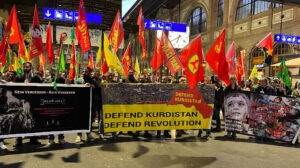
Hundreds of people took to the streets in several cities in Switzerland to condemn the ongoing Turkish attacks, stressing that they consider these attacks as attacks “against the freedom of the Kurdish people” and demanding that the air zones over northeastern Syria, which are controlled by Russia and the United States, be closed to Turkish warplanes and drones.
The protesters also acknowledged the recent family visit to Abdullah Öcalan by his nephew, DEM Party MP Ömer Öcalan, and emphasised that Abdullah Öcalan must now be given the opportunity to meet with representatives of the Kurdistan Workers’ Party (PKK) and his lawyers.
Germany
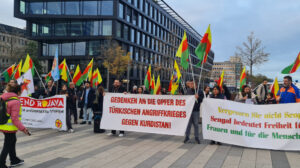
Kurds and international activists took to the streets in many cities all across Germany to condemn the attacks as part of a “massacre against the Kurdish people and its achievements”. International activists reiterated their stance that they will continue to be active against the attacks, stating that “the main goal of these attacks is to hinder the freedom of the Kurds, the Middle East and of humanity”. This stance was supported with slogans such as “Stop the occupation, protect humanity!”.
Austria
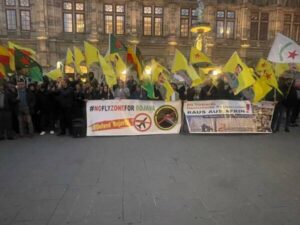
At a protest rally in Austria’s capital Vienna, people came together to express their support for the resistance of the people of North and East Syria, shouting “Long live the resistance of Rojava”. A speaker at the event emphasised this stance, saying “A just and equal world is not possible without resistance and sacrifice.”
France
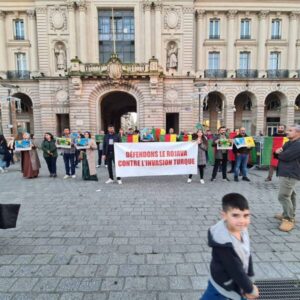
A protest rally was held in Rennes, France, where Kurds and international activists came together to condemn the war crimes of the Turkish state and to highlight the high number of civilian casualties, including children, reported as a result of the recent attacks.
In response to Kurdish leader Abdullah Öcalan’s recent message, which was delivered by his nephew Ömer Öcalan after the first family visit to İmralı prison in more than four years, Kurdish youth took to the streets in Paris. They carried a banner with the slogan “Thousand greetings to you, leader Apo¹”, highlighting Öcalan’s continued isolation and announcing their plans to join the march in Cologne on 16 November to demand his freedom.
¹Apo is Kurdish for uncle, an expression commonly used by supporters of the Kurdish movement to refer to Abdullah Öcalan