

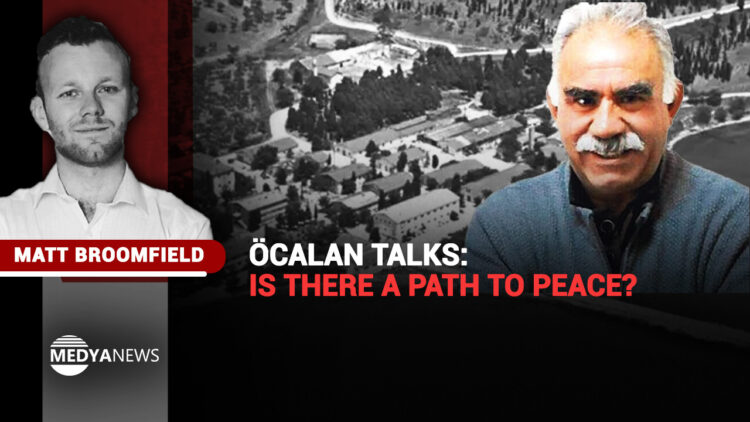
Matt Broomfield
Jailed Kurdistan Workers’ Party (PKK) head Abdullah Öcalan has been visited by a relative for the first time following a nearly four-year period in which he was denied a single visit, phone call, or communication with the outside world. The news adds to rumours of potential resumed peace talks between the Kurdish leader and the Turkish authorities that have held him in conditions of almost total isolation for the past 25 years, while prosecuting a bloody war against the banned PKK.
“The isolation continues,” the Kurdish figurehead stated in his first communication in 43 months. “If the conditions are right, I have the theoretical and practical power to move this process from the grounds of conflict and violence to the legal and political grounds.”
Yet the geopolitical situation does not necessarily appear conducive to peace talks. Turkey has recently witnessed an armed attack on an arms factory, followed by waves of Turkish airstrikes against civilian and humanitarian infrastructure, underscoring the difficult path that lies before any potential resumed talks. As the Middle East braces itself for further escalation of state-on-state confrontation, is there a potential route to peace?
As a look at the prior round of abortive 2013-2015 peace talks between Öcalan and the Turkish authorities suggests, any such negotiations would be fraught, open to subterfuge and disappointment, and form part of broader power-struggles within Turkey’s political establishment. But if we look back at the process which drove South Africa’s final apartheid-era premier FW De Klerk to release anti-apartheid icon Nelson Mandela, we can also recognize that even conservative politicians steeped in racist political culture can be forced to come to the negotiating table by factors beyond their power, creating radical results they never foresaw.
The circumstances of Nelson Mandela’s release suggest even pragmatic or cynical negotiations can lead to dramatic political outcomes.
Latest developments: talk about talks
Before getting too carried away with predictions of Öcalan following Mandela on the final step of a ‘Long Walk to Freedom’, let’s cover the facts as we have them. The meeting breaking the long-term and widely-condemned isolation of the Kurdish leader, which took place on 23 October, did not come out of nowhere. Earlier this month, far-Right nationalist politician Devlet Bahçeli made headlines when he extended a handshake to the progressive, pro-Kurdish DEM Party, which seeks to implement an Öcalan-inspired political programme of minority rights, women’s autonomy and democratic reform through Parliamentary means.
That gesture was followed by Bahçeli’s more recent statement that Öcalan should be allowed to address the Turkish Parliament and even have his life sentence reviewed, were he to call on the PKK to end its “terrorism”. Turkish President Recep Tayyip Erdoğan appeared to lend his support to the second message, adding credence to reports that the radical nationalist Bahçeli had been tasked with extending an olive branch to Öcalan as a way to convey the government’s genuine openness to talks.
At the same time, Öcalan had reportedly met with Turkish officials and had subsequently spoken with the PKK’s military and political leadership, in a development reported by Al Monitor’s Amberin Zaman. The PKK are now based in remote mountain ranges primarily in Iraqi Kurdistan, where they have been pursued by the Turkish Armed Forces in successive military operations that have inflicted heavy losses while killing and displacing civilian Kurdish villagers, but failed to dismantle the group’s organisation or operational ability.
Kurdish politicians including jailed figurehead Selahattin Demirtaş seized upon the opportunity to urge that restrictions on Öcalan be lifted. The Kurdish leader had been held in total isolation, without any visits or phone calls, for almost four years. The leader of the country’s largest opposition party, the People’s Republican Party (CHP), recently visited Demirtaş in jail. He appeared to repeat Demirtaş’ call for political dialogue.
This was the context when Öcalan was finally visited by his nephew, himself a DEM Party MP. Following that initial meeting, nephew Ömer Öcalan urged the authorities to allow repeated visits from the Kurdish leader’s family and lawyers, regardless of further political developments.
For this single communication marks only the first step in a long potential process. Both senior PKK figures in their Qandil headquarters, and officials from the parliamentary DEM Party, have urged caution over the Turkish government’s apparent thaw. Tülay Hatimoğulları, co-chair of the DEM Party, has described the need to lift Öcalan’s isolation as a precursor to any serious peace negotiations.”
The new negotiation claims have been described as ‘manipulative’ by Öcalan’s own lawyers. It’s been suggested that Erdoğan may be attempting some internal politicking, using the supposed negotiations to both exert pressure on the PKK’s executive committee while potentially also preparing for an appeal to Turkish voters as he prepares a potential attempt to extend his premiership beyond its currently legal limits.
Kurdish political leaders have reason to be suspicious of overtures from Turkish authorities, who sabotaged prior peace negotiations.
2012-2015: Failed talks
Likewise, Murat Karayılan, a member of the PKK’s executive committee urged caution: “They are still killing Kurds every day… there is a war, there is isolation on [Öcalan]. So there is no such thing [as government’s desire for peace with the Kurds].” The senior PKK figure cautioned against overinterpreting the developments, saying: “Some people even say, ‘I wonder if a new [peace] process will begin?’ There is no such thing. No one should have such dreams.”
His comments recall the limited reality of prior peace talks. As recently as 2015, the Turkish government and PKK were in productive, advanced peace talks and a state of ceasefire, mediated by Öcalan from his prison cell. Yet shortly after, the Erdoğan government reopened hostilities, resulting in the deaths of thousands of civilians, and moved to liquidate the legitimate political opposition in Turkey by arresting tens of thousands of politicians, activists, and journalists on trumped-up terror charges.
What happened? Kurdish journalist Amed Dicle has published a book suggesting that these secret talks, conducted far away from the public eye, were never intended to be taken seriously. Negotiations were followed up by air strikes targeting the PKK leadership, authoritarian measures aimed at curbing Kurdish identity and political expression, and making arrests which clearly suggested the so-called ‘Kurdish opening’ was set to close sooner or later.
The PKK nonetheless carried out the first part of the proposed ‘roadmap’, following public declarations by Öcalan and withdrawing from Turkey to their current positions deep in Kurdish mountains outside Turkish territory. Yet reforms said to have been promised in return for this move were never made. Rather, Erdoğan found excuses to resume the conflict, launching renewed military campaigns against the PKK, bloody waves of confrontations within Turkey’s Kurdish-majority cities, and ultimately two devastating invasions and occupations of Syrian Kurdish territory.
Erdoğan abandoned this peace process for two reasons. First, electoral gains made by the DEM Party’s predecessor, the Peoples’ Democratic Party or HDP (an equivalent party which has since been banned by Turkish courts). And second, the establishment of democratic autonomy in Kurdish-majority regions of Rojava (Syrian Kurdistan). These developments spooked the Turkish establishment and Erdoğan’s base with the prospect of genuine, pro-democratic reforms driven by Turkey’s Kurdish movement. Rapid reversal followed.
As these realities suggest, any peace process intended to serve the Turkish authorities’ short-term interests is liable to be sabotaged at any moment. The PKK is naturally suspicious of any attempt to force it back to the negotiating table absent strong guarantees which it is difficult to see emerging at the present political juncture.
Mandela and de Klerk: talks to action
But even a cynical, calculated resumption of peace talks aimed at stabilizing domestic politics without granting genuine reforms may have impacts beyond those intended.
The release of Mandela and eventual fall of apartheid came about as a result of international pressure and solidarity with the South African cause, but also as geopolitical contingencies forced unexpected outcomes.
In the context of declining Cold War tensions, FW De Klerk recognised that it would be untenable for South Africa to continue presenting itself as a bastion of Western civilisation against the ‘communist’ African National Congress (ANC). He therefore confounded expectations of a staunchly anti-apartheid policy, moving to implement reforms aimed at preserving South Africa into the 1990s while also opening secret talks with the ANC.
Thereafter, Mandela’s ANC was able to gain the upper hand in five years of difficult negotiations, ultimately sweeping to power in the post-apartheid era and implementing more rapid and wide-ranging reforms than de Klerk had ever envisaged as the first democratically-elected South African President. De Klerk’s attempt to read the winds of change and implement statesmanlike reforms did not exonerate him from his own complicity in the crimes of the apartheid era, as the country’s Truth and Reconciliation Commission found.
The failure of the post-apartheid consensus to achieve the structural, economic and social reforms needed to engender a new era of genuine mutual co-existence in South Africa is of less relevance here than these historic processes. As the South African case demonstrates, peace talks can break out even in seemingly unpromising circumstances, creating an unexpected political opening where an effective revolutionary movement can act.
Strategic tensions, continued attacks
But are the global political conditions right to force the Turkish authorities into a serious negotiation with Öcalan and the Kurdish movement? Erdoğan has long been effectively able to present himself as an effective partner to both Moscow and Washington, adopting distinct modes of diplomacy with both power blocs while carving out a niche to further Turkey’s own interests. And neither actor is interested in pressuring Turkey into domestic reforms, rather preferring to appease Erdoğan over the Kurds in an attempt to buy his loyalty elsewhere. As the latest round of Turkish attacks on humanitarian infrastructure in North and East Syria demonstrate, there is little appetite in the wider world for impeding Turkey’s aggressive actions or forcing them to the negotiating table.
Öcalan’s sole communication with the outside world is a significant step, for humanitarian and symbolic reasons if nothing else, and could be the prelude to more substantiative talks. But peace requires a substantiative commitment from all parties, particularly the Turkish state which retains the determinant ability to make war or peace, and sustained international pressure. As long as these geostrategic realities remain in place, any peace talks are likely to remain nothing more than ‘talks’.


