

Nick Brauns
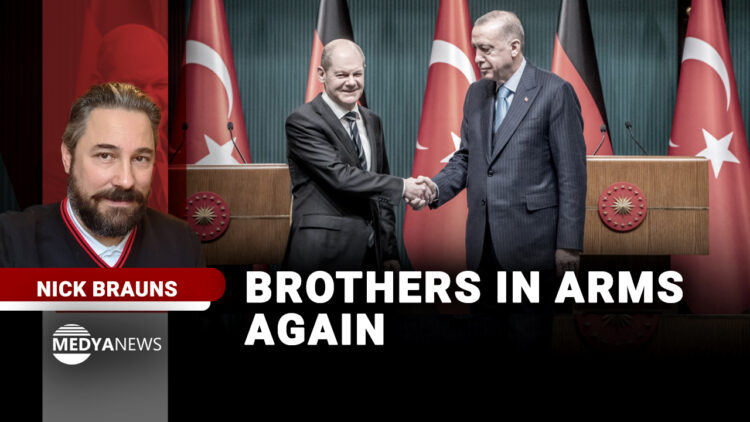
After some irritation in recent years, the German-Turkish brotherhood in arms, which can look back on a good 150 years of history, is back on track. This was signalled by German Chancellor Olaf Scholz’s visit to Turkish President Recep Tayyip Erdoğan at the weekend. “Of course” the NATO partner will receive German weapons, Scholz assured close cooperation in the defence sector. The German government has also given up its opposition to the sale of 40 ‘Eurofighter’ combat airplanes to Turkey by a multinational European consortium. In recent months, arms exports to Turkey authorised by Berlin have risen sharply and are back in the three-digit million range for the first time since 2011.
Arms deliveries have been cut back since 2016 – the year of the failed coup and subsequent state of emergency in Turkey as well as the Turkish army’s first incursion into northern Syria. The political situation has not improved since then. There are still tens of thousands of political prisoners in Turkish jails. Kurdish democracy and autonomy movements continue to be harshly persecuted – even Kurdish folk dances and folk music have now become grounds for imprisonment. And the Turkish army continues to occupy parts of Syria with the help of an Islamist mercenary army and is systematically destroying the civilian infrastructure in the north-east Syrian self-defence region in order to drive the local population to flee. And the Turkish army continues to advance in northern Iraq – also using internationally banned chemical warfare agents. If the German government were serious about its propagated “values-based” foreign policy, Turkey would not be allowed to receive a single bullet.
However, the German-Turkish relationship has never been about human rights and international law considerations. One reason for Scholz’s concession now, including with regard to the fighter jets, is likely to be the concern about Turkey’s further rapprochement with the Chinese-Russian-led BRICS group. Ankara has declared its intention to join BRICS and has been invited to the summit in Kazan, Russia, this week. Turkey’s flirtation with BRICS – just like its previous cooperation with Russia within the framework of the Astana format for Syria – essentially serves as a means of exerting pressure to expand its own room for manoeuvre vis-à-vis its Western partners; its strategic ties to the West, particularly in the economic and military sphere, are not seriously up for discussion.
One year before the federal elections, the German government, which has come under pressure from the right in terms of domestic policy, is also seeking success in the deportation of rejected asylum seekers. Berlin is hoping that Ankara will make concessions when it comes to taking back over 15,000 Turkish citizens who are currently “tolerated” and required to leave the country. The majority of these are Kurds who, as alleged or actual supporters of the liberation movement, must expect reprisals in Turkey if they are deported. In return for co-operation in taking them back, Turkey wants visa facilitation. Erdoğan is also calling for tougher action against the PKK and the Gülen movement in Germany, having absurdly accused both organisations of being responsible for anti-Muslim sentiment in Germany. While Berlin will probably continue to hold its protective hand over the followers of the recently deceased Fethullah, its stance towards the Kurdish liberation movement has already tightened in recent years.
The two heads of government are demonstratively at odds regarding the situation in the Middle East. While Erdoğan accused Israel of genocide in Gaza, Scholz rejected this and emphasised Israel’s right to self-defence. To the outside world, Erdoğan presents himself as an eloquent advocate for the Palestinians and a friend of Hamas, with whom his foreign minister Hakan Fidan met on the very day of the chancellor’s visit. But the Turkish trade in steel and building materials with Israel, for example, which Erdoğan has banned, is now continuing via Palestinian middlemen, as journalist Metin Cihan has proven on the basis of trade data. Israel even purchases barbed wire from Turkey to protect its settlements in occupied Palestine. Israel also covers a large part of its oil requirements with Azerbaijani oil via Turkey – it is not surprising that Turkey does not turn off the pipeline, however, as the Turkish brother state of Azerbaijan receives extensive arms supplies from Israel in return.
The country is playing the role of NATO’s Trojan horse in the Islamic world. Erdoğan’s eloquent but inconsequential threats against Israel serve to bind his religious constituency in his own country and, above all, his street credibility on the Arab street. It is not least about countering Iranian influence here. Scholz is also aware of this, so that the appearance of the two heads of government in Istanbul can be seen as a game played by the two NATO partners with distributed roles.
The geopolitical brotherhood in arms between the ruling classes of Germany and Turkey, which began in the last quarter of the 19th century during the construction of the Baghdad railway and the German military missions on the Bosporus, was always at the expense of democracy and freedom for the peoples of the Middle East. In the First World War, the Armenians were sacrificed so that the Ottoman Empire would remain on the side of the German Empire until the end of the war. And today the Kurds are being sacrificed so that Turkey remains firmly in the NATO alliance. And this integration of Turkey into NATO today prevents the Palestinians from receiving more than a few warm words from Ankara in their struggle for existence, while Germany and the USA supply the butcher Israel with weapons for the genocide.
Nick Brauns is the editor-in-chief of the daily newspaper junge Welt in Germany


