

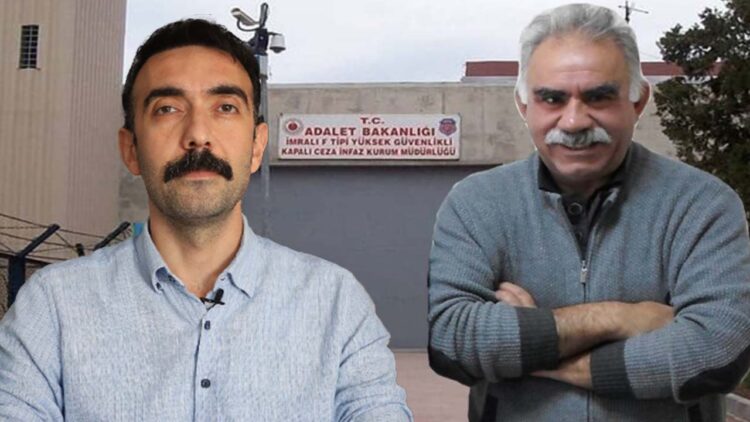
Cengiz Yürekli, the lawyer representing Abdullah Öcalan, has dismissed rumours of new negotiations with the imprisoned Kurdish leader as “manipulative”, stressing that there has been no contact with Öcalan for 43 months. Yürekli urged the Turkish government to lift the strict communication ban at İmralı Prison, where Öcalan has been held under severe isolation for 26 years, and allow him to speak freely.
Speaking to Mezopotamya Agency’s Ömer İbrahimoğlu on Thursday, Yürekli, from Asrın Law Office, emphasised that neither Öcalan’s family nor his legal team have had any communication with him since a brief, interrupted call with his brother in March 2021. “We are not in a position to confirm or deny any recent claims, but from our position, it is clear that these claims are not possible and carry manipulative value,” Yürekli explained.
Amid reports of alleged meetings between Öcalan and the Kurdistan Workers’ Party (PKK) leadership, Yürekli reiterated that only those directly involved can confirm or refute such claims. He called for transparency, urging the Justice Ministry to allow journalists to visit İmralı and meet with Öcalan. “If there is such a need for information, the relevant authorities should provide it. Journalists could be granted permission to conduct interviews at İmralı, just as they can in other prisons,” Yürekli added.
Yürekli also addressed the Turkish government’s discussions on a new constitution, asserting that any meaningful constitutional change must address the Kurdish issue and ensure collective and individual rights. “The key figure in such discussions must undoubtedly be Mr Öcalan,” Yürekli said, stressing that Öcalan’s inclusion in talks is essential for addressing the longstanding Kurdish question. He also highlighted the role of the pro-Kurdish Peoples’ Equality and Democracy (DEM) Party as a necessary voice in such discussions.
The lawyer further questioned the independence of Turkey’s judiciary under the current constitution, pointing out that Öcalan’s 43-month-long isolation violates constitutional rights. He criticised the lack of transparency surrounding İmralı Prison and urged the government to involve civil society in any dialogue about constitutional reforms.
Responding to the recent speculation about a new peace process, Yürekli warned that it would be misleading to describe ongoing discussions as a “peace process” without real engagement on the Kurdish issue. “If such a process is to take place, it must centre on the Kurdish question, and Mr Öcalan remains the essential interlocutor,” he stated.
In contrast, President Erdoğan’s advisor Mehmet Uçum and the ruling Justice and Development Party (AKP) Deputy Chair Efkan Ala denied the possibility of a new peace process. Uçum dismissed the notion as “a thing of the past”, stating that the state does not repeat strategies that have previously failed. Ala added that the current context differs significantly from the failed 2013–2015 peace talks, stating, “We don’t have to follow the same path every time.”
Despite these official denials, Yürekli maintained that any solution to the Kurdish issue and broader democratic reforms must involve Öcalan. “Mr Öcalan is capable of solving not only the Kurdish issue but also many of Turkey’s broader problems,” he noted, referencing Öcalan’s significant role in previous peace discussions. Yürekli urged for a renewal of dialogue that includes Öcalan, arguing that real progress will only begin once the doors of İmralı are opened.
Turkey’s political landscape was stirred on 1 October when far-right Nationalist Movement Party (MHP) leader Devlet Bahçeli, known for his hardline stance on the Kurdish issue, extended a symbolic handshake to members of the DEM Party during the opening session of parliament. While Bahçeli’s gesture was seen as a potential step towards peace, DEM Party leaders called for concrete political action, emphasising that resolving Turkey’s decades-long Kurdish conflict requires more than symbolic moves. They urged the government to pursue genuine dialogue and implement a comprehensive political solution.


