

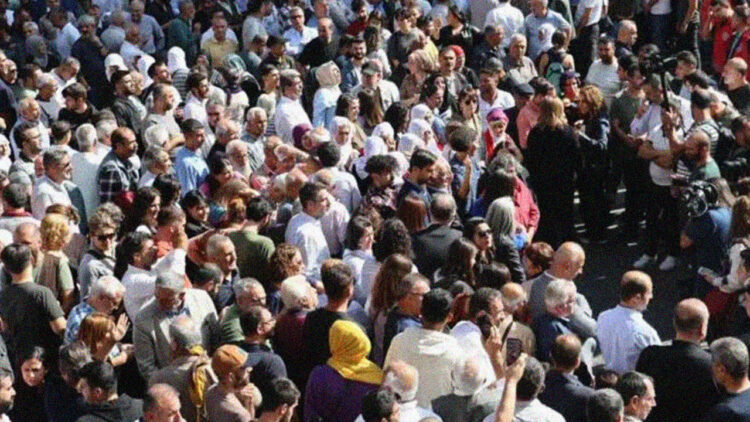
Thousands of protesters across Diyarbakır (Amed), Turkey, defied police restrictions on Sunday, gathering to demand the release of imprisoned Kurdistan Workers’ Party (PKK) leader Abdullah Öcalan and a democratic resolution to the Kurdish issue. The protesters mobilised in different areas of the city, resisting a ban imposed on the rally by the authorities, chanting slogans and calling for an end to Öcalan’s isolation and the oppressive policies of the state.
The rally, organised under the slogan “Resisting the plot, we gather in Amed for freedom,” aimed to call attention to Öcalan’s continued imprisonment and the ongoing struggle for Kurdish rights. Protesters gathered in neighbourhoods across the city, including Ofis, Sûr and Rezan, chanting “Bijî Serok Apo” (Long live [our] leader Apo) and “We will resist to win.”
A call for peace and freedom
Representatives of pro-Kurdish parties and civil organisations addressed the crowds at various protest sites. Peoples’ Equality and Democracy (DEM) Party Co-chair Tuncer Bakırhan criticised the government’s repressive approach to peaceful demonstrations. “Peace in Turkey cannot be achieved by silencing us or cutting off our voices,” Bakırhan said, urging the state to open up dialogue with Öcalan, whom he referred to as a key figure in solving the Kurdish issue.
Çiğdem Kılıçgün Uçar, Co-chair of the Democratic Regions Party (DBP), emphasised the centrality of Öcalan in any peace process. “The solution to the Kurdish issue lies in İmralı,” Uçar stated, referring to the high-security prison where Öcalan has been held in isolation for almost 25 years. Uçar called for an immediate end to Öcalan’s isolation and urged the Turkish state to engage in serious negotiations for peace.
During the gathering in Diyarbakır, Rezan Sarıca, a lawyer from the Asrın Law Office, stressed the importance of lifting the isolation imposed on Öcalan, calling for the creation of an environment in which he can participate in democratic processes. Sarıca recounted Öcalan’s past statements, when he expressed confidence that he could resolve the Kurdish issue within a week given the opportunity to engage in dialogue. Sarıca urged the Turkish authorities to open the doors of İmralı, stating, “We need to lift this isolation and create space for democratic engagement.”
Police blockades met with defiance
Throughout the day, police blockaded the streets, attempting to prevent protesters from reaching central locations. However, smaller protests were then held across the city in defiance of these restrictions. In Ofis, large groups gathered, waving flags and marching through the streets. “No one can stop us from expressing our demands for peace and freedom,” said a protester, Makbule Aşan, who was among those blocked by police. “We will resist and continue our fight for justice.”
Protesters gathered in Van (Wan) and Batman (Êlih) despite the attempts of local authorities to stop them. Hundreds sang Kurdish resistance songs, including “Herne Pêş” (Go Ahead), a symbol of the Kurdish struggle for freedom. “This repression will not silence us,” DEM Party members said as they staged a sit-in in Batman to protest the roadblocks preventing their travel to Diyarbakır.
Protests continue despite bans
In several regions, including Urfa (Riha) and Gaziantep (Dîlok), protesters gathered at local DEM Party offices after being stopped en route to Diyarbakır. They voiced their determination to continue the struggle, despite the restrictions placed upon them by the state.
“Isolation is a crime against humanity”, said Ferit Şenyaşar, the DEM Party MP for Urfa, calling for an end to Öcalan’s isolation and for the state to engage in a democratic process. He warned that peace cannot be achieved through oppression, but only through recognising Kurdish rights and establishing meaningful dialogue.
Though the final mass rally in Diyarbakır was prevented by the authorities, the many strong protests across different cities and districts in the Kurdish-majority southeast of the country demonstrated the resilience of the Kurdish movement and its insistence on a peaceful resolution to decades of oppression. As chants of “Long live our leader Apo” echoed through the streets, the message remained clear: The fight for freedom and peace will continue, undeterred by state repression.


