

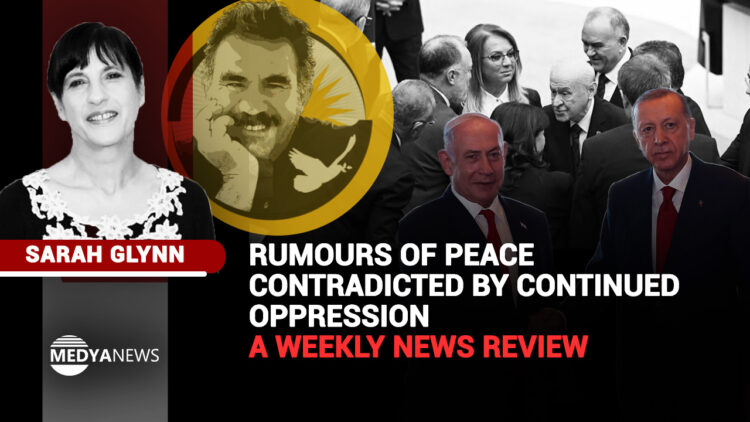
Sarah Glynn
Following far-right leader Devlet Bahçeli’s surprise handshake with the co-chair of the pro-Kurdish Peoples’ Equality and Democracy (DEM) Party, rumours abound – including rumours of moves towards new peace talks between the Turkish state and Abdullah Öcalan. These remain only rumours, and even if they prove to reflect real moves, there is no guarantee that those moves are genuine and not part of a game of smoke and mirrors. Meanwhile, Turkey continues along the path of internal authoritarianism and external attacks on the Kurds in Iraq and Syria. With the Middle East balanced on the cusp of all-out war, Turkish President Erdoğan claims that Israel is also planning to attack Turkey, but that claim is widely regarded as political theatre arising from internal Turkish politics rather than any genuine threat. Across the border, in the Kurdistan Region of Iraq, there are just eight days to elections that could see the pro-Turkish Kurdistan Democratic Party (KDP) lose their dominating control. And the anniversary of Öcalan’s expulsion from Syria, 26 years ago, that led to his capture in an international conspiracy, has been marked by actions across the world calling for his freedom.
Bahçeli is leader of the Nationalist Movement Party (MHP), which is part of Erdoğan’s ruling coalition. It was at his insistence that the state brought the (still uncompleted) closure case against the DEM Party’s predecessor, the Peoples’ Democratic Party (HDP); and, as recently as 21 August, he was calling for removal of the DEM Party’s statutory state funding, likening this to “donating munitions and bombs” to the Kurdistan Workers’ Party (PKK). So, when on 1 October, he offered his hand to DEM Party co-chair, Tuncer Bakırhan, and other party members after the opening of parliament, politicians and watching journalists were alike astonished and wondering what this meant.
Bahçeli, who enjoys symbolism, claimed that “We are entering a new era. While we want peace in the world, we need to ensure peace in our own country.” The intended significance of his gesture has since been underlined both by his own further statements and by Erdoğan. On Tuesday, a week after the handshake, Bahçeli told his parliamentary group meeting, “The hand I extend is a message of national unity and fraternity. My outstretched hand is the wish and offer to become a party of Turkey, to take a front against terrorism, to unite in our thousand-year fraternity.”
The following day, Erdoğan told his Justice and Development Party (AKP) group meeting that he found Bahçeli’s offer “very meaningful for the fraternity of 85 million people. We want to see a different discourse in politics in the new legislative year. We believe that we need more reconciliation. We do not avoid any dialogue for our nation.”
Political pundits have been debating and pontificating, and the rumour mill has gone into overdrive. There has been talk of a new engagement with Öcalan, and Al-Monitor reports that “Three well-placed sources with intimate knowledge of the government’s Kurdish dossier” told them that “exploratory talks for a possible resumption of actual negotiations between the government and Abdullah Öcalan, the imprisoned PKK leader, were already underway,” with two of the sources claiming that Öcalan had spoken with the PKK leadership, hidden in the Qandil (Qendîl) mountains of the Kurdistan Region of Iraq. İbrahim Bilmez, one of Öcalan’s lawyers, has questioned this, saying they have no knowledge of any communication.
The Kurdish response
The Kurdish Movement is, rightly, extremely wary. In 2015, just four months after prolonged negotiations with Öcalan had produced an agreement on ten priorities for the resolution of the Kurdish Question, which was signed by the deputy prime minister, Erdoğan made one of his 180 degree turns. He denied the existence of the agreement and instead designated the Kurds as an existential enemy that had to be physically destroyed. Brutal military attacks in Iraq and Syria, and in Turkey itself, have been accompanied by the extensive use of lawfare against Kurdish politicians and activists and the oppression of Kurdish cultural expression. The Turkish state has even used Kurdish politicians’ engagement in the government-backed peace talks as “evidence” of support for terrorism.
All Erdoğan’s actions are dictated by his own need for power. It has been suggested that Erdoğan and Bahçeli’s current moves may be aimed at winning support for planned constitutional amendments that would allow Erdoğan to stand for another presidential term, though the HDP’s renunciation, in 2015, of any sort of backroom deal to give Erdoğan increased presidential powers contributed to his rejection of the peace process.
Many believe that the 2013-15 negotiations were never intended to end in a peace agreement, but in any case, an intended outcome can be changed to suit the bigger power agenda. The success of the HDP in the June 2015 elections, and the success of Kurdish fighters in Syria reversing the advance of ISIS, convinced Erdoğan to crack down hard on anything that might strengthen Kurdish identity and self-organisation.
The roots of Kurdish wariness go back a hundred years to the Treaty of Lausanne. The Republic of Turkey was itself founded on false promises that the Kurds were a full and equal partner in the new nation – promises that Turkey’s leaders discarded as soon as the ink was dry.
Following Bahçeli’s statement on Tuesday, the DEM Party’s other co-chair, Tülay Hatimoğulları, told reporters, “The DEM Party is already a party of Turkey. The DEM Party is a party in which all the peoples and beliefs in Turkey are represented and exist… We defend peace and freedoms in Turkey. We defend the rights of workers and labourers, women and nature rights defenders. We defend these because we are the party of Turkey.”
Continued oppression
The DEM Party can only judge the words of Bahçeli and Erdoğan by their actions, and so far, there has been little to suggest any fundamental shift. Even their spoken messages contradict each other. At the same time as declaring Bahçeli’s handshake “very meaningful” Erdoğan remarked that the politicians imprisoned in the Kobanê Case, including the HDP’s former co-chairs, had “been given the punishments they deserve”. (Of course, promoting confusion and division among Kurdish politicians will be among Erdoğan’s aims.)
On Monday, at least ten trade unionists were detained in Istanbul and banned from meeting with their lawyers for 24 hours, and a further trade unionist was detained in Diyarbakır (Amed), where, in a separate operation, two Kurdish musicians were also detained. On Tuesday morning, many people were detained in Mardin (Mêrdîn) on the basis of their social media posts. On Wednesday, hundreds of police raided the DEM Party Provincial Organisation in Iğdir (Îdir) and eight people were detained in associated house raids, including one of the party’s provincial co-chairs. Also on Wednesday, five people were detained in Siirt, including a co-mayor from Kurtalan (Misirc) Municipality. On Thursday, the Court of Cassation, in a reversal of their own previous decision, upheld the nine-year prison sentence given to former co-mayor of Diyarbakır, Selçuk Mızraklı, who was replaced by a trustee and imprisoned five years ago. The only change since the court’s previous decision was the introduction of a so-called witness who has been responsible for the detention of some 600 people. Yesterday, there were more detentions in Diyarbakır, and also the first hearing of the case against the dismissed mayor of Hakkâri (Colemêrg), who was removed from his post in June, two months after being elected. Yesterday too, the HDP’s former Provincial Co-chair for Muş, Bermal Nergiz, was sentenced to 6 years for “violating the Law on Meetings and Demonstrations” in the protests against the detention of the newly-elected mayor of Van – who was only allowed to take up his position after those protests. The suppression of Kurdish culture continues with the banning of a film that depicts the difficulties facing Kurdish theatre and culture, the commercial distribution of which has been prohibited in Turkey.
Aggression across the border
DEM Party officials have observed that peace must include peace with the Autonomous Administration of North and East Syria, which has never posed any threat to Turkey. But Turkey is continuing their aggression here too. On Thursday morning, a Turkish artillery attack on a Manbij (Minbic) village killed two children aged nine and five and critically injured their three siblings.
In the Kurdistan Region of Iraq, Turkey has established a large network of military bases. On Monday the PKK reported that Turkish forces had carried out 76 airstrikes in the previous three days. Although ostensibly targeted at PKK bases, Turkey’s attacks empty villages and destroy agriculture and forests.
The forthcoming Kurdistan elections
Turkey has been helped in their attacks on Iraqi Kurdistan by the KDP and the KDP’s peshmerga forces. The KDP currently dominates the Kurdistan Regional Government, but is expected to lose support to the rival Patriotic Union of Kurdistan (PUK) in the elections scheduled for the 20 October. The PUK maintains good relations with the Autonomous Administration of North and East Syria, and refuses Turkish demands – backed by threats – that they too support Turkey’s attacks on the PKK. However, they have built their own ties to the government of Iran.
The election campaigning has been largely negative, and relations between these two dominant parties – which previously fought a civil war – are dangerously bad. The KDP has been accused of using an AI generated conversation to portray the PUK leaders discussing electoral fraud, and even without such tricks, the region’s media is tied to the political parties and allows no space for debate. The results of this election are important, but there are predictions that there will be no clear winner.
International conspiracy and international resistance
Moving further from Turkey, we find that events in support of Öcalan’s freedom have been taking place everywhere, reflecting his international importance. Of course, this importance was also realised by the international conspiracy that trapped him after his expulsion from Syria and brought him back to Turkey in February 1999. Crucial to this conspiracy was the refusal of different countries to give him asylum. His greatest hope was Italy, where he received widespread support, but he was not granted asylum status in time. In a new interview with Erem Kansoy for Medya Haber, the then Italian Prime Minister, Massimo D’Alema, describes the pressure applied to Italy by the United States, who demanded Öcalan be extradited to Turkey. In D’Alema’s words, “It was not easy to resist the United States because President Clinton personally called me and said, ‘You must hand over Öcalan to Turkey.’ Yes, President Clinton said this, and we replied with a firm ‘No.’ Believe me, it is not easy to say no to the United States, especially as their allies.”
At government level, international antagonism towards the Kurdish movement, and desire to appease Turkey, remain strong, as recently demonstrated in Germany. Last Saturday, armed police raided a Kurdish cultural centre in Berlin and detained Hüseyin Yılmaz, co-chair of the centre, and another person. Yılmaz, who was mayor of Ağrı (Agirî) between 1999 and 2004, has protested that German police methods were “no different from the oppressive policies applied in Turkey and Kurdistan, and should be viewed as a result of those same policies.” The following day the same community centre was the subject of an attempted arson attack, which may have been encouraged by the official targeting of the centre. And Germany has also restarted major arms exports to Turkey.
Medya News has reported on the many actions that have been organised to call for Öcalan’s freedom. These involve too many countries to list here, and include numerous discussions – reflecting the importance of his ideas – as well as demonstrations and cultural events. Trade unions have spoken up in Catalonia and the Basque Country, and also in Scotland; and Basque and Catalonian MPs have submitted a motion to the Spanish Senate. In North and East Syria, thousands of people joined rallies in Hasakah (Hesekê) and Qamishli 1-(Qamişlo).
The largest event is planned to be the rally in Diyarbakır tomorrow. On Tuesday last week, in yet another worrying turn for those looking for genuine signs of peace, the Diyarbakır Governorship, representing the Turkish state, banned any action in public areas for the five days from 9-13 October. Rally plans are going ahead with increased defiance; buses are booked to bring people from all over the country, and clashes can be expected.
Sarah Glynn is a writer and activist – check her website and follow her on Twitter


