

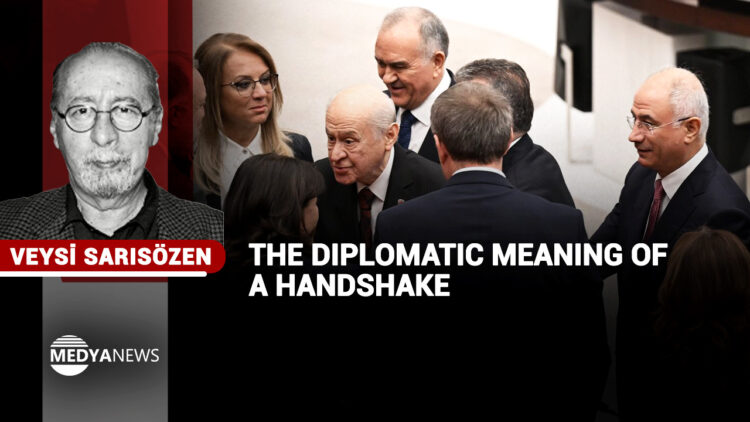
In October 2024, a surprising moment in Turkish politics occurred when Devlet Bahçeli, leader of the nationalist MHP, shook hands with DEM Party leaders during the opening of the Turkish Parliament’s legislative session. Known for his hardline stance and frequent criticism of the DEM Party, which represents Kurdish political interests, Bahçeli’s gesture sparked widespread discussion. Political analyst Veysi Sarısözen argues that while CHP’s gestures signal alignment with the ruling bloc, DEM Party’s diplomatic exchanges represent a principled stance: uncompromising in class struggle, open to peace talks.
Veysi Sarısözen
In Tele 1’s main news broadcast, criticisms were made by comparing the main opposition Republican People’s Party’s (CHP) standing ovation for Turkish President Recep Tayyip Erdoğan with the pro-Kurdish Peoples’ Equaliaty and Democracy (DEM) Party Co-chair’s handshake with the far-right Nationalist Movement Party (MHP) leader Devlet Bahçeli. At the same time, the stance of the Workers’ Party of Turkey (TİP) Chairperson was praised.
What can be said about this?
While searching for an answer to this question, I placed myself in the shoes of the DEM Party leaders. Would I have shaken Bahçeli’s extended hand?
If I were a TİP (the old TİP) leader, I would have left Bahçeli’s hand hanging in the air.
However, if I were a DEM Party leader, particularly from the Kurdish faction, I would not have hesitated to shake the hand extended to the Kurdish people’s representative in the name of the Turkish state, even if I couldn’t quite grasp the motive behind it at the time.
I believe there is a qualitative difference between a parliamentarian representing the leading sections of the Turkish working class and a parliamentarian representing the Kurdish people.
For the Turkish working class, there can be no “class reconciliation” with capital or its political representatives, especially when those representatives are ultra-nationalist and anti-labour. In the class struggle, there is no room for “parliamentary and diplomatic courtesy.” There can be no “social peace” with the class enemy in the class struggle.
In contrast, a parliamentarian representing colonial Kurdistan is also a diplomat amidst the conditions of war with the colonisers. In a way, they represent one of two countries at war and, like any diplomat, must observe the requirements of diplomatic “courtesy” with their “enemy.” This is because the role of that parliamentarian-diplomat is to both wage war against the colonial aggressor and to work towards peace with equal rights.
To be specific: Devlet Bahçeli greeted the DEM Party group at the opening meeting of the Grand National Assembly of Turkey and shook hands with the group’s representatives. Whose hand did he shake? The hands of the DEM Party leaders, whom he had previously called to be “immediately closed down, with their salaries confiscated and given to the families of our heroic martyrs.” It is Bahçeli, not the DEM Party members, who should explain this action. And indeed, he has explained: “While we want peace in the world, we also want peace in our country.”
These words hold no real value in Turkish politics. DEM Party leaders have heard even grander statements like this before and have not forgotten what those who called Kurdistan Workers’ Party (PKK) leader Abdullah Öcalan “Mr. Öcalan” during the peace process went on to say later. Politically, this is the case. On the other hand, when the most hawkish representative of the war against the Kurdish people speaks of “peace”, these words are not recorded in Bakırhan’s political logbook but in his diplomatic logbook as “valuable words for peace”. These words are valuable because the invincible struggle of the Kurdish Freedom Movement has compelled Bahçeli to utter them. They are valuable because they signal that those who merely speak of peace will one day be forced to sit at the peace table. And so it will be.
In the class struggle, both the DEM Party and Bakırhan have only one book, and in that book, the determination to pursue the class struggle without compromise until achieving “women’s libertarian, ecological, communal socialism” is written, underlined thickly many times over. In the war that has lasted nearly half a century, the words “Freedom for Öcalan and a solution to the Kurdish question based on equal, honourable peace” are written in the same bold terms in the notebooks that DEM Party and Bakırhan carry in their pockets.
No one can tarnish the DEM Party’s struggle in the slightest, based on the words written in these two books. At the same time, there is no contradiction between these two books. Some look only at the “diplomatic logbook” and see a conflict between the class struggle and the peace struggle, claiming that if peace between the PKK and the Turkish Republic is achieved in exchange for “Freedom for Öcalan and a solution to the Kurdish question,” the Kurdish people will turn away from the class struggle. They fail to see that it is precisely because such peace has not yet been achieved that the class struggle has been held back, and that Turkish workers have been forced into collaboration with their class enemies under the influence of nationalist-chauvinist-militarist propaganda.
The conclusion is clear: CHP leader Özgür Özel standing up, having coffee chat with Bahçeli, and the DEM Party leaders not leaving Bahçeli’s extended hand hanging in the air are two utterly irreconcilable actions that cannot be compared.
The state is pushing the CHP step by step towards a “national coalition” with the ruling Justice and Development Party (AKP), and the CHP leadership is responding in kind. Both the standing ovation and the friendly exchange with Bahçeli are nauseating signs of this.
Bakırhan, however, as a MP in the Turkish Parliament, says, “We will not compromise with you in the class struggle,” and this uncompromising stance is well-documented in his party’s half-century-long history. But as a Kurdish diplomat, Bakırhan is effectively saying, “We would even sit with you at the peace table to end the war that has lasted for half a century and to seek a solution.”
No one should muddle the situation with unfortunate comparisons, looking for something that isn’t there.


