

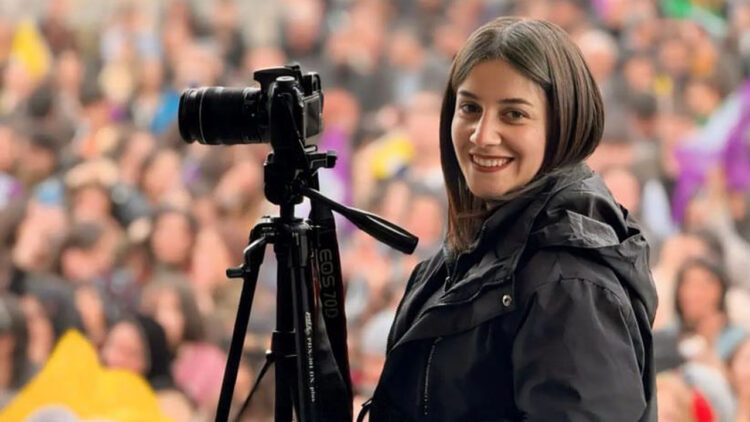
A Kurdish journalist’s home was raided in Turkey after she exposed drug and prostitution networks in Hakkari (Colemêrg), leading press organisations to condemn the raid as an attack on press freedom.
In a series of three reports published by the all-female Kurdish news agency JINNEWS on 18, 19, and 20 September, Rabia Önver investigated what she described as state-backed “special warfare” tactics targeting Kurdish communities in Hakkari.
The reports focused on Ayşegül Akdoğan, the leader of a group allegedly forcing young women into prostitution and drug use, with the complicity of local authorities. Akdoğan, whose father is a village guard and brother a sergeant, is accused of running a network that coerces young women and girls through threats and violence, while receiving protection from state officials, police, and judiciary members. Families attempting to file complaints against Akdoğan have reportedly been pressured by judicial figures, including prosecutor Furkan Akbulut, to withdraw their accusations.
Akdoğan’s group, composed of children and relatives of ruling Justice and Development Party (AKP) officials, is accused of operating with impunity. Önver’s reports revealed how drug use among youth in Hakkari has surged, with suspicious deaths and suicides also on the rise. Victims, like a 17-year-old girl named P.K. and her mother N.K., have described harassment, threats and even monetary offers from Akdoğan’s family in an attempt to silence them. Despite these efforts, P.K.’s mother refused to withdraw her complaint, stating, “I will not back down”.
Home raid and press outcry
Shortly after Rabia Önver’s investigative reports were published, her home in Yüksekova (Gever), Hakkari, was raided by Turkish police on Friday. Press organisations, including the Mezopotamya Women Journalists Association (MKG) and the Dicle Fırat Journalists Association (DFG), condemned the raid, calling it a blatant attempt to silence the free press.
“This raid is an attack on the free press and journalists,” said the MKG, emphasising that the raid followed immediately after Önver’s investigative work. “Threats and censorship against journalists prevent the public from accessing vital information.”
The DFG underscored that Önver was targeted because her reports exposed hidden truths about criminal networks that many in the region were too afraid to confront publicly. “Rabia uncovered facts that almost everyone in Hakkari knew but hesitated to discuss,” the organisation stated, urging authorities to focus on dismantling the criminal rings rather than targeting journalists. “The police should be going after those pushing Kurdish youth into drugs and prostitution, not raiding the homes of journalists.”
Both press organisations affirmed their solidarity with Önver, insisting that such actions would not deter journalists from exposing the truth. “Rabia is not alone,” said the DFG, vowing to continue uncovering the realities on the ground despite these forms of intimidation.
Political attention
The issue gained further momentum when Öznur Bartın, an MP for the pro-Kurdish Peoples’ Equality and Democracy (DEM) Party, raised the matter in the Turkish Parliament on Friday.
In her parliamentary motion, Bartın highlighted allegations that the prostitution and drug rings in Hakkari are closely tied to the state, especially since 2016. She called for a parliamentary inquiry commission to investigate these claims, which suggest that local authorities and AKP-affiliated individuals are protecting the criminal network. Bartın also emphasised how families attempting to file complaints were pressured by police and prosecutors to withdraw their cases.
Bartın’s motion has prompted growing calls for a thorough investigation into the alleged state complicity in criminal activities in Hakkari. Meanwhile, the situation remains tense as authorities appear more focused on silencing journalists than addressing the root of the problem.
Meral Danış Beştaş, DEM Party MP for Erzurum (Erzerom), criticised the raid on Önver’s home on X on Friday, stating: “What does the search of the home of the journalist who reported on the ‘drug and prostitution network,’ followed by an arrest warrant, mean??? We are awaiting a statement from the Ministry of Interior and the Ministry of Justice.”


