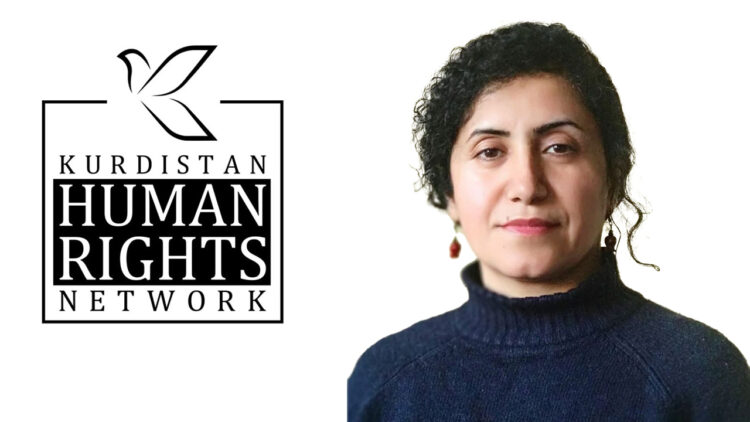
In an interview with Medya News, Fatemeh Karimi, a board member of the Kurdistan Human Rights Network (KHRN), provided a detailed account of the current human rights situation in Iranian Kurdistan (Rojhilat) two years after the killing of Jina (Mahsa) Amini. The KHRN, founded in 2014 and registered in France, works to promote human rights education and documents violations against Kurds in Iran. Karimi emphasised the network’s continued efforts to report daily on these abuses in Kurdish, Persian and English, as the Iranian regime’s repressive policies against Kurds persist.
Karimi detailed the aftermath of Jina Amini’s death at the hands of Iran’s morality police in 2022, a watershed moment that triggered widespread protests across Iran under the banner of Jin Jiyan Azadî (Woman, Life, Freedom). These protests, she explained, were driven by women and marginalised ethnic minorities, with Kurds playing a central role. Despite this, the cost for Kurdish communities has been severe: At least 123 Kurds, including children, have been killed, and many more detained or executed. The Kurdish region remains under heavy security surveillance, and recent waves of arrests and relocations demonstrate that the government’s repression shows no signs of abating.
In addition to repression, Karimi highlighted the regime’s use of Iran’s judicial system as a tool of suppression. She pointed out how the judiciary, heavily influenced by security forces, frequently issues harsh sentences for political activists, often based on confessions extracted under torture. Karimi cited the case of Zeinab Jalalian, sentenced to life imprisonment with a conspicuous absence of evidence, and the death sentence handed to Kurdish woman journalist Pakhshan Azizi, as stark examples of the regime’s manipulation of the legal system to crush dissent.
A notable theme in the interview was the unprecedented solidarity between Iran’s marginalised ethnic and national minorities, particularly during the 2022 protests. Karimi explained that while Kurds have long faced repression, other minority groups, including Baluchis and Arabs, are now experiencing similar crackdowns. This shared experience of persecution has fostered greater unity among these communities, who have increasingly aligned their struggles against the central government’s authoritarianism.
Karimi concluded by emphasising the significant role of women and youth in the Kurdish political struggle, noting their historical involvement and continued resistance. Despite facing severe repression, Kurdish women and young activists remain at the forefront of civil and political movements, embodying the spirit of the Jin Jiyan Azadî uprising and continuing to challenge the Iranian regime’s policies with remarkable resilience.
Fatemeh Karimi, an academic and author of multiple books exploring gender relations in Iranian Kurdish society and political groups, holds a PhD in Sociology from the Paris School of Advanced Studies in the Social Sciences and has a master’s degree in Women’s Studies from Tehran’s Allameh Tabatabai University.
Read the full interview below:
Can you introduce the Kurdistan Human Rights Network? When was it founded and what are its aims?
Fatemeh Karimi: The Kurdistan Human Rights Network is a non-governmental, non-profit organisation legally registered in France in 2014. The organisation operates in two main areas: education – the promotion of human rights principles and values; and the documentation and reporting of human rights violations against Kurdish citizens in Iran. The Network prints and publishes daily, monthly and annual reports on human rights violations in Kurdish, Persian and English on its website and official accounts on Twitter, Instagram, Facebook and other platforms.
Since 2017, the Kurdistan Human Rights Network has been a member of the World Coalition Against the Death Penalty and maintains ongoing communication and cooperation with Kurdish, Iranian and global human rights organisations.
What is the current state of repression in Iran and Iranian Kurdistan (Rojhilat), two years after the murder of Jina Amini and the following Jin Jiyan Azadî uprisings?
The 16th of September 2022 was a turning point in the history of political and social movements in Iranian Kurdistan. From the day of Jina Amini’s burial, a wave of protests erupted in Kurdistan and subsequently spread to over 160 cities across Iran. This uprising was a feminist revolution driven by a range of radical and interconnected demands. The main heroes of this movement were a coalition of women and marginalised ethnic and national minorities, primarily from the peripheral regions of Iran.
Kurds played a significant role in initiating and sustaining these protests, a contribution that came at a high cost. According to information confirmed by the Kurdistan Human Rights Network, at least 123 people, including 11 children, were killed by government forces. Some cities in Kurdistan were completely besieged, and hundreds of Kurdish citizens were injured or arrested. Two of the protesters, Mohammad Mahdi Karami and Reza Rasayi, were executed, and some of the detainees are still in custody and facing the threat of heavy sentences.
The repression of Kurds did not stop with these protests, it is continuing. In 2023, at least 745 Kurdish activists were arrested by security forces. Since the Jin Jiyan Azadî uprising, 12 Kurdish prisoners have been executed due to their political or religious beliefs. The sentencing of Pakhshan Azizi to death and Jina Modares Gorji to 21 years in prison exemplifies the continuation of these repressive policies.
The wave of arrests in Kurdistan has intensified as the second anniversary of Jina Amini’s government-sanctioned killing approaches. Moreover, the repression of Kurds is not limited to Iran’s borders. Recently, under pressure from the Tehran government, three Kurdish political parties from Iranian Kurdistan were relocated to a “less accessible” camp in Iraqi Kurdistan, after months of pressure [from Iran] on the Kurdistan Regional Government and the central Iraqi government.
As long as the Kurdish issue in Iran is viewed by the government as a “security” matter, rather than a Kurdish issue to be addressed, repressive policies will continue, resulting in significant human and financial costs for the Kurds in general and political and civil activists in particular.
How are legal procedures in Iran being used to suppress dissent?
To answer your question, we will refer to the judicial system of the Islamic Republic of Iran concerning sentencing. The laws of the Islamic Republic of Iran, as the name suggests, are derived from Shari’a and Islamic law. Some laws explicitly prescribe punishment for those who endanger national security, with offenders being sentenced to execution, flogging, imprisonment (both punitive and suspended), exile, fines, etc., for charges such as ‘corruption on earth’, ‘rebellion’, ‘membership of opposition groups’, ‘forming groups to disrupt national security’, ‘propaganda against the regime’, ‘conspiracy and collusion to commit crimes against national security’ and so on.
However, what happens in Iran is that the judicial system of the Islamic Republic is by no means independent and operates according to the will of security institutions. Many interrogators and judges have no autonomy. Not only do they act contrary to the laws of the Islamic Republic, but they also fully implement the scenarios desired by the security agencies regarding some accused and detainees. Many confessions are obtained under severe physical and psychological torture of the accused or through pressure on other family members.
The broadcast of coerced confessions on Islamic Republic of Iran TV aims to normalise the sentences handed down for some regime supporters at least. In addition to obtaining confessions under severe physical and psychological torture and keeping detainees in solitary confinement for weeks and months, many cases face blatant violations of evidence. Many sentences issued are disproportionate to the activities of the detained individuals.
The case of Zeinab Jalalian illustrates how the laws of the Islamic Republic are violated by the judiciary system itself. Zeinab Jalalian, a Kurdish political activist and the oldest and only female political prisoner with a life sentence in Iran, was sentenced to death for ‘Moharebeh’ (according to Article 279 of the Islamic Penal Code, this is the act of using weapons with intent to endanger life, property, or honour or to intimidate others, causing insecurity) due to ‘armed actions against the Islamic Republic, membership of the Kurdistan Free Life Party (PJAK), possession and carrying of weapons and military equipment, propaganda in favour of opposition groups’.
However, according to Zeinab’s statements during interrogations and the verdict against her, she was unarmed at the time of her arrest, and no military equipment was discovered from her. The Ministry of Intelligence staff also could not provide evidence of her participation in an armed operation to the court. Yet, the judge issued a death sentence based on the presumption of her involvement in armed operations, though this was eventually commuted to a life sentence.
How do other minorities interact with the Kurdish struggle in Iran/ Rojhilat?
In the years following the 1979 Revolution in Iran, especially in the 1980s, some leftist groups maintained close ties with various Kurdish political movements and closely followed their struggles. The struggles and demands of the Kurds were reflected in their writings, newspapers and publications. However, with the onset of the eight-year Iran-Iraq War, the central government used its propaganda tools and, in the absence of independent media and virtual networks, was able to impose its preferred narrative of the Kurdish struggle on its audience.
The rightful struggles and demands of the Kurds were interpreted as aiming to ‘promote violence’, ‘promote separatism’, ‘oppose Islam’ and so on. This propaganda yielded results for years, and in the absence of independent news and information flow, it achieved its goal of tarnishing the Kurdish struggle. However, in recent years, with the increasing number of Kurdish students entering universities across Iran, the exit of information flow from the control of government-affiliated institutions and media, especially with the expansion of satellite channels and social media such as Twitter, Facebook, Instagram, etc., and the creation of Kurdish platforms from television to virtual networks, Kurds have been able to present their own version of their struggles and demands.
Additionally, increased repression, particularly in recent years, has brought parts of the Iranian population, especially other minority groups, closer to a more accurate understanding of the Kurdish situation. Among these, marginalised minorities, especially women and some ethnic and national minorities such as Baluchis and Arabs, have gained a closer understanding of the Kurdish situation due to the various layers of repression they experience daily.
The revolutionary Jin Jiyan Azadî uprising of 2022 was a reflection of unprecedented solidarity among Iran’s marginalised minorities, and due to the significant role of Kurds in this uprising, this solidarity was especially felt within Iran. The active presence of Kurdish activists and discussions about their demands and specific conditions have become an important part of seminars, conferences, interviews, and other events organised by minority groups in recent years, particularly among the diaspora outside Iran.
In contrast to some minority groups, such an approach remains marginal among many centralist opposition groups. Many centralist political activists either remain silent about Kurdish political demands or, aligning with the government, consider them a threat to ‘Iran’s territorial integrity’ and accuse Kurds of ‘separatism’.
Today, although many activists and opposition groups advocate for women’s rights and recognise the oppression against other minorities like Baha’is, this clarity does not extend to Kurdish demands. Their demands are still met with many ‘buts’ and ‘ifs’. In such conditions, these activists, whether knowingly or unknowingly, produce and reproduce the repressive policies of the government. This attitude undoubtedly exacerbates the mistrust between Kurdish activists and centralist activists.
What are the roles of young people and women in this struggle?
Political and social struggles in Iranian Kurdistan are not limited to a specific class or group. From the beginning of these struggles in the early 20th century with the formation of the Kurdish Republic in 1946 until now, women and the youth have played a significant role and have paid a high price in this context. A brief look at the profiles of political prisoners and detainees clearly shows the role of young people. Regarding women’s political participation, although their presence, particularly the women from prominent Kurdish families, is undeniable, the peak of Kurdish women’s participation in political struggles dates back to the 1979 Revolution.
Their involvement was not limited to the revolution and its victory, and women from all ages, groups and classes actively participated in these events until the late 1980s. During this period, with the government’s attacks on Kurdistan and the beginning of armed struggles between Kurdish political factions and the central government, women joined the ranks of the armed struggle for the first time. Of course, they paid a heavy price for this struggle. Not only were many of their rights restricted from the very first day of the revolution and all forced to accept compulsory hijab, but hundreds of them also paid a price for their political participation.
For the first time, over a hundred Kurdish women were sentenced to death, hundreds were imprisoned or injured and many were either dismissed from their jobs or forced to leave Iran and go into exile. Their activities were once again facilitated with the start of the reform period and the opening of the political space, and this time it was within civil and political activities in the form of organisations and associations related to women, workers, professional and environmental.