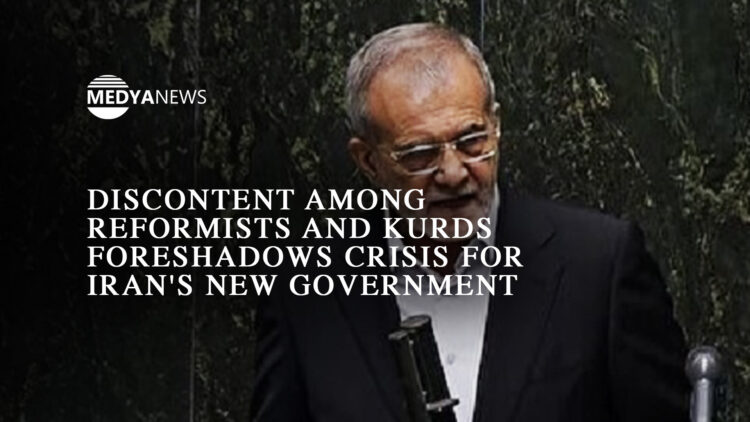
The proposed cabinet list by Masoud Pezeshkian has generated widespread dissatisfaction among both the general public and reformists in Iran and Kurdistan.
Following the assassination of Ismail Haniyeh, the chairman of Hamas’ political office in Tehran, and the Islamic Republic of Iran’s efforts to retaliate against Israel, Mohammad Javad Zarif’s sudden resignation as the strategic vice-president to Masoud Pezeshkian—before the new cabinet had even been finalised—has intensified speculation about an impending crisis in Iran’s future government. Zarif had previously served as Iran’s Foreign Minister.
Zarif’s resignation, along with the exclusion of minorities, particularly Kurds, from the list of future cabinet members, highlights internal disagreements among the reformist camp and a lack of coordination at the highest levels of Iran’s administration. This situation has created a sense of disillusionment among reformists.
Mino Khaleghi, a prominent reformist figure, suggests that Zarif’s resignation will weaken the credibility and unity of the future government.
While conservative factions within the Iranian government remain influential, the country’s ultimate authority lies with Ali Khamenei, the Supreme Leader of the Islamic Republic, who has historically played a decisive role in shaping crises within Iranian administrations.
Through both direct and indirect interventions, Khamenei seeks to influence future government decisions according to his conservative views. Given this context, Pezeshkian is unlikely to act independently of conservative elements and the Supreme Leader when forming his cabinet. For instance, the proposed list of ministers submitted to parliament primarily consists of middle-ranking officials with religious and conservative leanings, many of whom have backgrounds in security-related fields.
The inclusion of individuals like Hossein Simai Saraf, with a clerical background from the Qom seminary, as Minister of Science, and Iskander Momeni, a senior police official, in the proposed cabinet list, underscores Pezeshkian’s conservative approach, deepening the disappointment among reformist circles.
Public opinion and reformist voices increasingly argue that Pezeshkian lacks a clear and detailed plan for governing Iran, particularly in foreign policy, where he appears heavily dependent on Khamenei. This lack of confidence in leadership has been evident since the early stages of his election campaign.
Although Pezeshkian recently emphasised his intention to form a “government of national unity” based on discussions with Khamenei, the published list of ministers reveals a significant gap between this vision and the diverse expectations of Iran’s various social groups, including different nationalities, age groups, and genders.
Pezeshkian’s primary focus appears to be maintaining Khamenei’s approval, rather than genuinely bringing together rival political factions or opposition groups. As a result, Pezeshkian has disappointed some of his reformist supporters despite his campaign promises.
Historically, Iranian presidents, with the exception of Khamenei himself, have often faced unfavourable outcomes, including marginalisation, exile, or even death at the hands of the regime. Aware of this history, Pezeshkian seems determined to remain aligned with Khamenei in an effort to avoid a similar fate.