

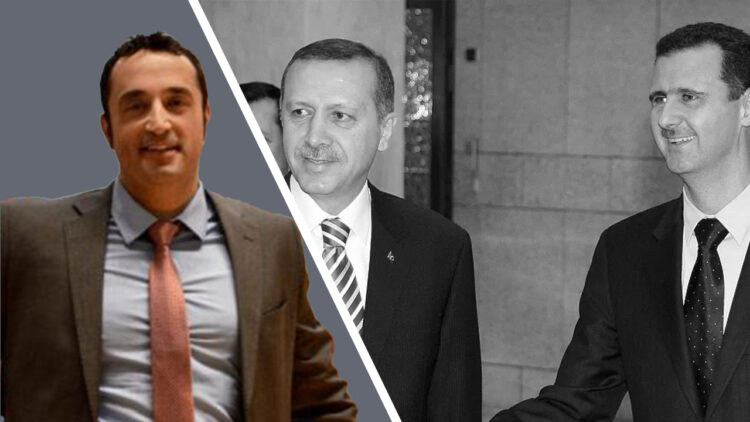
An article by political and religious scientist Hüseyin Çiçek titled “The fairytale of the Umma: Erdoğan’s foreign policy fiasco”, and published in the Austrian newspaper “Der Standard” on 8 August, comments on the changes in Turkey’s foreign policy towards Syria.
In his article, Çiçek notes the importance that Turkish President Recep Tayyip Erdoğan accords to the concept of the ‘Umma’ – referring to the global religious community of Muslims, while at the same time highlightıng Erdoğan’s hypocrisy in the use of this term, pointing out that as far as Turkey’s foreign policy towards Syria goes, “the Umma must follow political interests and not the other way around”.
Looking back at the history of Turkish-Syrian relations, Çiçek explains that Ankara has “spared no military effort to topple the Assad regime in Syria from 2011 onwards”, especially with the support of the Free Syrian Army (FSA) and of jihadist groups, even those “linked with Osama bin Laden’s terrorist organisation al-Qaeda.”
“At the same time, jihadist fighters were not prevented from travelling to Syria via Turkish territory and joining the ranks of the Islamic State (ISIS) terrorist militia there”, Çiçek continues, emphasising that at the time it was known that these jihadist groups would “ruthlessly enslave or kill people in the region who did not share their religious views”.
Çiçek also comments on the nearly 3.6 million Syrian refugees that have migrated to Turkey since the onset of the Syrian civil war in 2011, and states that there were two main reasons for Erdoğan providing refuge to these people: On the one hand, Erdoğan wanted to show the importance the Umma has to him, protecting his “brothers in faith” from the brutality of the Syrian civil war, on the other hand Erdoğan was hoping that these refugees would return to Syria to “rebuild their country, and remember Turkey’s role in the conflict, thus contributing to a new alliance policy.”
Explaining his labelling of Erdoğan’s foreign policy as a “fiasco”, Çiçek says that many Turkish citizens assume that the Syrian refugees will remain in Turkey and that Syria’s president Assad can “sit back and observe the situation, as he will only allow his citizens to return if the Turkish army withdraws completely from Syrian territory”.
Referring to the current Turkish incursions into Iraqi Kurdistan, Çiçek explains that the reason for these military attacks is so that finally Turkey “can declare the Turkish army’s various offensives since 2012 over, and so that Erdoğan can chalk up his failed foreign policy as a victory.”
Çiçek says that Turkey’s foreign policy towards Syria will be dependant on the results of the coming presidential elections in the US. Erdoğan is hoping that Trump will be elected so he can “try to persuade him to reduce the US troop presence in the region”, being aware that presidential candidate Kamala Harris is less likely to agree to such demands.
The article concludes by saying that the recent rapprochements between Turkey and Syria are an “attempt by Erdoğan to disguise the political fiasco [ongoing] since 2011” and that his “support for Hamas since 7 October shows that Erdoğan’s personalised foreign policy has no end as long as he rules Turkey”.


