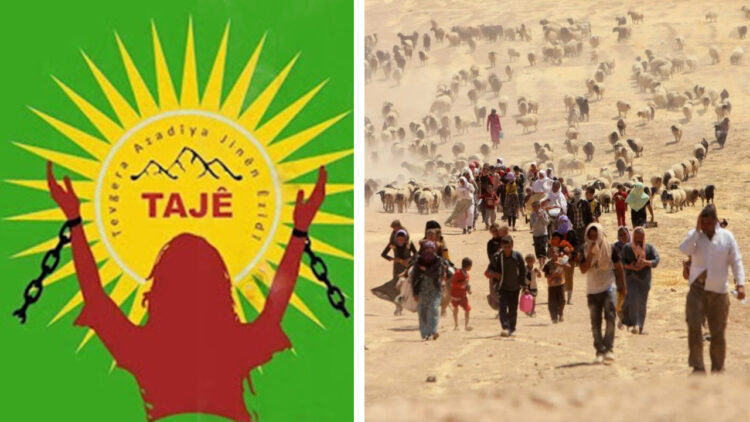
The Free Yazidi Women’s Movement (TAJÊ) have submitted a comprehensive report to various international bodies, including the European Court of Human Rights (ECtHR) and the German Foreign Ministry, demanding the trial of the Kurdistan Democratic Party (KDP) for its alleged role in the Yazidi genocide on 3 August 2014.
The report, submitted to countries recognising the Yazidi genocide, outlined the KDP’s actions and responsibilities during the genocide. The Yazidi women’s organisation TAJÊ accused the KDP, the ruling party in the Kurdistan Region of Iraq (KRI), of collaborating with the Islamic State (ISIS) and failing to defend the Yazidi community, leading to the massacre and abduction of thousands.
The report delved into the historical context, highlighting Article 140 of the Iraqi constitution, which deals with disputed territories including Sinjar (Şengal). TAJÊ claims the KDP exploited the administrative and security vacuum in Sinjar, failing to prevent the genocide.
Specific incidents, such as the bombings on 14 August 2007 in Tilizêr and Sîba Şêx Xidir, are cited. The report alleges KDP’s Peshmerga forces allowed explosives-laden vehicles to pass, resulting in civilian casualties. “Peshmerga told civilians there would be a big explosion,” the report stated, indicating foreknowledge and a failure to act.
A secret meeting on 1 June 2014 in Amman, involving various international actors and ISIS, is also detailed. TAJÊ alleges that the KDP struck a deal with ISIS, exchanging control of Sinjar for Kirkuk. The report called for this meeting’s decisions to be exposed.
TAJÊ underscored the genocide’s aftermath: thousands of Yazidis killed, enslaved, displaced and cultural sites destroyed. The report accused the KDP of abandoning their posts during the ISIS attack and subsequently attempting to regain control of Sinjar by introducing militia groups.
The controversial “9 October Agreement” between the Iraqi government and the KDP-led Kurdistan Regional Government (KRG), which aimed to restore Sinjar to its pre-genocide status, is critiqued. TAJÊ argues the agreement enables the KDP’s control over Sinjar, perpetuating injustice.
TAJÊ concluded by urging international legal action against KDP officials for their complicity in the Yazidi genocide, seeking justice for the Yazidi community.