

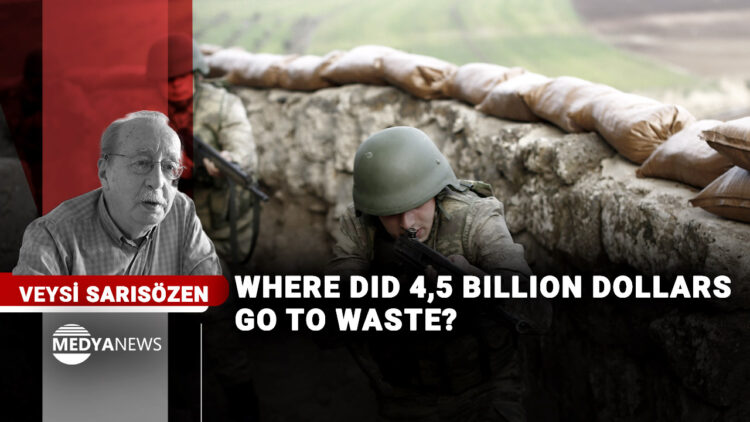
Veysi Sarısözen
Kurdish media has published a speech by the pro-Kuridsh Peoples’ Equality and Democracy (DEM) Party MP Sezai Temelli.
What makes a piece of writing or a speech meaningful is the presence of concrete facts or data that immediately convince the reader or listener. Sezai Temelli’s speech is just such a speech. It hit the nail on the head when he said:
“Five years ago, a report from the Stockholm International Peace Research Institute (SIPRI), which monitors military spending, showed that Turkey had spent $3 trillion on this war over the past 40 years. Some studies now say this figure has risen to $4.5 trillion. This is an enormous amount. If this money had not been spent in this field, Turkey and the Middle East could have been entirely different today.”
Forget counting to$4.5 trillion: even counting the number of zeros is difficult!
Opposing war expenditure, as a political saying puts it, is not something everyone can do. The DEM Party and its predecessors have always said “no” to governments’ war budgets throughout their history. To understand that this “no” is an act of heroism, let’s remember that during World War I then [communist politician] Karl Liebknecht was the only one in the German Parliament to say “no” to the war budget. Alongside Rosa Luxemburg, he paid for this “no” with his life.
Much time has passed since then: Today, the DEM Party’s parliamentary group is full of contemporary “Rosas” and “Karls”. Thousands of them are in prison. The names of countless martyrs who said no to war throughout the party’s history are written in the book of honour.
In light of this, let’s return to the mind-boggling $4.5 trillion war expenditure Temelli mentioned.
At first glance, one might find it hard to comprehend such a war expenditure that has driven the country’s economy to ruin in nearly half a century of war against the Kurdish freedom movement. As the peace process proved, if instead of investing $40 billion annually in war, negotiations with [Kurdish political leader Abdullah] Öcalan had resulted in a solution, Turkey would not have plunged into its contemporary economic crisis.
Did the Turkish state fail to calculate this? Let’s say [Turkish president Recep Tayyip] Erdoğan did not grasp this calculation. Did the entire cadre of Turkish state officials and academics also forget basic arithmetic?
This is implausible. They were all aware of what they were doing. For them, the $4.5 trillion spent was not a war expenditure but an “investment” made to eliminate the Kurdish freedom movement and seize Middle Easern oil resources. They meticulously calculated that this “investment”, made over nearly half a century, would be compensated many times over in a few years if they could enter Kirkuk, Mosul, and go from there to Rojava (Syrian Kurdistan), and if they could leap to North Africa with the assistance of the Muslim Brotherhood in Egypt and Tunisia. [Former Prime Minister Ahmet] Davutoğlu’s book “Strategic Depth” inspired them. They imagined that by becoming a regional power centre, they could enter the European Union and become one of the four or five leading states in the global capitalist system.
We mentioned Karl and Rosa. They followed Lenin’s pre-World War I doctrine. They fought against the social chauvinism of Social Democrats who supported the bourgeoisie in that imperialist war. They called on the proletariat of every country to “revolutionary struggle” against the imperialist war.
Now let’s think. If the Kurdish freedom movement had supported the Turkish state’s policy of regional imperialist war in the name of their “national interests,” if they had demobilised their fighters and engaged in “politics in the plains” [as opposed to militant struggle in the mountains] what would have happened? Let’s recall that before Erdoğan openly attacked Rojava, he had offered an “alliance” to [Syrian Kurdish] Democratic Union Party President Salih Muslim against [the central Syrian authorities] and invited him to Ankara. If the Kurdish freedom movement had said yes to this alliance, the Islamic State of Iraq and the Levant (ISIS) would have marched on Damascus at that moment. Erdoğan would have prayed in the Umayyad Mosque. Because the Kurdish freedom movement did not say yes to this alliance, that is to say did not engage in class collaboration with the colonial bourgeoisie, Turkey directed ISIS towards Kobane. And that is where the ‘film’ cut out. The $4.5 trillion ‘investment’ led Turkey to bankruptcy that day. The Erdoğan administration lost the war that day.
But just as a defeated wrestler never tires of wrestling, and a gambler never gives up the desire to win even as they lose at the roulette table, so too is the government. It has lost trillions of dollars. It has to make up for the loss. The government is stuck in a vicious cycle. Therefore, this time, it abandoned its strategy of expansion in connivance with Russia. Instead, clinging to NATO, it has set out to raise the $4.5 trillion to $5 trillion, and thus to at least reach Iraq’s oil.
Strange things are happening in this conflict. In the last ten days, three Skorsky helicopters and a few unmanned aerial vehicles (UAVs) were shot down [by the Kurdistan Workers’ Party (PKK)]. The total loss is a few hundred million dollars. Imagine the extent this loss will reach in a few months.
Moreover, this time the situation is grave. Whenever the Turkish army advances one kilometre into Iraqi territory, it gets one kilometre closer to the Iranian state. Soon we will see: agitation about “Shia imperialism” will peak in the mainstream media.
Isn’t it clear? The state that spent 4.5 trillion dollars against the PKK’s armed wing will spend everything it has on the war budget when it faces Iran.
The sign indicates that this road is a dead end. No one will gift Turkey a second Lausanne Treaty.
Therefore, by saying no to war and war budgets, the DEM Party becomes a uniquely patriotic and internationalist force in Turkey.
I salute Temelli and his comrades for their efforts against Turkey’s war policy. The government is in a dead end, while the DEM Party’s path, despite all dangers, remains open and can lead to peace, resolution, and prosperity.


