

Fréderike Geerdink
This week, an interview with veteran PKK guerrilla Duran Kalkan dropped into my e-mail inbox. He has interesting things to say, but unfortunately, people who don’t know the Kurdish struggle will find it hard to understand it fully. Access to the PKK by independent journalists would be good to reach a wider audience. But that’s impossible now. That the mountains have turned into a no-go area for journalists, is a deliberate consequence of Turkey’s excessive and illegitimate violence that I want to condemn out loud.
The last time I was visiting the PKK as a journalist was in summer 2017. It was at the end of my year with the fighters inspired by the ideology of Abdullah Öcalan, for the book I wrote about them. In the years prior, I had gone to the mountains several times to interview the leadership of the KCK (the umbrella organisation under which also the PKK resorts), among whom were Besê Hozat and (several times) Cemil Bayık, the KCK’s co-leaders. The aim of my book was to spend time with common fighters to get to know their world, their aspirations, their reasons to fight, their daily lives and circumstances.
Sunlight
On one of the last mornings in that year, a ray of sunlight on my face woke me up. We were sleeping outside for security reasons. Very soon, I thought, I will be back in the Netherlands. Maybe I will visit a camp or interview one of the leaders again for a story, but never will I have the access again that I have now. My deep access into the guerrilla universe was about to end.
Little did I know that soon after that, it became impossible all together to visit the mountains. When I was there, Turkey already had armed drones, but they were not as omnipresent as they are now. It’s just too dangerous to go.
The KCK has since stepped up its efforts to publish and spread the perspectives of members of the Executive Council in ‘interviews’ – put between quotation marks because they are not interviews in a classical journalistic sense, with critical questions and with extra information to clarify the quotes. This makes them interesting reads for those who know the situation on the ground, the context of the Kurdish struggle and the PKK’s role in it and the way of thinking of the movement, but too complicated for relative outsiders.
İmralı prison
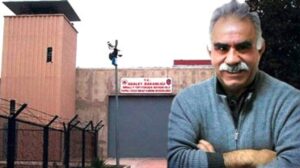
İmralı Island Prison, where Abdullah Öcalan has been incarcerated since 1999
Whenever I receive a link to a new publication, I read and I get eager to ask extra questions. When Duran Kalkan for example refers to a ‘genocide system in İmralı’ (and İmralı is the prison where Öcalan has been incarcerated since 1999), what does he mean? When he says ‘the entirety of the North is a battle zone’ (with the North being Kurdistan occupied by Turkey), I’d ask if he could elaborate, because from the outside, it seems as if in the North the PKK has significantly weakened in the last few years. And indeed, Turkey will not succeed in eliminating the PKK by this summer, as Erdoğan vowed, but many formerly PKK-held areas are occupied by Turkey now, as he says himself, so what will the eventual outcome be? How much longer can the PKK resist?
PKK leaders, I have learned, take the time to answer questions, and as long as it is politely phrased, you can ask just about anything, also rather basic and direct questions. Especially these informed yet rather basic questions will make it possible for a wider audience to understand what is going on. And the better and wider the audience is informed, the more pressing demands they can make to their representatives, and the smarter decisions they can make for their own lives and for their own contributions to, for example, anti-fascist struggles everywhere in the world.
Watermelon
Besides that, visiting the mountains and talking to the PKK as a journalist gives you insightful extra information. So far, most of the interviews I have done were given somewhere in a forest, where beforehand some fighters had hung a PKK flag between two trees, place some plastic chairs around a plastic table with a plate on it filled with pieces of watermelon. An interview would easily take two hours. Any changes in these routines would be interesting to note, and ask a few questions about.
Also changes on the road to Qandil (a specific area in the mountains, but generally used to refer to all the lands the PKK holds) would be significant. Are the villages there still inhabited? Are the memorials for citizens who were killed in Turkish strikes still standing, or has Turkey destroyed them? What does the stretch of road where the first PKK checkpoint always was or maybe still is, look like now? Can the martyrs’ graveyard, not too far from that point, still be visited, and is it still possible to maintain it well?
Occupation
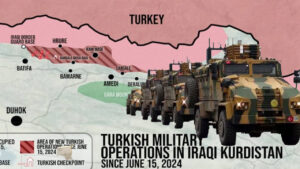
Turkey has stepped up its occupation campaign in recent weeks
The public has the right to information and answers, provided by independent journalists. I am sure the PKK would welcome reporters from outside as soon as possible. But Turkey likes the current situation. Its war is senseless and won’t solve the Kurdish issue, its expanding occupation of Kurdistan in Iraq is illegal, and the ruthless use of drones is illegitimate (because civilian deaths are casually taken as collateral damage if not outright deliberate), and the less outside reporters come in, the less attention it will get and the easier it will get away with it.
As a journalist and citizen, how could I not speak out against that? As soon as it’s possible to visit Qandil again, I’ll be the first to sign up.
Fréderike Geerdink is an independent journalist. Follow her on Twitter or subscribe to her acclaimed weekly newsletter Expert Kurdistan.


