

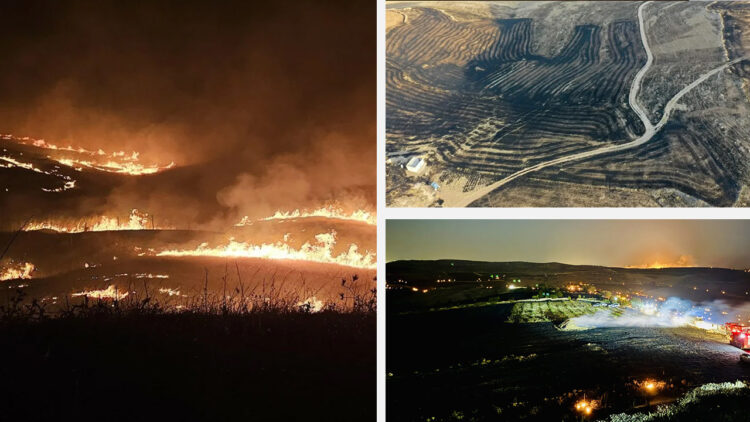
At least five people have lost their lives in a deadly wildfire in Kurdish-majority regions of southeast Turkey, prompting growing anger, accusations of government culpability, and comparisons to prior government mishandling of natural disasters.
In addition to the deaths, Turkish Health Minister Fahrettin Koca said, “44 people were affected by the fire, 10 of them seriously. We have three casualties in Diyarbakır and two in Mardin. Thirty-five ambulances and seven UMKE teams were assigned due to the incident.”
Opposition figures were quick to challenge the government’s handling of the catastrophe as slow, off the mark, and insufficient. Pro-Kurdish Peoples’ Equality and Democracy (DEM) Party leaders demanded an immediate aerial intervention to tackle the fire, saying: “There are casualties and injured people. So far, the ground intervention is insufficient. Authorities should intervene more comprehensively and from the air without wasting time. We call on all… institutions to intervene quickly.”
Meanwhile, Melis Tantan, the co-spokesperson for the DEM Party’s Ecology and Agriculture Commission, criticised the government response as “just a show”.
“It is not acceptable that a night vision helicopter was not sent to the region from the moment the fire started,” Tantan said, adding: “The fire spread to a large area in a short time. And unfortunately, the calls were silenced. In such cases, early intervention from the air can prevent the fire from spreading to large areas.”
The lack of government response recalls previous tragedies in Turkey, which are widely seen as having been worsened by government negligence, corruption and malpractice. The most notable recent example is the deadly 2023 earthquakes.
“Unfortunately, our country is constantly caught unprepared for such disasters. This is not a coincidence or fate. This is a case of those responsible not fulfilling their responsibilities,” said Tantan.
Massive earthquakes measuring 7.8 and 7.7 on the Richter scale struck southeastern Turkey and areas of northern Syria on 6 February 2023, killing 53,537 people in Turkey, and up to 8,500 in Syria.
Following that tragedy, the state failed to provide basic services such as shelter, food and health care, and left communities to fend for themselves. Aid distribution was politicised, with aid confiscated in Kurdish-majority provinces by government-appointed local leadership (‘trustees’). The Turkish Red Crescent, the largest humanitarian foundation in Turkey, was exposed as prioritising profit over provision. Journalists uncovered the Turkish government’s role in systematically unsafe and corrupt construction projects, channelling funds into the pockets of businessmen close to the government, while leaving Kurdish-populated regions exposed to the natural disaster.
Following the latest blaze, the Bar Association in Turkey’s largest Kurdish-majority city of Diyarbakır (Amed) have already filed a criminal complaint, addressing the crimes of ‘causing the death and injury of more than one person’, ‘deliberately endangering general security’ and ‘intentional abuse of office’. Calling for a swift and thorough investigation into the deaths, the Association said: “We wish God’s mercy on those who lost their lives in the fire, condolences to their relatives and a speedy recovery to the injured.”


