

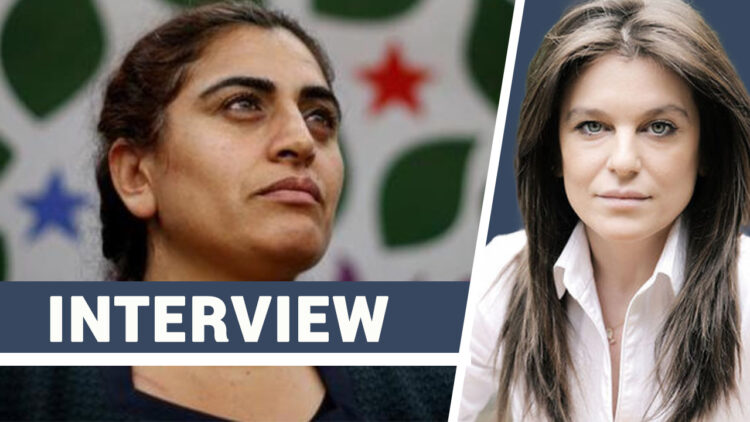
Turkey’s treatment of the Kurdish issue has evolved from physical destruction in the 1990s to a more insidious form of political annihilation today, according to Kurdish politician and former MP Sebahat Tuncel, speaking to T24’s Tuğçe Tatari on Saturday.
Tuncel, a seasoned Kurdish politician, was notably tried in the high-profile Kobane case, which targeted several members of the pro-Kurdish Peoples’ Democratic Party (HDP), including co-chairs Figen Yüksekdağ and Selahattin Demirtaş. After a contentious trial and nearly a decade of detention, Tuncel was released, while Yüksekdağ and Demirtaş received sentences of 30 and 42 years, respectively.
In the interview, Tuncel shed light on the persistent challenges faced by Kurds in Turkey, portraying their plight as a battle against systemic marginalisation and changing state tactics. She noted how the Turkish state is perceived as part of the family unit, which tolerates and normalises its oppressive actions, contributing to the marginalisation of Kurdish rights and identities. “In Turkey, the state is viewed as part of the family, but Kurds remain excluded,” Tuncel emphasised, indicating the profound societal exclusion Kurds endure.
Tuncel argued that while the direct physical violence against Kurds might have decreased, legal and political strategies continue to suppress Kurdish political and cultural expressions. She highlighted the inconsistent experiences of Kurdish politicians, noting how they may have been elected during more tolerant times, only to later face harsher treatment such as imprisonment or political marginalisation, marking a decline in democratic rights for Kurds over the years. “Previously, the destruction policy against the Kurdish issue was more physical in the ’90s, now there is political annihilation,” she explained.
Expressing scepticism about various peace processes, especially those led by the ruling Justice and Development Party (AKP) and President Recep Tayyip Erdoğan, Tuncel described these efforts as superficial tactics rather than genuine attempts at reconciliation. “The peace process was essentially a continuation of the policy of denial and annihilation under a different guise,” she criticised, pointing out the manipulation of these processes to appease international observers while undermining Kurdish political power.
Tuncel also highlighted severe conditions in Turkish prisons, particularly for Kurdish political prisoners, where suppression extends to denying basic human rights and medical care. “They do not allow you a living space; they do not leave you any air to breathe,” she stated. She further detailed bureaucratic abuses in prisons, such as the arbitrary power of the Administrative Observation Board, which acts without transparency and fairness. “Friends who are due for release are not being released. An Administrative Observation Board has been established. This board sets itself up as both a health committee and a court,” she reported, illustrating the unjust prolongation of incarceration.
Turning to the potential for policy change, Tuncel called on the main opposition Republican People’s Party (CHP) and its leader Özgür Özel for more decisive action. She urged the main opposition party to move beyond rhetoric to substantive reforms that genuinely improve Kurdish rights and integration. “It is significant and meaningful if the CHP intends to establish a meaningful and equal relationship with the Kurds,” she noted, advocating for opposition to trustee appointments and the isolation regime, as well as a firmer stance against political trials targeting Kurdish politicians.


