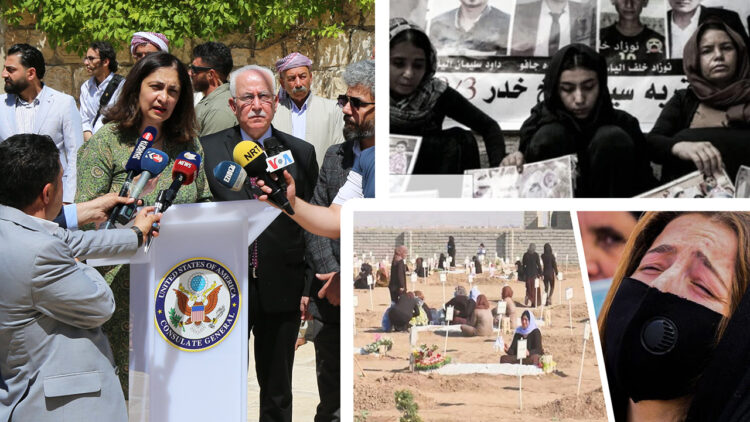
United States Under Secretary for Civilian Security, Democracy, and Human Rights Uzra Zeya commemorated the tenth anniversary of the Yazidi Genocide in the Kurdistan Region of Iraq (KRI), during an official visit to the region last week. She memorialised the victims, outlined US-backed initiatives to help survivors heal, including the return to homelands and rebuilding of communities, and called for the perpetrators to be brought to justice.
“The United States is committed to supporting both government and grassroots efforts to deliver justice to survivors, and to help them to heal. […] We wish to see survivors and all displaced persons safely and voluntarily return home, to sew the fabric of Iraqi society back together,” Zeya said, during a speech outside the Yazidi’s Latish Temple.
The Under Secretary said that the US had encouraged the Iraqi government to further the rebuilding of Yazidi communities in areas liberated from ISIS, such as Sinjar (Şengal), the Ninewa Plain and elsewhere, to foster and facilitate the return of Internally Displaced People (IDPs). “The negative impact of militia groups on the security and stability of communities prevents IDP returns and stymies local communities’ economic development,” she explained.
“ISIS pitted members of different tribes and communities against each other to sow seeds of division, mistrust and hatred… The US government has led dialogue among community and tribal leaders to ease communal tensions and divisions,” Zeya said, adding, “These communities co-existed peacefully before the genocide and can exist in peace again.”
Evidence for the crimes committed by the ISIS caliphate against the Yazidis has been systematically collected by UNITAD, a United Nations investigative team, to promote accountability. The mandate of UNITAD is scheduled to expire later this year. Zeya assured the communities in Iraqi Kurdistan that the US was working towards processing the findings to ensure future accessibility for stakeholders.
“We have also encouraged the Iraqi government to work with UNITAD on continuing protection measures for witnesses and victims who bravely provided their testimony and evidence,” Zeya added.
The Under Secretary also outlined an ongoing cultural project, comprising an immersive media experience, that aims to educate audiences through art and testimony on the narrative and impact of the Yazidi Genocide. The exhibit, first open to the public in Washington, is set to move to the KRI during the summer to help survivors feel heard.
On 3 August 2014, ISIS slaughtered an estimated 5000 civilians in Sinjar. Over 400,000 more were displaced. Thousands of Yazidi women, enslaved during the atrocities, remain missing. Mass graves, some of which have been discovered during UNITAD-led investigations, reveal the extent of the massacres, including against children. Survivors witnessed executions, torture, rape and sexual slavery among other abuses defined as war crimes by the international community.
The atrocities have been formally recognised as genocide by the United Nations and numerous governments and bodies in the international community. Nevertheless, much work still needs to be done by authorities, and on a grassroots level, Zeya said, to support the survivors and foster a stronger peace.