

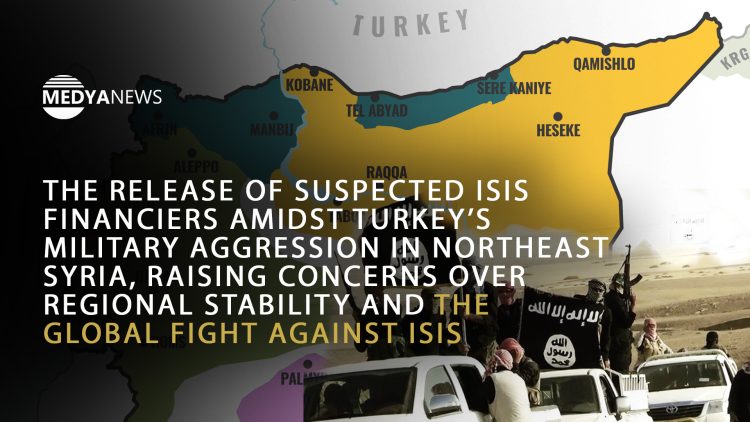
Hale Gönültaş, a dedicated journalist known for her groundbreaking investigations into ISIS’s complex financial and operational activities, has once again revealed a troubling development. Her latest report exposes the release from Turkish custody of 18 suspects accused of funding ISIS through multi-million dollar transfers made through Turkey. Her meticulous work continues to shed light on the challenges of combating the financing of terrorism.
Last week, 18 individuals accused of financing ISIS and facilitating multi-million dollar money transfers between Turkey and Syria were released due to what the Turkish authorities said was “insufficient evidence”. The suspects had been charged with “membership of a terrorist organisation” and “financing terrorism”, and had each been facing between 15 and 42 years in prison. The president of the Istanbul Bar Association İbrahim Kaboğlu strongly criticised the decision of the judge of the court in question, raising questions about the potential illegality and anti-judicial nature of the process, implying that politics had influenced the decision.
The case, based on an extensive indictment, highlighted how six front companies operating in tourism and jewellery were used to cover up illegal transactions. The illicit funds, exceeding one billion lira (equivalent to USD 28.4 million), supported ISIS operations between 2017 and 2023. A covert financial system known as Hawala enabled these transactions, via WhatsApp groups using labels like “charity” and “donations”.
The indictment also revealed that funds had been sent to human traffickers in northern Syria to aid the escape of ISIS-affiliated women and children from detention camps. Among the suspects, Syrian national Imad Machnouk emerged as a key figure, owning companies linked to laundering operations as well as funding ISIS. Machnouk remains in custody, with his trial set for February 2025, but his application for Turkish citizenship, backed by a $500,000 deposit, has raised eyebrows.
The release of the suspects coincides with Turkey’s escalating military operations against the Syrian Democratic Forces (SDF) in North and East Syria. The SDF, a key ally and boots-on-the-ground in the US-led Global Coalition to Defeat Da’esh (ISIS), has been pivotal in dismantling ISIS networks and maintaining regional stability. However, Ankara’s attacks on the regions governed by the Kurdish-led Autonomous Administration of North and East Syria (AANES) have diverted critical resources from counterterrorism missions, weakening coalition efforts.
“While the world fights ISIS, Turkey’s aggression against Kurdish regions undermines collective efforts to eliminate terror networks,” an SDF spokesperson said. International observers warn that continued instability in northeast Syria could enable ISIS to regroup and strengthen its foothold in the region.
Related Articles
Erdoğan’s expansionist vision: To bring all of Syria under Turkish control
Supporting Syrian Kurdish partners crucial for stability in Syria, US senators say
The developments have reignited concerns over Turkey’s approach to the financing of terrorism and its broader policies in Syria. Turkey’s 2021 placement on the Financial Action Task Force (FATF) grey list highlighted its deficiencies in addressing money laundering and terrorism financing. Although the country was removed from the grey list in mid-2024 after implementing reforms, the release of the ISIS funders raises questions.
Global powers have urged Turkey to prioritise its role in the anti-ISIS coalition and halt its aggression against Kurdish-led regions. “The international community must address Turkey’s actions, which jeopardise both regional stability and global counterterrorism efforts,” a coalition representative remarked.


