

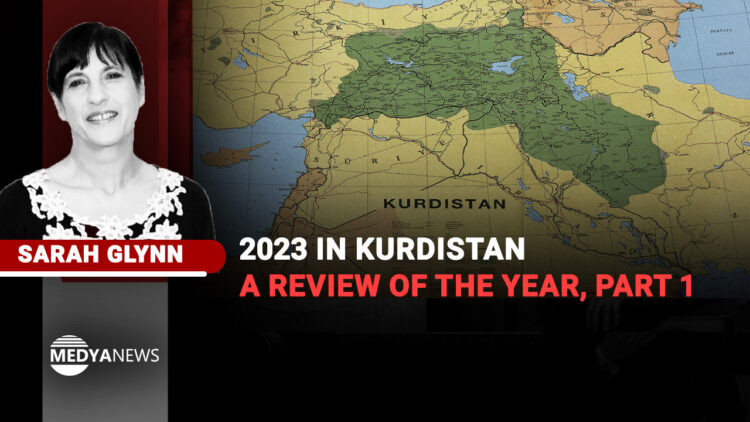
Sarah Glynn
The year that began with mourning and anger over the triple murder of Kurdish activists in Paris has ended with mourning and anger over Turkish bombing of civilians and civilian infrastructure in Rojava. In between, it brought the devastation of the February earthquakes – a natural phenomenon that became a horrific disaster due to institutionalised corruption and political exploitation – and – despite this and despite a cost-of-living crisis – the end of hopes for political change in Turkey as a disunited opposition failed to oust President Erdoğan and his Justice and Development Party (AKP) in the May elections.
On the world stage, 2022 was dominated by the war in Ukraine. This has continued into 2023 and will go on into 2024, but in the last three months international attention has been focussed on Israel’s genocide of the Palestinians in Gaza. World politics are undergoing a sea change as the United States faces the loss of their global dominance to China, and lesser powers are asserting their strength, making new alliances, and jostling for a bigger share of the action. What is happening to the Kurds, and international reactions to it, needs to be seen in the context of these wider events.
Turkey has been able to benefit both from their strategic geographical location – at the intersection of East and West and controlling the entrance to the Black Sea – and from placing themselves at the intersection of NATO and Russian politics, able to play one side off against the other.
Ukraine gave Turkey a new importance. It provided another reason for Western nations to try and avoid annoying the Turkish Government, and it enabled Turkey’s President Erdoğan to present himself as an international statesman. It allowed Turkey and Russia to develop relationships beneficial to both countries, and provided the opportunity for Turkey to assert their power over NATO by using their veto to delay Swedish membership and force them to make concessions – to the detriment of Sweden’s relationship with the Kurds.
Erdoğan has also attempted to exploit the situation in Gaza, first trying to find importance as a negotiator, and then seeking popular support through pro-Hamas rhetoric, even as Turkey continues to be the conduit for 41% of Israel’s oil needs and to provide Israel with 65% of their steel. He has benefited from Gaza’s monopoly of world attention, which has allowed him to carry out his own attacks on Kurds and their neighbours in North and East Syria unnoticed.
For this end of year review, I will try and sum up the situation and major developments in the four parts of Kurdistan, and because this is a complicated part of the world, I will do this over two articles.
Earthquake
The first major event of this relentless year was the earthquake that struck southern central Turkey and north-west Syria in the early morning of 6 February and left over 50,000 dead. While an earthquake itself is a natural phenomenon, the devastation it causes is very dependent on human society, both preparedness and response.
The Turkish state failed miserably in both these areas and bears responsibility for a large proportion of those deaths. Notably, they had allowed developers to ignore regulations designed to help buildings survive in earthquakes, even boasting of giving amnesties for non-compliant housing. And the government response to the disaster was more concerned with public perception than maximising the potential for rescuing and helping survivors. Much effort was spent in making sure that the credit for any help went to the state Disaster and Emergency Management Authority, AFAD, and in blocking relief efforts organised by others. A state of emergency was declared, giving President Erdoğan even greater powers, and in their attempt to control the narrative, the government even blocked Twitter, until forced to backtrack by furious rescuers who were using the app to communicate with people buried in the rubble. Little use was made of the second biggest army in NATO, and there were suggestions that Erdoğan was afraid of being upstaged by the generals. There are concerns that rebuilding works will also be inadequately regulated; and predictions of an Istanbul earthquake in the near future bringing even greater tragedy for which no prevention work is being undertaken.
In Syria, the areas worst affected were under the control of al-Qaeda offshoot, Hayat Tahrir al-Sham (HTS), and of the Jihadi militias installed by Turkey, and also of President Assad’s Syrian Government. The Autonomous Administration of North and East Syria was largely undamaged except for the two isolated Aleppo neighbourhoods, Sheikh Maqsoud and Ashafrieh. The earthquake forced around 3000 families to leave these neighbourhoods and seek safety in Al Shahba, another part of the Autonomous Administration that is isolated from the rest. Al Shahba and the Aleppo neighbourhoods are under a blockade imposed by Assad. The Autonomous Administration wanted to help supply fuel and other vital aid to the affected areas, but this was not easy. Occupied Jarabulus kept the Administration’s trucks waiting at the border for a week before agreeing to allow some through, and aid was only allowed to the isolated autonomous regions after it was agreed to give the Syrian Government a large cut.
The PKK announced that they would observe a ceasefire to allow all resources to be concentrated on earthquake relief, but the Turkish government continued their attacks on the PKK guerrillas.
Election
The Turkish government’s response to the earthquake, together with rampant inflation that left a large portion of the population struggling to meet rising living costs, should have spelt the end of Erdoğan’s ambitions for a third presidential term, but a divided opposition was not able to overcome the structural advantages available to an incumbent leader of an authoritarian state. The political earthquake didn’t happen.
May’s parliamentary and presidential elections took place on a far from level playing field. Erdoğan controls the media, and many of his critics are either in prison or afraid to speak out. State events can be used as government propaganda, and corruption buys the support of an elite layer who in turn protect their followers. These huge structural advantages were of more significance than the apparently-systematic mis-recording of some votes as they were transferred to the computer records, which was not large enough to change any results.
The main opposition alliance was only united in their desire to oust Erdoğan and undo his presidential system, and briefly fell apart over the choice of the Republican People’s Party (CHP) leader, Kemal Kılıçdaroğlu, as presidential candidate. While Erdoğan relied on ethno-religious populism, rallying voters through hatred and war, Kılıçdaroğlu ran a generally more positive and inclusive campaign. However, in the second round of the presidential vote, when he was competing for the votes of the third candidate, who was from the far right, Kılıçdaroğlu showed a much more ruthless face. He made a secret deal with the leader of the ultra-nationalist Victory Party in which, as was subsequently revealed to the horror of many of his voters, he bought their endorsement with the promise of three government ministries, including the Ministry of the Interior.
The pro-Kurdish leftist HDP competed in the parliamentary election under the banner of the Green Left, but chose to endorse Kılıçdaroğlu rather than put up their own candidate for president. The hope was that this would allow Kılıçdaroğlu to get elected in the first round, so minimising the opportunity for dirty tricks, but many have wondered if that was a correct decision. Did the HDP’s own message get lost? Did HDP support for Kılıçdaroğlu make it easier for Erdoğan to paint the CHP as equivalent to the HDP and therefore, in Erdoğan’s view, to the PKK and “terrorism”? What if Kılıçdaroğlu had been forced to try and appeal to HDP voters in the second round, rather than to the far right?
Erdoğan’s right-wing populism on top of a century of Turkish ethnic nationalism has taken a large part of the Turkish population to a very dark place. In Erdoğan’s victory speech he declared that the HDP’s former co-chair, Selahattin Demirtaş, would never be released from jail – and was met with calls for the death penalty. (Demirtaş’ case is currently sub judice, but that doesn’t bother Erdoğan.)
The PKK announced that they would continue their ceasefire for the election period, but their move received no recognition or response from the Turkish government.
HDP/Green Left/HEDEP/Dem Party
The HDP has continued to be under constant and existential attack. This year has witnessed the detention of nearly 3,000 activists, and the continuation of two major court cases. The Kobanî case and the HDP closure case both make mockery of the judicial system. Political parties in Turkey receive public money, but for a period of two months, funding for the HDP was stopped as an “administrative measure” in connection with the closure case.
If Erdoğan wants it, the closure case can be completed quickly. Because the party feared this could happen in the course of the election, they stood under the name of the Green Left, one of their constituent parts. After the election, they reconstituted themselves as the Peoples’ Equality and Democracy Party, abbreviated to HEDEP; and when that abbreviation was disallowed, they chose the abbreviation DEM Party. All these changes take valuable time and effort and affect voter recognition – which is why they have been imposed.
Many HDP politicians have legal cases hanging over them. Elected members are immune from prosecution, but hundreds of requests have been submitted for lifting the parliamentary immunity of DEM Party MPs.
Turkey’s next elections are for local mayors and councils and will be held in March. Government authorities are preparing for these by manipulating voter lists through mass registrations of government supporters in areas where the DEM Party might be vulnerable.
Politicised justice
Turkey’s court and prison system is used as a tool of political control, through grotesquely farcical court cases and through increasingly brutal prison regimes. There have been many reports of systematic mistreatment, and of sentences prolonged on absurd excuses when prisoners refuse to show remorse. Harsh regimes of isolation take their cue from the conditions imposed on imprisoned Kurdish leader, Abdullah Öcalan – conditions that have been challenged by the United Nations Human Rights Committee.
A petition calling for an end to Öcalan’s isolation and for his ultimate release has been signed by 60% of the adult population of North and East Syria. His vital importance to achieving a peaceful and dignified future for the Kurds is recognised in a new international campaign that was launched this October under the title Freedom for Abdullah Öcalan: a political solution for the Kurdish Question. There has now been no communication allowed with Öcalan for 33 months and no news as to his well-being and health.
Turkey pressurises other countries to use their judicial systems against the Kurds too. One way they do this is by encouraging them to classify the PKK as a terrorist organisation. At the end of January, a three-million-signature petition was delivered to the European Parliament calling for the removal of the PKK from the EU’s terrorism list.
I will stop here and leave the sections on Syria, Iraq and Iran to part 2
To gain further insights into the unfolding events and issues in Kurdistan throughout 2023, please refer to the second part of this review here: 2023 in Kurdistan: A Review of the Year – Part 2.
Sarah Glynn is a writer and activist – check her website and follow her on Twitter.


