

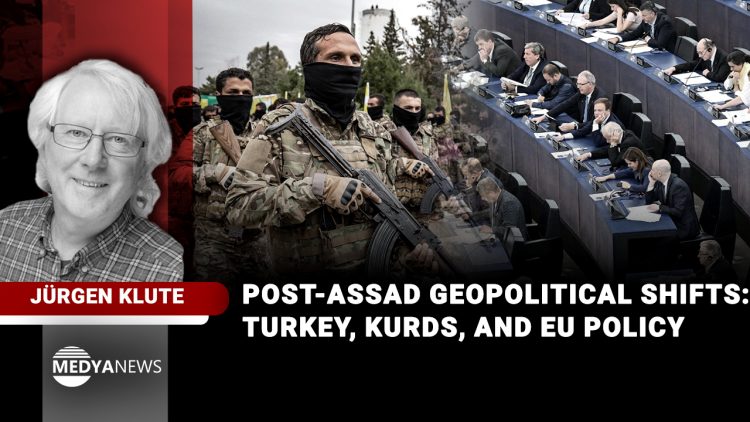
Jürgen Klute
When Hamas carried out its terrorist attack against Israeli citizens on 7 October 2023, no one could have foreseen the consequences that would be revealed by this attack, which, in terms of the number of victims, was the worst terrorist attack against Jews since the end of the Shoah, some 14 months later. The Israeli government’s military response to the attack of 7 October, which has since been heavily criticised internationally for its severity and unclear political goals, on the one hand led to tens of thousands of dead and injured – not only within Hamas – as well as widespread devastation in Gaza. On the other hand, the Israeli army and Israeli secret service have severely weakened both Iran-controlled and -financed Hezbollah and Iran itself.
That in turn created the conditions to bring down the Syrian dictatorship, which was one of the most brutal in the world at the time. As a result of the Israeli attacks, Iran and Hezbollah were too weakened to come to Assad’s rescue again. And Russia, Assad’s other ally, has weakened itself to such an extent by the war against Ukraine that it was also no longer able to provide support, abandoned Assad and even withdrew from Syria. Syria was Russia’s only military base in the Mediterranean region and also a hub for its terrorist activities in Africa.
Since the fall of Assad, the balance of power in the Middle East has shifted fundamentally, as a late consequence of the Hamas terrorist attack of 7 October 2023 shortly before the end of 2024. For the time being, Israel and Turkey appear to be the states in the region that are benefiting most from the current power shift.
These political changes have the potential to lead to long-term stabilisation in the region, provided that the current opportunities are seized. This is urgently needed in view of the climate policy imperative to phase out the use of fossil fuels, on which parts of the region have been economically dependent in the past. The EU, in particular, which wants to push ahead with a transformation of its energy and transport systems, must have an interest in political stabilisation in the region. So far, however, the EU has been more of a spectator than an active participant in the restructuring of the region, and has failed to seize the opportunities for long-term political stabilisation.
This is partly due to France and Germany, the two leading EU member states. France is in the throes of a major government crisis, while Germany is busy with early elections in February 2025. In addition, Germany lacks foreign policy goals and strategies that it could contribute to EU foreign policy. It remains to be seen whether the EU’s new leadership team, consisting of EU Commission President Ursula von der Leyen, permanent Council President António Costa and EU High Representative for Foreign Affairs Kaja Kallas, will develop new ideas and strategies in view of the changes in the Middle East.
Meanwhile, Germany and Austria are discussing how to send back to Syria as quickly as possible those Syrians who fled to Europe around 10 years ago to escape the civil war in their country of origin, since Assad is no longer causing trouble there. At least in Germany, many of the Syrians have long since been integrated into German society and work in important professions. Sending them back would create gaps in the German economy that cannot be closed in the short term. Forward-looking policy would, in the spirit of international law, allow former Syrian refugees to stay or go, and work with them to develop a political, cultural and economic bridge between Syria and Germany and the EU.
Another critical point is the situation of the Kurds in Northern Syria/Rojava. The Turkish government is determined to weaken the political role of the Kurds in Northern Syria under the changed circumstances. Accordingly, it is increasingly attacking the Kurds living in Northern Syria militarily. The Kurdish side expects Turkey to attack the northern Syrian border town of Kobanê [Kobani], which was successfully defended against ISIS by Kurdish forces in cooperation with the United States about 10 years ago.
The European Union has so far remained silent on the matter. The German Foreign Minister Annalena Baerbock (Greens), according to the German news magazine DER SPIEGEL, demanded in a meeting with Turkish Foreign Minister Hakan Fidan in Ankara on 20 December 2024 that the Kurdish self-defence forces and anti-IS militias in northern Syria should lay down their weapons. Obviously, the German foreign minister is not aware that by kow-towing to the Turkish foreign minister, she is adding fuel to the fire. However, Baerbock’s position aligns with controversial German arms deliveries to Turkey, which in 2024 have increased for the first time in years, as reported by the same magazine on 6 October 2024.
In view of Turkey’s preparations for an attack on Kobanê, the Kurdish side will not be able to agree to the German foreign minister’s demand. Turkey’s actions are ultimately aimed at destroying the Kurdish self-government that has been established in Northern Syria/Rojava in recent years. This runs counter to the political stabilisation of the entire region.
What is needed at present is to significantly increase pressure on the Turkish government to immediately stop its military action against the Kurds in Northern Syria (and Northern Iraq), which is just as illegal under international law as the Russian attack on Ukraine.
Recently, the leader of the right-wing nationalist Turkish party MHP [Nationalist Movement Party], Devlet Bahçeli, surprisingly brought up the proposal to release Abdullah Öcalan from custody on condition that the PKK [Kurdistan Workers’ Party] lays down its weapons (see my column A turning point for Turkey-Kurd peace?). Such a proposal would only be realistic, however, if it were accompanied by guarantees from the Turkish side that it would cease all military action against the Kurds, release Kurdish politicians and journalists imprisoned in Turkey and at the same time guarantee the Kurds autonomy rights within the framework of the existing Turkish state, as the Kurds demand.
If the German Foreign Minister has linked her demand to this proposal from the MHP leader, then she should have linked her demand of 20 December to the Turkish government with corresponding demands for guarantees vis-à-vis the Kurds.
In the report Global Terrorism Threat Assessment 2024, published in February 2024 by the Centre for Strategic and International Studies (CSIS) in Washington, it says on page 80 (see my column Is the PKK a terrorist organisation?)
“The Turkish government has expanded its campaign against Kurdish groups beyond its borders. The number of attacks in Turkey has decreased since 2020, but violence between Turkish forces and Kurdish armed groups outside of Turkey has increased dramatically in the same period. The Turkey-PKK conflict continues to drive regional instability and, indirectly, terrorism in the wider Middle East. Turkey has escalated its rhetoric against Kurdish nationalist groups, including the People’s Defence Units (People's/ Women's Protection Units, YPG/YPJ) that comprise a sizeable portion of the US-supported Syrian Defence Forces (Syrian Democratic Forces, SDF).”
The authors continue: “Terrorist attacks pose a minor threat inside of Turkey, although the Turkey-Kurdish conflict remains a major driver of violence and instability in the wider region. […] This decrease in terrorist violence within Turkey has occurred alongside a substantial increase in conflict between Turkey and the PKK in Iraq. The PKK poses no direct threat to Western countries other than Turkey. […] The PKK threat to Turkish territorial integrity is also questionable. The group lacks the capabilities to directly challenge the Turkish military as has been made repeatedly clear during Turkey’s interventions into northern Syria and northwest Iraq. The PKK officially accepts the current borders of Turkey and has replaced its demands for independence with calls for greater self-determination. The PKK currently espouses an ideology [leader Abdullah] Öcalan calls ‘democratic confederalism’, which attempts to achieve self-determination without questioning the existing political borders. The PKK’s public statements at least suggests that the group poses no meaningful threat to Turkish territorial integrity.”
The conclusions of the authors of the CSIS report are clear: it is not the Kurds who endanger the stability of the Middle East, but the Turkish government’s power interests in the region. Accordingly, the European Union and NATO should increase pressure on the Turkish government to stop its military attacks on the Kurds in Turkey and in its southern neighbouring countries, which are contrary to international law, and to open up to a political solution. At the same time, the German government should stop its uncoordinated foreign policy cross-fire (as well as its controversial arms deliveries to Turkey) and coordinate its actions with the EU foreign policy representative in order to use the window of opportunity that has unexpectedly opened up for a long-term political stabilisation of the Middle East. This is in the interest of the people in the Middle East as well as in the interest of the European Union and its efforts to achieve political stability and stop global warming.
Jürgen Klute is a former Die Linke (The Left) MEP and spokesman for the Kurdish Friendship Group in the European Parliament from 2009 to 2014. He is editor of Europa.blog and a columnist for Medya News.


