

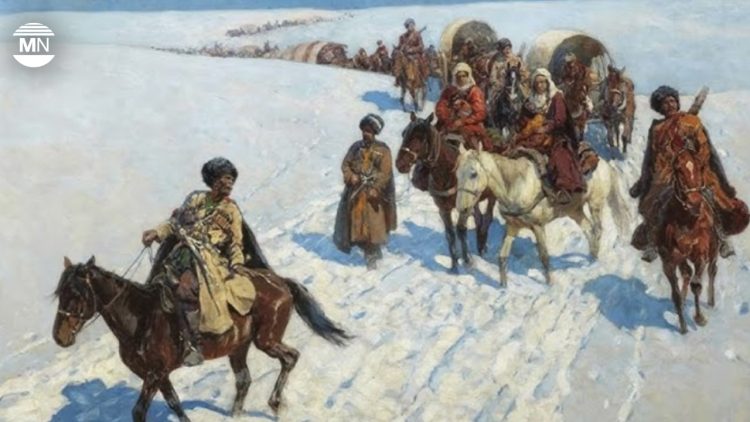
Human rights advocates and pro-Kurdish politicians commemorated the 161st anniversary of the Circassian Genocide and Exile on Wednesday, urging Turkey and the international community to officially recognise the atrocity and address its enduring consequences.
The Circassian Genocide refers to the forced expulsion of approximately 1.5 to 2 million Circassians from their native North Caucasus by Tsarist Russia in 1864. At least 500,000 people perished during the mass deportations due to starvation, disease, and harsh conditions, while survivors faced assimilation pressures in foreign lands—including the Ottoman Empire, where many eventually resettled.
“The Circassian tragedy is not merely a tale of historical conflict but the name of a catastrophe: a planned and systematic attempt to annihilate a people,” said Yüksel Mutlu, Deputy Co-Chair of the Peoples’ Equality and Democracy (DEM) Party, on Wednesday, in a statement on behalf of the party’s Commission on Peoples and Beliefs.
Observed annually as a day of mourning, 21 May marks the fall of the last Circassian resistance forces against Russian colonisation in the Caucasus. Activists consider it a symbol of genocide, forced exile, and cultural erasure.
The Human Rights Association (İHD) in Turkey also issued a powerful appeal, describing the Circassian Genocide as “modern Europe’s first ethnic cleansing and genocide,” and urged global recognition. “The genocide against the Circassian people must be acknowledged. Societies that do not confront their past cannot build a future based on justice,” the statement read.
According to İHD, the Circassian case fits the United Nations’ definition of genocide and should not be subject to a statute of limitations. The group called for memory centres to be established, an official apology to be issued, and reparations for cultural and material losses.
The Circassians, who are predominantly Sunni Muslims, have historically sought to preserve their language, cultural identity, and collective memory despite being scattered across several countries. In Turkey, where hundreds of thousands of Circassians live today, activists are demanding constitutional recognition, the right to learn and use their mother tongue, and the option to return to their ancestral homeland with dual citizenship.
“Their demands are legitimate,” said Mutlu. “Circassians in Turkey contribute to the country’s social and democratic development, and their rights must be upheld.”
Circassian activists and scholars often draw parallels between their plight and other historical atrocities, including the Armenian and Kurdish genocides and the Holocaust. The call for recognition is not merely about historical accuracy but is tied to a broader push for multiculturalism and equality in Turkey and beyond.
“This is not just about Circassians,” said one demonstrator at a memorial in Istanbul. “It’s about building a society where all peoples and cultures can exist freely and equally. Recognition is the first step toward justice.”
While Turkey has not officially recognised the events of 1864 as genocide, Circassian groups continue to lobby at national and international levels. Campaigners say that formal recognition would not only validate their historical suffering but also help protect endangered languages and traditions.
Commemorations took place across Turkey and in the Circassian diaspora, with black ribbons, speeches, traditional music, and moments of silence. Online, the hashtags #CircassianGenocide and #21May were used to spread awareness and demand justice.


