

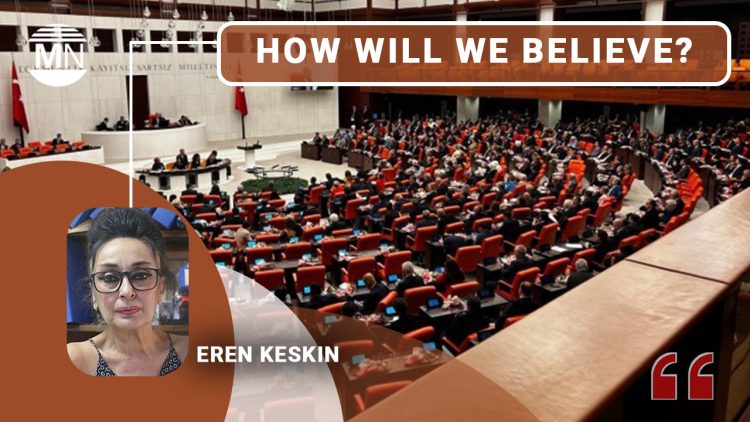
Eren Keskin, a prominent human rights lawyer and co-chair of the Turkish Human Rights Association (İHD), comments on the legal and political context surrounding the recent announcement of a new peace process in Turkey. She highlights the continued imprisonment of political detainees and seriously ill inmates, and recalls previous judicial reform packages that promised progress but were never implemented. Emphasising the importance of concrete state action and genuine political will, Keskin questions how society can be expected to believe in the sincerity of the process.
Keskin’s column, titled ‘How will we believe?’ was first published by Yeni Yaşam Gazetesi on 11 June in Turkish. See below for a full Medya News translation:
Eren Keskin
For some time now, we have been experiencing a new process that has given rise to hopes of peace in society. This process was introduced to the public in a rather superficial manner following a speech by [far-right leader] Devlet Bahçeli in Parliament. Until now, nobody has fully understood what the state intends to do. Abdullah Öcalan, the founder of the PKK [Kurdistan Workers’ Party] — the opposing side in the conflict — has stated that the Kurdish movement will now shift in a new direction, ceasing the armed struggle. The PKK Co-Presidency Council has also announced that it will comply with Öcalan’s call following the congress it convened. This was evidently a highly significant decision.
Today, wars are waged with unmanned aerial vehicles. The nature of armed conflict is changing, with people being killed remotely via phone and both weapons and methods of warfare undergoing complete transformation. As a human rights defender, I believe that it is very meaningful to continue the struggle through civil politics in such a period. As human rights defenders, we have always advocated for an unarmed solution. This is why the decision to bring the armed struggle to an end is of such great importance to our region.
Of course, Kurdistan is spread across four different countries. Developments in one area affect the others. As all of us are aware, the developments in Rojava [Kurdish-led northern Syria] have been the major catalyst for initiating a new state-led process in our region. Regardless of the reason, the beginning of a new peace process is significant. But what is the political will doing during this process?
As we have repeatedly stated, the Republic of Turkey is party to many international treaties and, under Article 90 of its constitution, recognises international law as superior to domestic law. However, it fails to uphold its international commitments and does not act in accordance with its own domestic law either. The Turkish judiciary does not even implement the decisions of the Constitutional Court, the country’s highest judicial authority. In such a context, how can we see a way forward, and how can we place our trust in this process?
It has been suggested that a new judicial process will begin for political prisoners and ill inmates currently in prison. Unfortunately, however, we saw that none of our expectations were met with the new law passed last week. According to data from the country’s Human Rights Association (İHD), there are 1,412 sick prisoners in Turkish prisons, and this figure only includes those known to the İHD.
Many prisoners, especially those convicted of criminal offences, lack awareness of their rights and do not apply to any institution, even when they are terminally ill. In fact, we know that many seriously ill prisoners have not submitted any applications. Perhaps we are also unaware of some political prisoners, due to them being convicted and unreachable by their legal guardians. As such, this figure only reflects those ill inmates that the İHD has been able to reach, some of whom are in an extremely critical condition.
With the new law, the Forensic Medicine Institution, which was previously not a legal requirement, has effectively been made obligatory. We have consistently objected to the Forensic Medicine Institution being the sole authority to document torture and illness because it is an official expert body that is entirely subordinate to political will. For this reason, it often fails to adequately report on the condition of ill prisoners.
Furthermore, even when the Forensic Medicine Institution issues a report, the observation boards established within prisons can disregard these reports by declaring the prisoner to be ‘a danger to society’. Consequently, the new law has introduced no concrete change. In fact, no new law is even needed to release ill prisoners. If the Forensic Medicine Institution certifies their condition, convicted prisoners can be released with a deferred sentence. Detainees can also be released based on a medical report by court decision. If there was the will, this would be an extremely simple process.
Under the new law, the execution of sentences for individuals convicted of repeated offences has been amended, and these individuals have been released. In other words, only criminal offenders with multiple convictions have been released. However, no meaningful or satisfactory releases have yet begun for ill prisoners. As human rights defenders, we are waiting for these releases to take place without further delay.
The governing bodies of the Republic of Turkey have announced judicial reform packages many times. When we look at the 2019 Judicial Reform Package, we see that it promised to fully support freedom of expression and organisation, make detention an exception and ensure that release pending trial would be the norm. Instead, today we are witnessing the exact opposite.
Until ten years ago, we used to hold several press statements in the streets every day as human rights defenders; today, even we are not allowed to make press statements in public. The Saturday Mothers, whose civil disobedience campaign is recognised as one of the most legitimate in the world, can now only carry out their actions with a limit of ten people after being repeatedly taken into custody for a year.
I cannot remember a time when freedom of expression and organisation was under greater pressure, or when arrest decisions were made so recklessly. So what happened to those judicial packages? Why are they not being implemented? As human rights defenders, we have always supported peace processes. However, it is clear how important the steps that the state needs to take are, and how much they could strengthen belief in the process. Convince us.


