

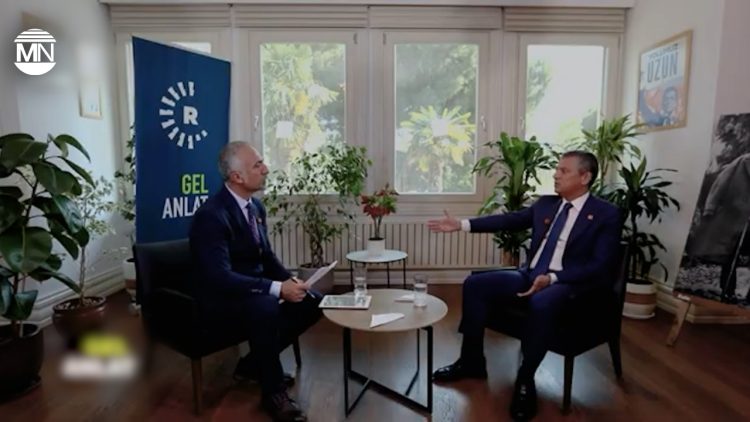
Özgür Özel, leader of Turkey’s main opposition Republican People’s Party (CHP), has called for the creation of a cross-party platform in parliament to address the country’s long-standing Kurdish issue, backing education in the Kurdish language and a more inclusive definition of citizenship.
Speaking on the ‘Gel Anlat’ programme on Rûdaw Türkçe on Saturday, Özel said the CHP supports “a table for solutions, not for confrontation” – where all political parties can take part. “If Kurds say ‘everyone is equal, but I’m less equal,’ that is the problem,” he said.
Özel emphasised the importance of protecting linguistic and cultural rights. “People must be able to speak their mother tongue freely, to produce culture, to do science. Restricting Kurdish language education or treating it as a threat is not the way forward,” he said. “When the violence ends and the bloodshed stops, no one will see Kurdish as a form of propaganda. At that point, the issue disappears.”
The CHP leader said the party has already prepared legislative proposals on justice and democracy, developed by a team of legal and political experts. These were shared with the pro-Kurdish Peoples’ Equality and Democracy (DEM) Party’s co-chairs, who reportedly responded positively.
Özel was sharply critical of the government’s long-standing trustee policy, which sees elected Kurdish mayors replaced by state-appointed officials. Speaking after attending a prison wedding at Silivri Prison, he said: “To spend the happiest day behind bars is deeply saddening. This is not just CHP’s concern—this is an issue of democratic will.”
On the question of political prisoners, Özel reaffirmed his support for their release. “I visited [former Peoples’ Democratic Party, or HDP, co-chair] Selahattin Demirtaş in prison. At the Saraçhane rally, we had the crowd applaud him just as they applauded [İstanbul mayor] Ekrem İmamoğlu. There isn’t a serious divide within our base on this.”
While distancing himself from blanket amnesties, he endorsed legal reforms that would allow for the release of political detainees. He rejected the idea of the same leniency being extended to crimes such as femicide or child abuse.
Özel also commented on discussions around imprisoned Kurdish leader Abdullah Öcalan’s ‘right to hope’—a legal concept referring to the possibility of release after long-term imprisonment. “While Öcalan’s right to hope is debated, they’re preparing Silivri Prison for İmamoğlu. This erodes the very ground on which a rational solution could be built,” he warned.
Turning to regional policy, Özel supported a unified and democratic Syria in which all ethnic and religious groups, including Kurds, Arabs, Turkmens and Druze, are represented constitutionally. He said such a political outcome would benefit Turkey.
“If conflict ends, why shouldn’t someone from Qamishli (Qamişlo) commute to Nusaybin (Nisêbîn) for work like people travel between Kaş and the island of Meis? Peace creates those opportunities,” he said, signalling openness to cross-border cooperation with Kurdish regions in Syria.
On the Democratic Union Party (PYD), which operates in Kurdish-held parts of Syria, Özel said now is not the time for a political opening. “We are a political party within Turkey. An opening with the PYD is not realistic at this stage,” he said. However, he left the door open for future dialogue if violence ends and Syria adopts a democratic constitution.
Regarding Iraq, Özel called for improved relations with the Kurdistan Region. “We support good ties with both Erbil [Hewlêr] and Sulaymaniyah [Silêmanî]. We don’t stand for hostility between brothers,” he said, adding that visits by CHP delegations are in the planning stages.
Reinforcing his support for social cohesion, Özel said defending the rights of Kurds and women was a central duty. “No one has the right to shout over Kurdish identity,” he said. “It is my responsibility to stand up for women’s and Kurds’ rights.”


