

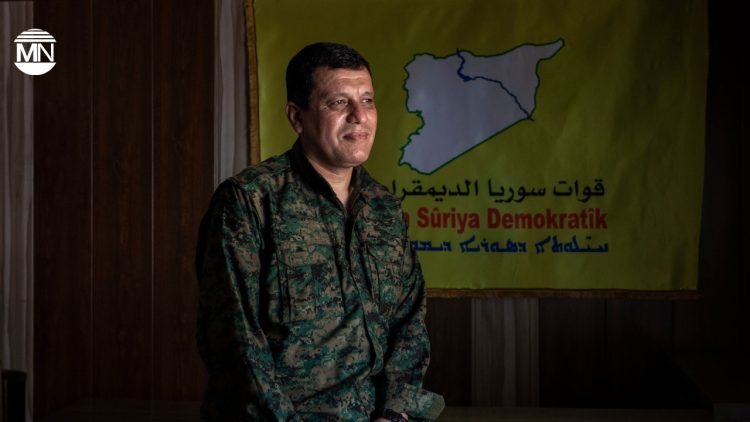
Mazloum Abdi, the commander of the Syrian Democratic Forces (SDF), has confirmed direct talks with Turkish officials and said he is open to meeting President Recep Tayyip Erdoğan, marking a possible shift in long-standing hostilities along the Syrian-Turkish border.
Speaking to the Erbil-based Arabic broadcaster Shams TV on Friday, Abdi said a temporary ceasefire with Turkey had held for over two months and that efforts were under way to establish a permanent agreement. “We have a ceasefire with Turkey that has lasted for two and a half months. It is conditional and temporary, but we hope to turn it into a lasting ceasefire,” he said.
Abdi said both sides were addressing key issues, including border arrangements and Turkey’s security concerns. He also acknowledged that Turkey had prioritised the SDF’s future status and the possibility of integration into the Syrian army. “Turkey has files it wants to resolve, and we are working on those. These include the borders, lines of contact, and discussions around integration with Syrian forces,” he added.
Asked whether he would meet Erdoğan, Abdi responded, “There is currently no plan for such a meeting, but I see no objection. We are not at war with Turkey. The possibility of improved relations exists, and we are prepared for that.”
Abdi linked the current ceasefire to broader political developments, including the recent decision by the Kurdistan Workers’ Party (PKK) to end its armed campaign. “We welcomed the PKK’s decision. It was their own initiative, but it has had an impact on this region. In my view, our ceasefire with Turkey is a result of that process,” he said.
He also discussed political negotiations with the Syrian government, underlining the SDF’s position that any agreement must protect the gains made in North and East Syria over the past decade. “We are not starting from scratch. We reject superficial solutions. Our forces should remain part of an agreed national framework,” he said.
Abdi stressed the need for a decentralised system in Syria that respects the rights of all communities. “We have formed a joint delegation with the Kurdish National Council and the Autonomous Administration to negotiate with Damascus. The rights of all components must be recognised to rebuild Syria. The Kurdish people have been marginalised for decades, and we will not accept a return to that situation,” he said.
This delegation refers to the unified Kurdish front established at the Kurdish Unity Conference in Qamishli (Qamişlo) on 26 April. The conference brought together over 400 representatives from various Kurdish political groups, including the Kurdish National Council (ENKS), the Democratic Union Party (PYD), and the Autonomous Administration of North and East Syria (AANES), to form a collective delegation for negotiations with the Syrian government.
He added that the integration of SDF forces into the Syrian army must be part of a comprehensive political agreement. “This process could take years. We are looking for a formula that allows our forces to remain structured under a national framework that protects decentralisation and the rights of North and East Syria’s peoples,” he said.


