

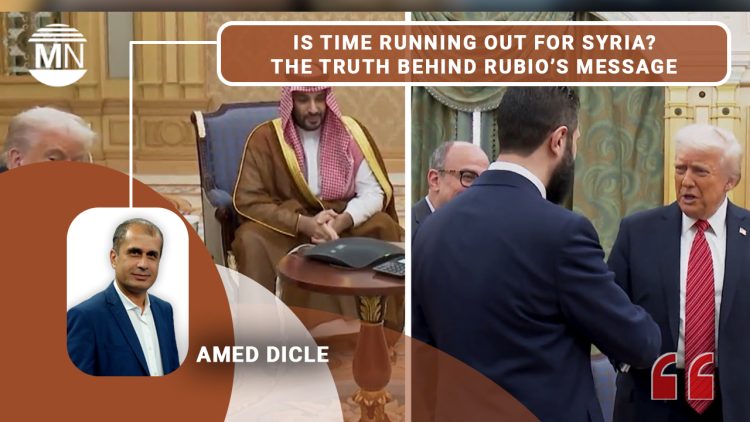
Amed Dicle
Syria is a place where sect, identity and borders forged through betrayal are intertwined. In this country, where the map is drawn in boardrooms and fate is written in the streets, the fatigue of war has now been replaced by the shadow of diplomacy. However, this is not a search for peace, but rather a new reckoning over who will take what. The meeting in Riyadh, shaped by Gulf money, Washington’s plans, the Abraham Accords and the fate of sanctions, marks a period in which powers seeking to reshape Syria are stepping forward. Yes, everyone is at the table, but they are all against each other.
Despite the apparent diplomatic traffic, tensions on the ground in Syria remain high. The attack on the Khmeimim air base, which resulted in the deaths of two Russian soldiers, was not just a military development; it calls into question the future of Russia’s military presence in Syria. Meanwhile, the defection of a senior HTS commander to ISIS highlights the growing fragmentation within the jihadist movement. This division could be the first step towards the US’s “controlled war between jihadist groups” scenario.
Attacks on SDF forces around Tishreen can be seen as an attempt to draw the Kurds into the conflict. However, the SDF successfully repelled these attacks, demonstrating that strategies to provoke clashes are also being employed on the ground.
Riyadh summit: Who will bring Damascus under their influence?
To understand the current situation, we must consider the summit held in Riyadh last week, which was the backdrop to significant diplomatic negotiations. This summit was made possible by the economic agreements that Saudi Arabia made with Trump. Gulf capital knocked on Washington’s door, brought Trump to Riyadh and arranged a meeting with Ahmed Al-Sharaa.
The goal was to draw Damascus away from Ankara’s sphere of influence. It’s a competition: Gulf vs. Turkey. While Saudi Arabia wants to assert its influence over Syria in the Arab world, Turkey is trying to send the message “No decision can be made at this table without me”. Erdoğan joined the summit via teleconference with Trump. However, this participation symbolised Turkey’s diplomatic isolation.
Turkey wants to be at the table, but lacks the resources to lead. It lacks both economic power and restored regional credibility. Gulf capital and Europe (especially Germany and France) are the real financial players shaping Syria’s future. Turkey is ‘included’ in the equation, but not ‘shaping’ it. This is because:
• The political capital invested in Syria has not yielded results.
• The economic crisis has forced it to turn its attention away from domestic priorities.
• Its hostile policy towards the Kurds has brought it into direct conflict with the most dynamic actor on the ground.
Following the Riyadh summit, Trump’s statement that ‘We could include Syria in the Abraham Accords’ revealed that Washington now views Syria as part of its regional integration projects, not just a civil war file. This statement also shows that the new diplomatic approach, shaped by Gulf capital, is gaining legitimacy in Syria with US support.
Al-Sharaa’s receptiveness to this shift indicates that Damascus is willing to align more closely with the Gulf axis. Meanwhile, Washington is operating not through direct influence, but through indirect tools. The US aims to establish a new structure in Syria, positioning actors and allocating roles rather than physically moving pieces on the ground.
In this setup, the roles are clearly defined:
• Saudi Arabia will act as the key player in opening diplomatic and financial channels.
• Turkey is to be kept in a balancing position, using its limited influence on the ground.
• The Kurds are being positioned as key to ensuring security and stability within the system.
However, the most critical hurdle to realising this plan is the US Congress. Heavy sanctions on Syria can only be lifted with their approval. This is where US Secretary of State Marco Rubio’s statement comes into play. While Rubio’s warning from the Congress podium that “Syria could divide soon and the regime could collapse within weeks” may sound alarming, it is actually a calculated persuasion strategy.
It is not a policy of fear; it is a plan to inform decision-making. Rubio’s real message is:
If the Al-Sharaa regime is not supported, radical groups like ISIS will quickly fill the resulting vacuum. The consequences of this scenario would be severe not just for Syria, but for the region and the West. Therefore, keeping Al-Sharaa within the system under specific conditions is presented as the most ‘cost-effective’ way to prevent the rise of radicalism.
Washington’s tactical brilliance lies in attempting to create a transition plan that causes the least possible harm, without either fully exonerating or completely excluding the Damascus regime. This plan is seen as a functional tool for both expanding the Abraham Accords and curbing Iran’s influence.
Rubio’s rhetoric, presented to Congress, is not limited to domestic politics; it also serves to influence international financial and security architecture. If sanctions are not lifted, however, the Gulf’s promised investments and reconstruction projects will remain in limbo. If they are lifted, the US public will need to be informed as to why concessions were made to the regime. Rubio is preparing Congress psychologically to maintain this balance.
However, Al-Sharaa’s diplomacy with the West is plagued by a deep credibility crisis. Agreements with the SDF are not being implemented, and the constitutional draft has been enacted through a centralised system that disregards the decentralising vision proposed by Rojava. The parliament, which is expected to be announced soon, continues this trend. Al-Sharaa is attempting to design the future without addressing the past, but this approach is failing to generate legitimacy within Syria and is not fostering international trust. Furthermore, the insistence on centralisation is creating new divisions, not only with the Kurds, but with other minorities in the country as well.
This situation is narrowing the manoeuvring space not only for Damascus, but also for Ankara. Al-Sharaa’s stance, far from offering a solution, undermines Turkey’s long-held position of ‘opposing the regime’. In Syria, ‘opposing’ is no longer enough; your position in the new balance of power and your associations have become the deciding factor.
Turkey’s way out…
For a long time, Turkey had a visible military presence in Syria and adopted an assertive rhetoric. However, today it finds itself increasingly isolated on the ground and with diminishing influence at the negotiating table. The main reason for this is its combative and short-sighted foreign policy. The temporary partnership it formed with Russia and Iran through the Astana process has collapsed. Its security-based relationship with the US has completely unravelled over the Kurdish issue. Its efforts to shape the Syrian opposition have been unsuccessful, and its engagement with radical groups has led the West to view Turkey as part of the problem. With the deepening economic crisis, Turkey no longer has the financial power to play a key role in the reconstruction process. Gulf money now flows through Riyadh, diplomacy is under Washington’s control, and Europe is engaging with actors that prioritise dialogue with Damascus over Turkey.
Following these developments, Turkey is left with one realistic option: reaching an agreement with the Kurds in Rojava based on status. Unless this step is taken, Turkey will remain excluded from the negotiations and will become a fragile and isolated actor, constantly on the defensive against a legitimate entity just across its border in northern Syria. Such an agreement would offer Turkey security advantages, as well as the opportunity to regain its role as a prominent regional player. Perhaps this is exactly the issue being discussed in Imrali now.
There is no other way.
This article was first published on numedya24 on 22 May.
Amed Dicle was born and raised in Diyarbakır, Turkey. He has worked for Kurdish-language media outlets in Europe, including Roj TV, Sterk TV and ANF. His work has taken him to Rojava, Syria, Iraq and many countries across Europe. Follow him on X (twitter).


