

The pro-Kurdish Peoples’ Equality and Democracy (DEM) Party has called for the establishment of a national truth commission to investigate unresolved cases of enforced disappearance, declaring it a critical step toward lasting peace and democracy in Turkey.
In a statement issued on 17 May, the first day of the “Week of the Disappeared”, the party’s Law and Human Rights Commission said Turkey must confront the legacy of enforced disappearances, particularly those linked to the decades-long Kurdish conflict. The commission said that confronting this history “would be a major step toward building peace and a democratic society.”
The “Week of the Disappeared” has been observed since 1995 by Turkey’s leading rights organisation the Human Rights Association (İHD), and is marked by public vigils and campaigns across Turkey, led most prominently by the Saturday Mothers—a group of relatives of the disappeared who have held weekly sit-ins since May 1995, often outside İstanbul’s Galatasaray High School.
The DEM Party, which has been engaged in political efforts to support a renewed peace process, linked the demand for a truth commission to the latest development in the conflict, in which the armed Kurdistan Workers’ Party (PKK) announced its formal dissolution on 12 May following a appeal for peace from imprisoned Kurdish leader Abdullah Öcalan.
“The reality of enforced disappearances in Turkey dates back to the Ottoman era, but became more prevalent during the recent period of armed conflict,” the DEM Party said. “With the building of a new democratic and peaceful society, confrontation with the past becomes unavoidable.”
Tuncer Bakırhan, co-chair of the DEM Party, echoed this message at a Saturday Mothers’ vigil in İstanbul. “This issue is a bleeding wound in this country. The demands of the families of the disappeared are also our demands,” he said. “If there is to be societal peace, Turkey must confront this issue. Those dark archives must be opened and the truth must be shared with the public.”
He added that such a confrontation would be integral to the broader democratic transformation called for by Öcalan earlier this year. “It is not too much to ask to want a gravestone, a name to remember, a place to pray,” he said.
Pervin Buldan, a member of the İmralı Delegation—a group involved in Kurdish peace negotiations—also addressed the gathering. “If we want a real, honourable peace, it must begin with finding the disappeared and prosecuting those responsible. Otherwise, peace will remain incomplete,” she said.
The DEM Party has further called for Turkey to ratify the UN Convention on the Protection of All Persons from Enforced Disappearance and the Additional Protocols to the Geneva Conventions, and to recognise the jurisdiction of the International Criminal Court. It also urged reforms to the Turkish Penal Code to clearly classify enforced disappearance as a crime against humanity.
The party demanded that restrictions on the gatherings of the Saturday Mothers be lifted and that police barricades be removed from Galatasaray Square to allow free and peaceful assembly.
“The demand to confront the reality of the disappearances is not only about justice for the families,” the party said. “It is a test of Turkey’s commitment to truth, democracy and peace.”
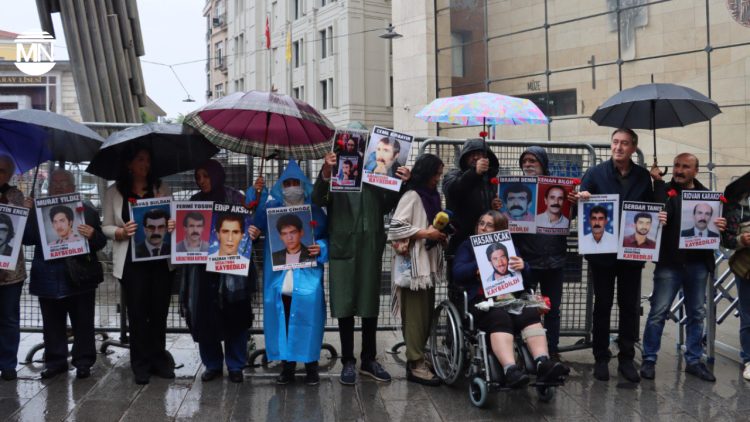
Meanwhile, the Saturday Mothers once again called for truth and accountability for their forcibly disappeared relatives, marking 1,051 weeks of silent protest in İstanbul’s Galatasaray Square. Gathering with carnations and photographs of their loved ones, the group dedicated this week’s vigil to the “Week of the Disappeared” (17–31 May), calling on the Turkish state to confront its legacy of enforced disappearances.
The Saturday Mothers called on the Turkish government to reveal the fate of all disappeared persons, prosecute those responsible, criminalise enforced disappearance under the Penal Code as a crime against humanity, and ratify the UN Convention for the Protection of All Persons from Enforced Disappearance. They also urged the authorities to lift the unconstitutional ban on gatherings in Galatasaray Square.
Maside Ocak, whose brother Hasan was tortured to death in custody, condemned the enduring culture of impunity, saying it continues to fuel human rights violations and obstruct efforts towards democratic reconciliation. “We ask again: Where are our loved ones? Such crimes cannot be subject to statutes of limitation. Enforced disappearances are not just about those who vanish, but the lives of generations left behind in trauma,” she said.
Ocak stressed that truth, justice and official recognition of these crimes are prerequisites for a lasting peace. “This new phase must be accompanied by truth-telling, accountability and human rights. The chance for peace must not be sacrificed to political expediency,” she said. Fellow activist Mikail Kırbayır, whose brother Cemil disappeared in custody, pledged to continue the struggle for justice: “We will not stop until truth and justice prevail.”


