The 12th Congress of the Kurdistan Workers’ Party (PKK) marked a historic turning point by declaring the dissolution of its organisational structure and an official end to its armed struggle. This declaration has created a major political and moral responsibility for the Turkish state and the international community alike. It presents a historic opportunity for Turkey’s democratic transformation and a new chapter in the Kurdish people’s struggle for freedom.
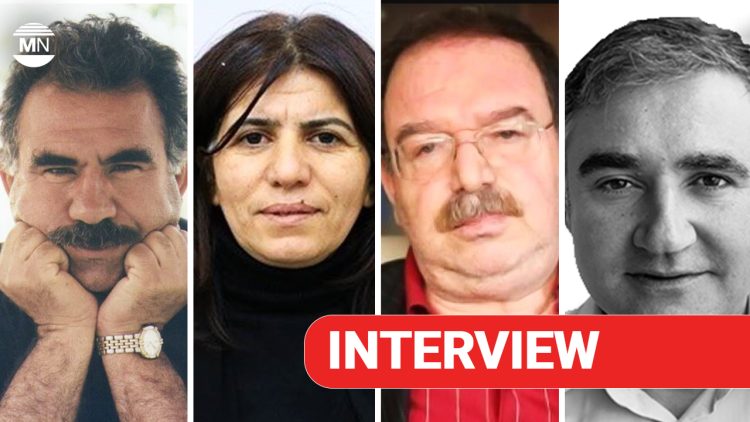
‘Freedom for Öcalan, a Political Solution to the Kurdish Question‘ campaign spokespersons Hatip Dicle, Zübeyde Zümrüt and Sinan Önal spoke to freelance journalist Barış Boyraz, arguing that the time has come to move beyond conflict and denial and to initiate a new phase based on dialogue, recognition, and equal rights — beginning with the release of Abdullah Öcalan after 26 years in isolation on the Turkish prison island of Imrali.
This interview was first published on 14 May by Firat News, which has closely followed the developments of the global campaign for Öcalan’s freedom and a political solution to the Kurdish question.
What should Turkey do after the PKK’s congress decision to end their armed struggle?
First and foremost, Kurdish people’s leader Abdullah Öcalan must be physically freed, and his health and safety guaranteed so he can participate freely in legal and democratic politics. Öcalan’s role is vital for a just and lasting peace. His negotiating skills, ability to bridge communities, and persistent peace calls have inspired today’s transformation.
Turkey must now take political and legal steps to establish a negotiation framework and implement legal reforms that recognise Kurdish rights. The success of this process depends directly on equal citizenship rights enshrined in a democratic constitution.
To enable progress, the European Union and all states must immediately remove the PKK from terrorist lists. This outdated classification is incompatible with the organisation’s new direction and obstructs peace efforts. European states must pressure Turkey diplomatically and pass laws in their own parliaments supporting this transformation.
Kurdish politics will continue to prioritise democratic engagement, diplomacy, and social solidarity. Symbolic gestures are not enough — concrete legal and political changes are essential for credibility.
European states should support legitimate Kurdish demands and provide legal mechanisms for a solution beyond militarism. This is a historic chance to transition to dialogue, justice, and democracy. For the Kurdish people, it must be seen as a spring of freedom — and for Turkey, a spring of democracy. This peace call rising from the heart of the Middle East is decisive not just for Turkey, but also for regional peace and stability.
At what stage is the global campaign, and what are its goals now?
We are now in the third phase of our campaign. The first phase began in October 2023 and lasted until November 2024, with press conferences in over 70 countries and 120 major cities. These included public readings of Öcalan’s books and discussions on how his Democratic Confederalism paradigm offers solutions to the world’s pressing crises.
The second phase ran from November 2024 to this year’s Newroz. In all parts of Kurdistan — Rojhilat, Rojava, Başûr, and Bakûr — and across Europe and other continents, millions of Kurds and their allies celebrated Newroz as a global freedom day, calling for Öcalan’s release.
Now, we are in the third phase, launched after Öcalan’s 27 February ‘Call for Peace and Democratic Society’. This was not just a text but a roadmap and political vision for the democratic resolution of the Kurdish question. Despite 26 years of harsh isolation, Öcalan’s call sent a powerful message of freedom and peace — warmly received across Turkish society, the region, and international civil society.
The 2025 Newroz echoed this call, showing the public’s growing belief in peace. Now it is time to respond to the call and initiate democratic reforms. The first step is Öcalan’s release, allowing his ideas to be discussed and applied in public political life.
Legal experts highlight the “right to hope”. The Council of Europe set a firm deadline of September 2025 for Turkey to reform its aggravated life sentence system.
Our campaign also aims for the release of all political prisoners. Our work will intensify both inside Turkey and internationally. This campaign is laying the foundation for a new democratic process.
How are international mechanisms, like the Council of Europe, engaging with this process?
The Council of Europe’s Parliamentary Assembly will reconvene at the end of June in Strasbourg. During this 86th session, we’ll push again — through relevant rapporteurs and political groups — for urgent reform regarding the “right to hope” and those sentenced to aggravated life imprisonment.
European institutions must take concrete steps and ensure Turkey meets its obligations. The European Parliament recently welcomed Öcalan’s 27 February peace call in its Turkey report, advising Turkey to respond. This signals growing institutional awareness of the Kurdish question and expectations for a solution.
Meanwhile, the Committee for the Prevention of Torture (CPT) has still not released its report from a visit to İmralı 2.5 years ago. Despite visiting Turkey again recently, it failed to go to İmralı — raising serious concerns. Legal and human rights groups continue to press the matter. Institutions failing to fulfil their legal and ethical responsibilities risk losing public trust.
Last year, as part of our campaign, dozens of intellectuals and 69 Nobel laureates sent letters to the Council of Europe, its Committee of Ministers, and the CPT demanding an end to Öcalan’s total isolation. While responses acknowledged the issue, we now plan to launch a new global letter campaign with the slogan “I want to meet with Öcalan”. This campaign gives voice to the global public’s commitment to peace and freedom.
What kind of public ground for peace exists in Turkey today?
Today, there is a strong will for peace across Turkish society. The public response following the death of Sırrı Süreyya Önder — expressed through condolence visits and statements — has shown that the demand for peace is now voiced openly and fearlessly.
Peace is now as essential as bread and water in Turkey. Artists, academics, workers, farmers, and youth are speaking up in unity. The conditions for peace are well-known from global examples: equal negotiations, participation of civil society and political actors, a free press, and constitutional reforms.
Turkey can build a new peace process by learning from past experiences. Taking steps to release Öcalan and begin democratic transformation is vital. Despite enduring the harshest conditions for 26 years, Öcalan has never wavered from peace. His release would provide the foundation for a credible and inclusive peace process.
Nelson Mandela’s negotiations with the De Klerk government in South Africa provide an inspiring example: upon Mandela’s release, the country began to democratise and Black South Africans gained self-determination.
Similarly, peace and democracy can progress hand in hand in Turkey. This will require broad consensus and collective effort.
Our campaign will continue to encourage Turkey to take courageous steps and keep the peace agenda alive. We will fight resolutely for a new social contract where everyone has responsibility and voice.