

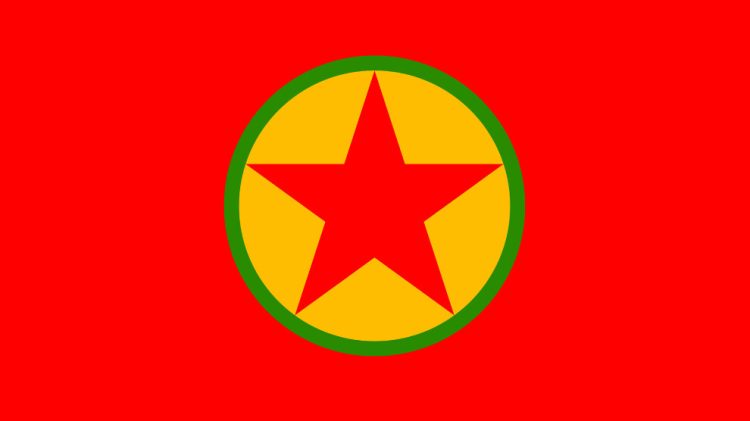
The Kurdistan Workers’ Party (PKK) has formally dissolved its organisation and declared the end of its armed insurgency, marking a historic shift in the Kurdish movement’s strategy after more than four decades of conflict.
In a final statement released on 12 May following its 12th Congress, the PKK said it had “fulfilled its historic mission” and would cease all activities under its current structure. The group announced that the “practical implementation” of the transition will be led by Abdullah Öcalan, the imprisoned PKK leader, in alignment with his February 2025 ‘Call for Peace and Democratic Society’.
The declaration calls on Turkey’s parliament to play a “historic role” by facilitating legal and political reforms, including the recognition of Öcalan’s role, guarantees for Kurdish rights, and amnesties for political prisoners.
The group also introduced a new political framework, ‘Democratic Society Socialism’, which centres on gender equality, ecology and local governance, and rejects traditional state-based socialism.
The congress was dedicated to late PKK figures Ali Haydar Kaytan and Rıza Altun, whose deaths were officially announced for the first time in the PKK’s statement. The PKK also reaffirmed a commitment to the peace legacy of recently deceased parliamentarian Sırrı Süreyya Önder.
The PKK’s dissolution ends one of the region’s longest-running insurgencies. The path ahead, however, now depends on the Turkish state’s response and willingness to engage in a reciprocal peace process.
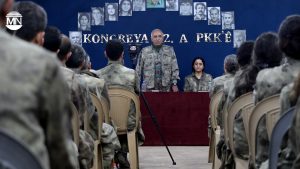
The full text of the declaration issued is given below:
Final declaration of the Extraordinary 12th Congress of the PKK
The process initiated by Leader Abdullah Öcalan’s statement on 27 February has culminated successfully with the completion of our 12th Party Congress, held from 5-7 May, guided by his multifaceted efforts and the perspectives he presented in various forms.
Our Congress was conducted securely despite challenging conditions, including ongoing conflicts, relentless air and ground attacks, the encirclement of our areas, and a continued embargo by the KDP [Kurdistan Democratic Party]. For security reasons, it was held simultaneously in two separate locations. With the participation of a total of 232 delegates, the 12th Congress of the PKK discussed the themes Leadership, Martyrs, Fighters and Veterans, the Organisational Existence and PKK Method of Armed Struggle, and the Construction of a Democratic Society, making historic decisions that mark the beginning of a new era for our Freedom Movement.
Activities conducted under the PKK name have been terminated
The PKK’s Extraordinary 12th Congress made the evaluation that the struggle of the PKK has shattered the politics of denial and annihilation imposed on our people, brought the Kurdish issue to the point of resolution through democratic political means, and, in this regard, has fulfilled its historic mission. On this basis, the PKK’s 12th Congress decided to dissolve the organisational structure of the PKK and terminate the method of armed struggle, with the practical implementation process to be managed and executed by Leader Apo [Öcalan], thereby ending all activities conducted under the name of the PKK.
Our Party, the PKK, emerged on the historical stage as the freedom movement of our people in response to the politics of Kurdish denial and annihilation rooted in the Treaty of Lausanne and the Constitution of 1924. At its inception, it was influenced by real socialism and adopted the principle of the right of nations to self-determination, waging a legitimate and just struggle based on the strategy of armed struggle. The PKK was shaped under conditions dominated by rigid denial of the Kurds, policies of annihilation and practices of genocide and assimilation. Beginning in 1978, through its freedom struggle, it succeeded in asserting Kurdish existence and establishing the Kurdish issue as a fundamental reality of Turkey. Through the struggle it successfully waged, it achieved a revival revolution on behalf of our people, becoming a symbol of hope for freedom and the pursuit of a dignified life for the peoples of the region.
In the 1990s, under conditions where our revival revolution led to significant developments for our people, the [then] President of the Republic of Turkey, Turgut Özal, pursued efforts to resolve the Kurdish issue through political means. Leader Apo responded to this pursuit by declaring a ceasefire on 17 March 1993, initiating a new process. However, the heavy influence of real socialism, the imposition of gang-like mentalities on our war strategy, and the elimination by the deep state of Turgut Özal and his team, coupled with its insistence on the politics of Kurdish denial and annihilation, escalated the war and sabotaged this new process. Thousands of villages were evacuated and burned. Millions of Kurds were displaced from their homes, tens of thousands were subjected to torture and imprisoned and thousands were murdered in extrajudicial killings. In response, the Freedom Movement grew both quantitatively and qualitatively, and guerrilla warfare spread across Kurdistan and Turkey. Under the impact of the guerrilla’s war, the Kurdish people rose in serhildans (uprisings). Thus, war became the primary option for both sides. The escalation of the war by both parties created a cycle that could not be overcome. Consequently, Leader Apo’s efforts to resolve the Kurdish issue through democratic and peaceful means remained fruitless.
Rearrangement of Kurdish-Turkish relations is inevitable
The process entered a new phase with the international conspiracy of 15 February 1999. During this period, the Kurdish-Turkish war, a significant objective of the conspiracy, was prevented thanks to the immense sacrifices and efforts of Leader Apo. Despite being held in the İmralı torture and genocide system, he persisted in his commitment to resolving the Kurdish issue through democratic and peaceful means. For 27 years, Leader Apo, held in absolute isolation, has resisted the İmralı genocide system, thwarting the international conspiracy. In the struggle against the international conspiracy, he analysed the male-dominated, power-centric, statist system and developed the paradigm of a democratic, ecological and women’s liberation-oriented society. In doing so, he concretised an alternative freedom system for our people, for women and for oppressed humanity.
Taking as reference the period before the Lausanne Treaty and the 1924 Constitution, which problematised Kurdish-Turkish relations, Leader Apo adopted the perspective of a Common Homeland and a Democratic Republic of Turkey, with Kurdish and Turkish peoples as founding elements, alongside the concept of a Democratic Nation, as the framework for resolving the Kurdish issue. The Kurdish rebellions throughout the history of the Republic, the 1,000-year dialectic of Kurdish-Turkish relations, and the 52-year struggle of Leader Apo have demonstrated that the Kurdish issue can only be resolved on the basis of a Common Homeland and Equal Citizenship. Current developments in the Middle East within the context of the Third World War further make the rearrangement of Kurdish-Turkish relations inevitable.
Our people will understand the dissolution of the PKK and the termination of the armed struggle better than anyone, and will embrace the tasks of the era
Our honourable people, who have participated in the 52-year march of the Leadership and the PKK at great cost, resisting the politics of denial and annihilation, genocide and assimilation, will embrace the process of peace and democratic society with greater awareness and organisation. We have full confidence that our people will better understand the decision to dissolve the PKK and terminate the method of the armed struggle, and will take ownership of the tasks of this era of democratic struggle based on the construction of a democratic society. It is of vital importance that our people, led by women and the youth, establish their own organisations in all areas of life, organise on the basis of self-sufficiency with their language, identity and culture, become capable of self-defence against attacks, and build a communal democratic society with a spirit of mobilisation. On this basis, we believe that Kurdish political parties, democratic organisations and opinion leaders will fulfil their responsibilities to develop Kurdish democracy and achieve Kurdish democratic nationhood.
The legacy of our history of freedom, marked by struggle and resistance, will grow stronger through the decisions of the 12th Congress of the PKK, employing the method of democratic politics, and the future of our peoples will develop on the basis of freedom and equality. Our poor and working-class peoples, all faith groups, women, youth, workers, peasants and all sectors excluded from power will defend their rights in the process of peace and democratic society, fostering a shared life in a democratic and just environment.
We call on everyone to join the process towards peace and democratic society
The decision of our Congress to dissolve the PKK and terminate the method of armed struggle provides a strong foundation for lasting peace and a democratic solution. The implementation of these decisions requires Leader Apo to lead and guide the process, the recognition of the right to democratic politics and a robust, comprehensive legal guarantee. At this stage, it is crucial for the Grand National Assembly of Turkey to fulfil its historic responsibility. Likewise, we call on all political parties represented in the parliament, starting with the government and the main opposition party, as well as civil society organisations, religious and faith communities, democratic media outlets, opinion leaders, intellectuals, academics, artists, worker and labourer unions, women’s and youth organisations and ecological movements to take responsibility and participate in the process of peace and democratic society.
The embracing of the Peace and Democratic Society process by Turkey’s left-socialist forces, revolutionary structures, organisations and individuals will elevate the struggle of peoples, women and the oppressed to a new level. This will mean achieving the goals of the great revolutionaries whose final words were, “Long live the brotherhood of Turkish and Kurdish peoples and a fully independent Turkey!”
The process of Peace and Democratic Society and the struggle for socialism, represented by a new phase of Democratic Society Socialism, will foster a global democracy movement, creating a just and equal world. On this basis, we call on the democratic public, particularly our friends leading the Global Freedom Initiative, to fortify international solidarity within the framework of the theory of democratic modernity.
We invite international powers to acknowledge their responsibility for the century-long policies of genocide against our people, to refrain from obstructing a democratic solution and to make constructive contributions to the process.
We announce the martyrdom of comrades Ali Haydar Kaytan and Rıza Altun
Our PKK’s 12th Congress, convened at the call of our Leadership, has announced the martyrdom of our Party’s leading cadres, Fuat, aka Ali Haydar Kaytan, who fell on 3 July 2018, and Rıza Altun, who fell on 25 September 2019. The PKK recognises Comrade Fuat, aka Ali Haydar Kaytan, a founding leading cadre, as a symbol of “Loyalty to Leadership, Truth and Sacred Life”, and Comrade Rıza Altun, one of Leader Apo’s first companions, as a symbol of “The Camaraderie of Freedom”. We dedicate our historic 12th Party Congress to these two great martyr comrades, who have led us with their uninterrupted struggle from the start of our Freedom Movement, reaffirm in their names our pledge of success to all the martyrs of our struggle, and assert our determination to realise the dreams of the Martyr to Peace and Democracy, Comrade Sırrı Süreyya Önder.
Nation-state socialism leads to defeat; Democratic Society Socialism leads to victory!
Persistence in humanity is persistence in socialism!
Long Live Leader Apo!


