

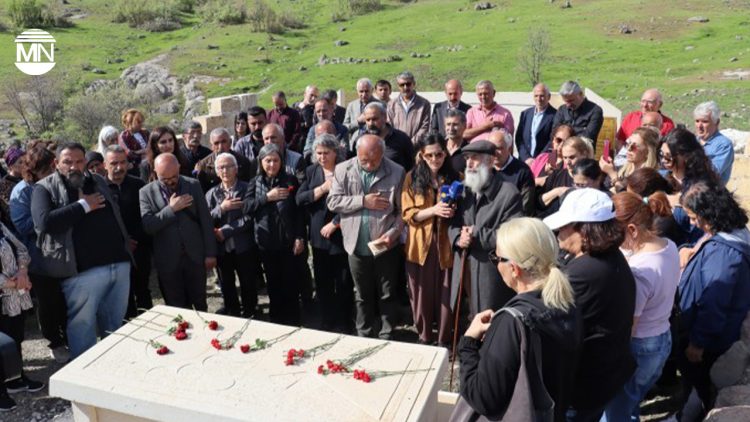
Commemorations were held across Turkey on Saturday to mark the 88th anniversary of the Dersim massacre, a 1937–38 military campaign in eastern Turkey that led to the mass killing, forced displacement and cultural repression of thousands of people, predominantly Kurdish Alevis.
One of the main ceremonies took place in the village of Bargini in Hozat (Xozat) district, Dersim (officially Tunceli), where 24 members of the Baran and Canan families were killed and buried in a mass grave in the Sekasur area. Representatives from the Democratic Alevi Associations (DAD), the Peoples’ Equality and Democracy (DEM) Party and local civil platforms gathered together with local residents for a memorial, lighting çerax (ritual candles) and recounting oral histories of the massacre.
The original name of the province, “Dersim or Dêrsim”, meaning “silver door” in Kurdish/Zazaki (der = door, sim = silver), holds deep cultural significance for locals and remains a point of contention since its replacement with the Turkish name “Tunceli” (tunç – bronze, el = fist) in 1935 to reflect the state’s domination over the region. Alevi and Kurdish groups reject “Tunceli” as a symbol of cultural erasure, demanding the restoration of the name “Dersim”. In 2019, Tunceli’s Municipal Council, led by Mayor Fatih Mehmet Maçoğlu of the Communist Party of Turkey, voted to reinstate the name “Dersim” and offer services in the Zazaki and Kurmanji dialects of Kurdish to honour local identities. However, a regional court overturned this decision following a complaint from the Governor of Tunceli, reflecting the Turkish state’s ongoing push for a Sunni Turkish identity.
Local elder İnanç Dolu related how soldiers deceived the villagers in August 1938 on the pretext of an operation relating to the census, only to detain and kill them. “When they approached the military station, they saw soldiers crushing the head of 90-year-old Mother Xecê with stones. That was when they realised a massacre was taking place,” he said.
Bones were later discovered under stones in Sekasur during a 2014 site preservation effort, but local prosecutors dropped an investigation initiated into the remains. Activists and local families have since built a memorial at the site with the support of civil society groups.
Speaking at the event, Democratic Islam Congress representative Emin Ay said, “The people of Dersim resisted and held onto their land, language and culture in spite of the genocide.” DAD co-chair Kadriye Doğan drew attention to ongoing massacres of Alawites* (both Alevis and Alawites are followers of Imam Ali, though most Alevis live in Turkey and are predominantly Kurdish, while most Alawites live in the Levant and are predominantly Arabs) in Syria and said, “This persecution never ended. We must unite against it.”
Alevi leaders, including Alirıza Bilir of the Federation of Dersim Associations (DEDEF), Cuma Erçe of the Pir Sultan Abdal Association and Zeynel Kete of the DAD, reiterated long-standing demands for the Turkish government to disclose the burial sites of those executed, return the historical name “Dêrsim”, and open state archives.
“This massacre wasn’t only a physical extermination but a calculated campaign to destroy cultural and religious identity,” said Bilir. “As long as this history is not confronted, there can be no democracy in Turkey,” added Erçe.
The commemorations also honoured Sırrı Süreyya Önder, the Peoples’ Equality and Democracy (DEM) Party MP and a member of the İmralı delegation in Kurdish peace talks, who died the previous day.
* Both Alevis and Alawites revere Imam Ali, but their beliefs, practices and historical development differ significantly. Alevis, primarily in Turkey, include Kurds and Turks, and make up up to 10–20% of the country’s population. Practices vary regionally, from Bektashi Sufi influences to oral culture and local spiritual lineages. Alawites are mainly concentrated in the Levant and are predominantly Arab. While Alevism reflects a broad spectrum of regional and ethnic traditions, Alawite practices are rooted in Shia Islam and Levantine customs.


