

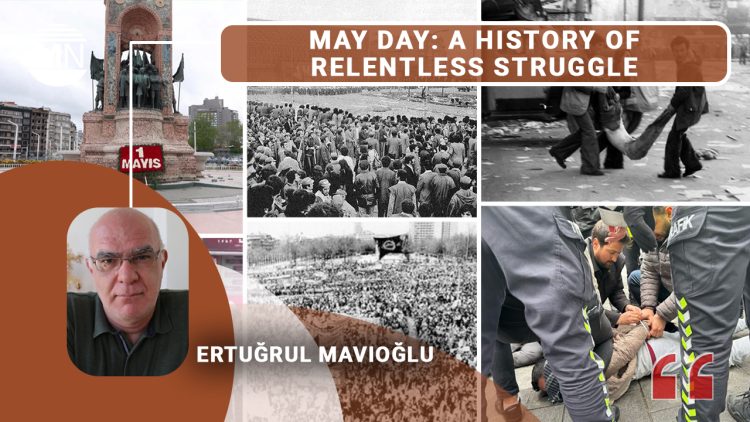
Ertuğrul Mavioğlu
In many countries around the world, May Day is celebrated in a festive spirit. In Turkey, however, it has become synonymous with massacres, heavy police violence, or outright bans. Indeed, the origins of 1 May in Turkey are also rooted in bloodshed.
The reason 1 May was declared the day of workers’ unity, solidarity, and struggle by the Second International was the workers’ uprising in Chicago of the United States of America (USA) on 1 May 1886, when labourers demanded an eight-hour working day—a protest brutally suppressed by the state.
The first example of this decision by the Second International was the May Day rally held in Thessaloniki of Greece in 1911 by tobacco, port, and cotton workers.
In Istanbul, May Day was celebrated for the first time in 1912. While some sporadic workers’ actions continued in subsequent years, these activities remained rather muted under the shadow of the First World War. Notably, in 1921, despite bans imposed by the occupying forces in Istanbul, a May Day rally was still held.
Following the proclamation of the Turkish Republic in 1923, May Day was legally recognised as “Labour Day”—but already by 1924, mass celebrations were banned.
Using the Sheikh Said rebellion as a pretext, the Turkish state launched annihilation and genocide campaigns against the Kurds, and on 4 March 1925, with the enactment of the Law on the Maintenance of Order, strikes, unions, and demonstrations were banned. Thus, May Day was completely outlawed.
In the years that followed, May Day celebrations took place under strict state control. For example, a 1 May 1930 article in Cumhuriyet newspaper detailed police precautions, while a 2 May 1933 article in Vakit noted the day had passed quietly—revealing much about May Day in those years.
From workers’s day of struggle to a spring festival
By 1935, the Turkish state made a cunning move, declaring 1 May a public holiday under the guise of a “Spring Festival.” The state aimed to encourage outings into the countryside, picnics, and the erasure of workers’ day of unity, solidarity, and struggle from collective memory.
Authorities identified those seeking to celebrate 1 May in its true meaning, arresting them from their homes the night before and holding them in prison until the day had passed.
After 1935, one of the primary justifications for the long-running communist arrests was celebrating 1 May as Labour Day.
After this long period, 1 May was celebrated en masse for the first time in 1976 in Taksim Square. Organised by The Confederation of Revolutionary Workers Unions (DISK), hundreds of thousands of workers, intellectuals, and youth gathered. The enormous crowd in Taksim in 1976 struck fear into the heart of the state.
1 May 1977: The counter-guerilla massacre at Taksim
On 1 May 1977, another rally organised by DISK in Taksim, drawing nearly 500,000 workers, turned bloody when counter-guerrilla forces staged a provocation.
Twenty-eight people were crushed or suffocated in the ensuing panic from gunfire and police stun grenades, five were shot dead, and one was crushed under an armoured vehicle—a total of 34 people lost their lives.
The perpetrators of the 1977 massacre were known, but they were never prosecuted or punished. The state covered up the massacre, shielding the culprits in its deep shadows.
Despite the bloodshed of 1977, workers returned to Taksim in 1978, once again in their hundreds of thousands.
After the 1978 rally, Taksim Square was banned to workers. In 1979, May Day rallies were held in other provinces while Istanbul was placed under curfew.
12 September 1980 coup d’etat: Even breathing was banned
In 1980, May Day was once again banned in Istanbul. Following the 12 September fascist military coup, the banning policy intensified.
The junta led by Kenan Evren not only banned May Day but also abolished the official “Spring and Flower Festival” holiday. DISK was among the first institutions targeted: its offices were shut, leaders arrested and tortured. Strikes were banned; a manhunt was launched for leading workers.
For years, Kurds, youth, workers, women, even the elderly and children were subjected to the junta’s murders, oppression, detentions, torture, imprisonment, and even executions. The May Day bans imposed by the coup persisted for years.
In 1988, despite efforts by some union leaders, May Day celebrations were blocked by the government.
Kenan Evren was gone; Turgut Özal was in power—but no improvement came for workers’ rights and freedoms.
In 1989, as socialist groups grew among the youth and the working class launched a spring of resistance after long years under the junta, a new opportunity for May Day emerged. Crowds marched towards Taksim, refusing to be locked out of the squares. But police drew their guns and attacked ferociously.
During this brutal assault, 18-year-old revolutionary worker Mehmet Akif Dalcı was killed by police bullets. Many were injured, detained, tortured. Police even attacked Dalcı’s funeral on 4 May 1989, injuring many mourners. The police officer who shot Dalcı, Mehmet Kazım Çakmakçı, was later assassinated by the Revolutionary Left organisation.
Everywhere is Taksim, everywhere is resistance!
In 1996, with Taksim still banned, tens of thousands gathered in Kadıköy disctrict of Istanbul for May Day.
When police opened fire in the early minutes of the demonstration, three people were killed, sparking a massive rebellion.
In 2006, May Day was celebrated in Kadıköy; in 2007, groups attempting to return to Taksim faced police attacks once again. Due to mounting social pressure, the AKP government was forced in 2008 to declare 1 May “Labour and Solidarity Day.” Yet Erdoğan’s duplicity quickly became evident.
Taksim remained closed; in 2008, police attacked unions marching towards the square. Police threw tear gas into DISK headquarters and other leftist institutions. Many were injured by gas and police beatings. In April 2009, 1 May was finally declared a public holiday again—yet Taksim remained banned. DISK and others continued their determination to march.
In 2010, 2011, and 2012, May Day was once again celebrated in Taksim Square.
In 2013, under the pretext of a pedestrianisation project, the AKP government shut down Taksim to all demonstrations. Police attacked groups attempting to enter Taksim.
During the Gezi uprising, Taksim was liberated by crowds for 19 days—only to be banned again afterwards.
In 2020, May Day was held in Maltepe Square, while union leaders trying to march to Taksim were detained.
In 2021, amid the Covid-19 pandemic, 212 people were arrested for attempting to reach Taksim.
In 2022 and 2023, May Day rallies took place in Maltepe; socialist groups attempting to enter Taksim faced mass arrests.
In 2024, groups gathering in Saraçhane and attempting to march to Taksim were blocked by police barricades.
Police attacked those trying to break through with pepper spray and water cannons.
After the celebrations, 74 people were detained.
The 2025 May Day in Istanbul starkly illustrated the enduring struggle for workers’ rights and democratic freedoms in Turkey. Despite a longstanding ban on gatherings in Taksim Square, thousands of demonstrators attempted to march towards the iconic site, symbolizing resistance against state repression. The government’s response was swift and forceful: over 50,000 police officers were deployed, public transportation was halted, and more than 400 individuals were detained for participating in unauthorized protests . These events unfolded amidst heightened political tensions following the recent arrest of Istanbul’s mayor, Ekrem İmamoğlu, a prominent opposition figure . This year’s May Day serves as a poignant reminder of the resilience of Turkey’s labour movement and the ongoing quest for democratic expression in the face of authoritarian constraints.
Throughout history, workers, youth, and women—who faced hostile attacks from every regime yet refused to bow—have never stopped fighting to make May Day free.
Ertuğrul Mavioğlu is a journalist, author, and contributor to Medya News. He was imprisoned from 1980 to 1991 for opposing the 1980 military coup in Turkey. Active in journalism since 1985, he has published eight books. Mavioğlu faces ongoing legal challenges over his 2013 documentary ‘Bakur’, filmed in Kurdish guerrilla camps. His latest work, ‘Bakur Notes’, was released in 2013.


