

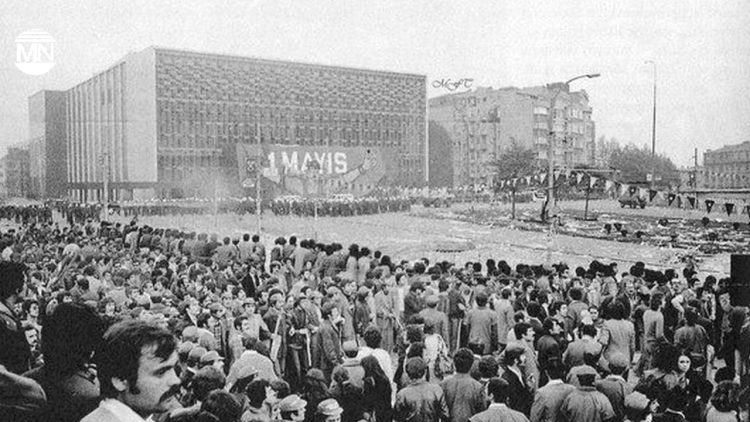
“Justice has remained out of reach – almost invisible,” journalist Tuğçe Yılmaz wrote an article for Bianet on Wednesday, marking the five-year anniversary of her investigation into the 1 May 1977 massacre in İstanbul’s Taksim Square.
During the 1977 Labour Day celebrations at Taksim, gunfire erupted and panic followed. At least 34 people were killed. Nearly half a century later, no one has been held accountable.
Yılmaz reflected on five years of research, interviews and grief, underscoring how impunity has become embedded in Turkey’s political and legal culture. “Impunity is not just a legal term in this country,” she wrote. “It’s a state of mind, a way of governing, and a deeply rooted societal reality.”
Among the victims was 18-year-old university student Sibel Açıkalın, who was crushed to death during the chaos. “She dreamed of a democratic and just country,” Yılmaz wrote, noting that Sibel was part of her university’s student association and joined the rally with hope, not fear.
Yılmaz’s investigation began in 2020, when human rights lawyer Hatice Can connected her with Sibel’s cousin, Cihat Açıkalın. Can and her husband Mithat, also a rights defender, both died in the 6 February 2023 earthquake. “Their son Eren waited for days by the rubble. No rescue team arrived in time. No state authority took responsibility,” Yılmaz recounted. “Their deaths, like those of 1 May, went unpunished.”
Through years of meticulous work, Yılmaz managed to contact relatives of 27 victims. Despite missing archives, state denial, and silenced records following the 1980 military coup, the stories survived through collective memory. “These people are no longer just numbers,” she wrote. “Listening to their stories is the only way to rebuild a collective memory and imagine a more just society.”
Today, many families commemorate their losses by publishing newspaper notices every 1 May. Media outlets Evrensel and BirGün continue to support their efforts.
Yılmaz concluded her reflection with a renewed demand: “The real perpetrators of 1 May 1977 must be prosecuted. Because Turkey is still living under the shadow of a dark past. And yes, Taksim must be a 1 May square again.”
The article arrives amid broader conversations in Turkey about historical justice and state violence. Victims of events like the 1977 massacre, the 1980 coup, and recent natural disasters remain largely unacknowledged by official institutions.
For families such as the Açıkalıns, and journalists like Yılmaz, the pursuit of truth continues not just as a matter of remembrance, but as a political act. “Their trust in me became a lasting bond,” she said. “It left me with a deeper, perhaps more fragile sense of responsibility.”


