

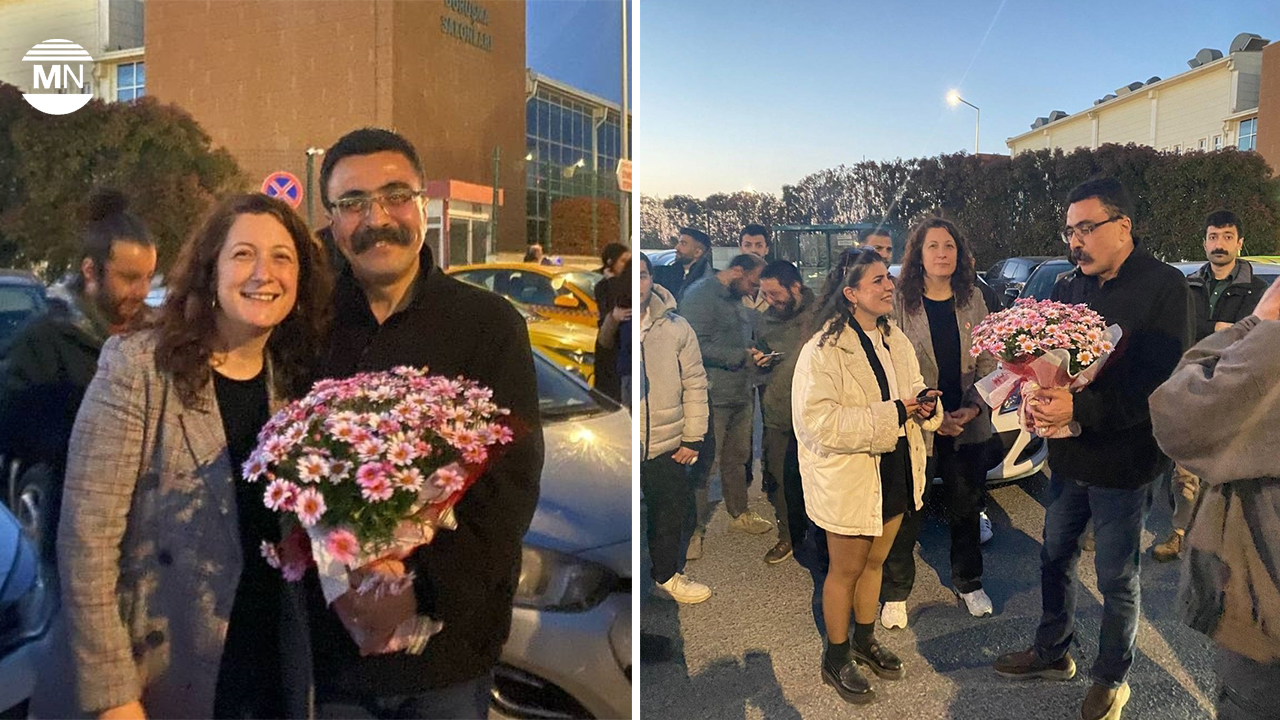
Turkey’s prominent human rights lawyer Selçuk Kozağaçlı was released from İstanbul’s Marmara Prison on Wednesday evening after spending more than seven years behind bars on terror-related charges that international organisations condemned as politically motivated.
Kozağaçlı, honorary chair of the Progressive Lawyers’ Association (ÇHD), was jailed in 2017 over accusations of membership and leadership of a banned Marxist-Leninist group, the Revolutionary People’s Liberation Party/Front (DHKP-C). His release comes amid a continuing retrial, with prosecutors still seeking up to 30 years in prison.
Upon walking free, Kozağaçlı was greeted with flowers by supporters and members of the ÇHD, a group known for defending workers, environmental activists, and victims of state violence.
In an emotional address outside the prison gates, he recalled fellow detainees still behind bars, including lawyer Ebru Timtik, who died during a hunger strike in 2020 demanding a fair trial. “I thought of Ebru with every step. We will continue the struggle from where she left off,” he said.
In his first public statement, he wrote: “The struggle continues relentlessly, whether in prison or outside, and it will continue. The harm done to us will come to an end, the oppression will stop. Together, we will create a life of dignity. We are right! We will win!”
Kozağaçlı’s release follows years of criticism from international legal and human rights groups, who argued he was being punished not for violence, but for defending politically sensitive clients. These included the families of miners killed in the 2014 Soma disaster, hunger-striking educators Nuriye Gülmen and Semih Özakça, and residents resisting environmentally harmful dam projects.
The initial indictment against Kozağaçlı and 19 other lawyers was filed in 2013, with several defendants detained after raids on their offices. A second case followed in 2019, with 18 lawyers sentenced to a total of 159 years in prison. In 2020, Turkey’s Court of Cassation overturned part of that ruling, prompting a retrial.
In 2022, Kozağaçlı was sentenced to 11 years and 3 months for “membership in a terrorist organisation” in one of the ongoing trials. Meanwhile, the prosecution requested up to 30 years on separate charges of leadership. On Wednesday, the court ruled to release him pending the continuation of proceedings.
Groups such as the Council of Bars and Law Societies of Europe (CCBE) and Amnesty International have repeatedly called for Kozağaçlı’s release, citing his role as a legal representative, not a militant. “His imprisonment represents a grave threat to the independence of the legal profession in Turkey,” Amnesty said in a previous statement.
The Turkish government has faced mounting accusations of weaponising anti-terror laws to silence lawyers, journalists, academics, and opposition figures—especially in the aftermath of the 2016 failed coup attempt.
While his future remains uncertain, Kozağaçlı made it clear that he would not abandon his cause. “It would take more than 10 years to break my resolve,” he said. “No one should fear prison if they have self-respect. We will not be silent. We will not surrender.”
His next court hearing is expected in the coming months, with the outcome likely to signal whether Turkey’s justice system remains on a punitive path—or if legal reform and political change may finally be on the horizon.


