

Sarah Glynn
Today I will look at two meetings. The meeting on Monday between Donald Trump and Benjamin Netanyahu in Washington – or more specifically – Trump’s widely shared press statement afterwards where he talked about his admiration for Recep Tayyip Erdoğan; and the meeting on Thursday between Erdoğan and the two senior members of the DEM Party who have been meeting with Abdullah Öcalan in İmralı Prison, Pervin Buldan and Sırrı Süreyya Önder.
Erdoğan meets with DEM Party MPs
I will begin with the latter meeting, of which we know only the post meeting statement and comments by the DEM Party. This was the first meeting between members of the party (or its HDP predecessor) and Erdoğan since 2012, before the abortive 2013-15 peace talks. Up to now, Erdoğan had avoided personal engagement with the new opening to Öcalan, but this meeting suggests that he may have decided to become invested in turning this into a new process for peace. That said, the Turkish state is yet to respond to Öcalan’s 27 February call for peace and democracy with any concrete changes that would make the dissolution of the PKK possible; and rather than move towards greater democracy, Turkey has been going in the other direction. However, Erdoğan’s eye is on retaining the presidency, for which he wants the support of the Kurds, who make up around 1/5 Turkey’s population.
The DEM Party statement described the meeting as taking place in “an extremely positive, constructive, productive, and hopeful atmosphere for the future,” and noted that “we are more hopeful than yesterday as of the point reached today.”
Concurrently with the new opening to Öcalan, which cannot yet be described as a peace process, the Turkish government is continuing to clamp down on what remains of the country’s democracy. Yesterday, Ekrem İmamoğlu, deposed mayor of Istanbul and main challenger for the presidency, made his first appearance in court on charges that all but government loyalists believe to be completely political and without legal basis. İmamoğlu is from the main opposition Republican People’s Party (CHP) and his arrest has only consolidated the support for him and his party.
Despite their all-important talks with Erdoğan, the DEM Party has not let up on their condemnation of the government’s attacks on the Istanbul mayor – condemnation that is combined with resistance to government attacks on their own DEM Party mayors. They have not compromised their position, and not fallen into the government trap of divide and rule. On the morning of the meeting with Erdoğan they Tweeted a strong condemnation of the detention of journalists Timur Soykan and Murat Ağırel, who had spoken about alleged irregularities in the İmamoğlu case, calling this “a clear intervention against the press, freedom of expression, and information,” and commenting, “The attempt to suppress critical thought with the stick of the judiciary is never acceptable. Turkey must rid itself of this shame.”
For their part, and despite their party’s past history, the CHP leadership have emphasised their own investment in the resolution of the Kurdish Question and insistence that this must take place through parliament and that it is not the monopoly of Erdoğan’s Justice and Development Party (AKP). Following Erdoğan’s meeting with the DEM Party, CHP leader, Özgür Özel stated, “If the Kurds say there is a ‘problem’, then there is, and it is up to all of us to solve it.” He recalled that one of the original charges against İmamoğlu concerned him giving council positions to Kurds, and commented “The mentality that does not even see Kurds as worthy of municipal councils cannot solve this problem.”
Erdoğan’s latest attack on democracy has seen him lose support to the CHP and so become further committed to maintaining power through force; but he still has the possibility of changing direction and of ensuring his legacy as the leader who resolved the Kurdish Question. He could also choose to bring peace to Syria if he could overcome his fear of allowing autonomy to the Kurdish regions.
In Syria
As Badran Çiya Kurd, advisor to the Autonomous Administration of North and East Syria, made clear to Reuters this week, the Autonomous Administration is now demanding “a federal, pluralistic, democratic parliamentary system;” and they also share this demand with the opposition Kurdish National Council (ENKS), with whom they have agreed to cooperate in negotiations over Syria’s future. The Autonomous Administration has always argued that they are an integral part of Syria, but they don’t want to lose their regional self-governance and carefully developed system of bottom-up multiethnic democracy – indeed, they would like to see this become a template for all of Syria’s regions. They don’t want to return to centralised control, and especially not to the Islamist autocracy that is prescribed by Syria’s new Interim Constitution and is set to be enacted by the new Caretaker Government. In addition, constant attacks from Turkish mercenary militias and Turkish bombs have demonstrated the need for the Autonomous Administration to maintain the ability for self-defence; and the need for self-defence was reinforced for all Syria’s different regions by the mass-killing of Alawites by fighters linked both directly and indirectly to Syria’s acting president, Ahmed al-Sharaa. The interim arrangements agreed a week ago for the Kurdish neighbourhoods of Aleppo, in which they retain autonomous local governance and internal security forces, have been welcomed as a possible model for other regions.
The Autonomous Administration is duly wary of the intentions of al-Sharaa, but the biggest impediment to their hopes for a peaceful future is Turkey. Al-Sharaa and his Hay’at Tahrir al-Sham (HTS) were able to flourish under Turkey’s wing before eventually taking control of Syria, and Erdoğan is attempting to ensure that Syria is dependent on Turkey, both economically and militarily. Erdoğan’s drive for power in Syria is complemented by his desire to stamp out autonomy in the Kurdish areas, both through political influence on the Caretaker Government and through military attack.
As I discussed last week, Turkish dominance is being challenged by Israel, who also want to dominate the region. The two countries have been in deconfliction talks to prevent dangerous escalation, but there is no intention to normalise relations. Israel has systematically destroyed Syrian military sites, including bases that Turkey had planned to take control of. Their attacks as a whole are dangerously and deliberately destabilising, but by putting Turkey on the back foot, they have opened a small window through which North and East Syria is attempting to negotiate a more autonomous survival.
All this is happening under the watchful eyes of other countries that exert influence in the region, especially the United States, which has strategic relationships with both Turkey and Israel. America’s interest in Syria has been focused on containing Iran and on stopping the resurgence of ISIS, and in the fight against ISIS, they have found themselves allied with the Autonomous Administration’s Syrian Democratic Forces (SDF). America is not bothered about the survival of North and East Syria’s autonomy or democracy, but they do not want to see their various allies destroying each other, nor to recreate the political chaos that encouraged the growth of ISIS. They have been busy behind the scenes trying to help broker agreements between the Autonomous Administration and the Syrian Caretaker Government (though they have made clear that they don’t give this government formal recognition), and to persuade Turkey to stop attacking North and East Syria.
The many ongoing talks and negotiations appear to have brought about a lull in Turkish attacks. The Syrian Observatory for Human Rights (SOHR) reports that some of Turkey’s mercenary militias have been pulling out from the Turkish occupied area of Serêkaniyê and Girê Spî, retreating across the border into Turkey. And that the Autonomous Administration and the Syrian Caretaker Government have agreed on joint management of the vital Tishreen Dam, which has been the target of relentless attacks by Turkey and their militias, and the scene of intense popular resistance, where many Kurds have lost their lives.
The Trump factor
While these are positive developments, a new layer of unpredictability – here as elsewhere – is introduced by Donald Trump. During Trump’s previous presidency, his personal decision to withdraw US troops following a phone call with Erdoğan was responsible for Turkey’s capture and brutal occupation of Serêkaniyê and Girê Spî.
Trump’s USAID cuts have been playing fast and loose with people’s survival. Sanctions have brought Syria to its knees and left it dependent on the UN World Food Programme. Last weekend America terminated emergency food aid to the programme for fourteen countries including Syria, and the UN said their action could prove a death sentence for millions. On Tuesday, aid to Syria and five other countries was reinstated.
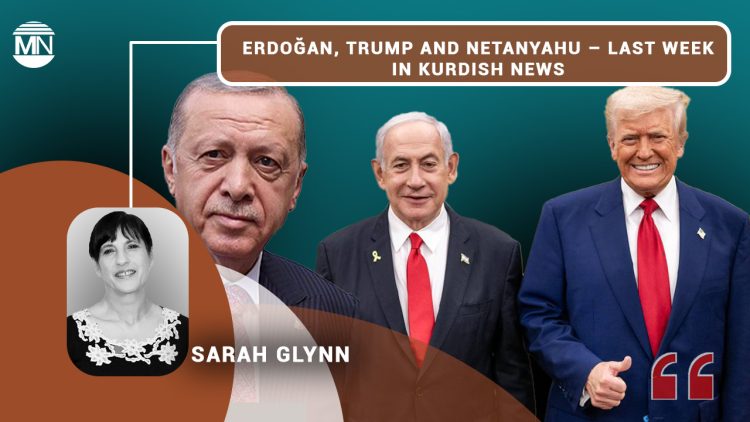
Monday’s meeting provided another display of Trumpian uncaring bravura. With Netanyahu sitting largely silent beside him in the Oval Office, Trump spoke of his “great relations” with Erdoğan, who’s “a tough guy” and “very smart”. He claimed to have told the Turkish President, “Congratulations, you’ve done what nobody’s been able to do in 2,000 years. You’ve taken over Syria – with different names but same thing.” He made no reference to the Kurds or to other peoples of Syria, but boasted of his previous deal to bring back an American Pastor imprisoned in Turkey. And he told Netanyahu “Any problem that you have with Turkey I think I can solve – I mean as long as you’re reasonable – you have to be reasonable.” There seems little chance that either Netanyahu nor Trump himself will be “reasonable”, or that they will have any considerations beyond what they themselves might benefit from.
Sarah Glynn is a writer and activist – check her website and follow her on Twitter or bluesky


