

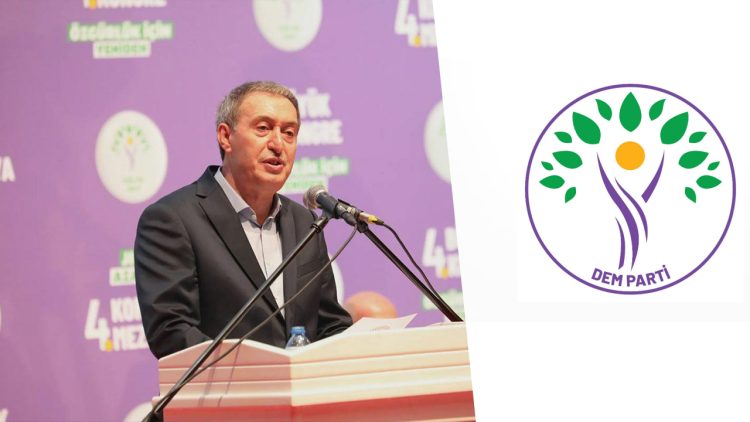
Turkey’s pro-Kurdish Peoples’ Equality and Democracy (DEM) Party Co-Chair Tuncer Bakırhan, has called for democratic reform and peace in Turkey, framing the Kurdish issue as central to broader national and regional transformation.
In an opinion piece published on 4 April in the Yeni Yaşam newspaper, Bakırhan argues that Turkey’s current approach to ethnic and political tensions, centred on denial and suppression, has reached a breaking point. He contends that genuine peace is only possible through democratisation, and that the country now faces a critical choice: continue with superficial fixes, or pursue deep-rooted change.
According to Bakırhan, a hundred years of policies of marginalising Kurdish identity and suppressing democratic participation have led to repeated cycles of unrest. “We no longer need a temporary bandage; we need a fundamental cure,” he writes, advocating for a democratic society based on inclusive dialogue, societal consensus and equal citizenship.
Bakırhan refers to what he dubs the “Call of the Century” made on 27 February by imprisoned Kurdish leader Abdullah Öcalan, who said that democratic consensus is necessary for progress. This sentiment, Bakırhan claims, was echoed by millions who took part in the annual Kurdish Newroz celebrations this year, signalling widespread public support for peaceful democratic reform.
The DEM Party’s proposal centres on the drafting of a new democratic constitution. Such a constitution, Bakırhan states, would protect pluralistic and justice-based values while enabling peaceful coexistence in a diverse society. He adds that the Grand National Assembly of Turkey (TBMM) has an opportunity to initiate this transformation by introducing a “Trust and Democracy Package” during April.
Bakırhan also criticises government practices that he says undermine local democracy, such as interference with elected officials and the limiting of the freedom of expression. These actions, he argues, contradict official government statements supporting peace and contribute to growing political polarisation.
“Local democracy is the lifeblood of democracy itself,” he writes, warning that ignoring the democratic will of local populations will only deepen existing divisions.
Framing the Kurdish issue not as an isolated concern but as integral to Turkey’s democratic future, Bakırhan stresses that meaningful peace would benefit the entire population, not just one group. “Peace benefits everyone,” he writes, linking democratic progress to economic and social stability across the country.
Bakırhan concludes with a direct message to those in power: “Don’t fear democracy.” According to him, embracing pluralism, safeguarding freedoms and implementing a rights-based political order would not only stabilise Turkey but also offer hope to the broader Middle East.
Below is the full English translation by MedyaNews:
A call for peace and democratic transformation
Tuncer Bakırhan, Yeni Yaşam, 4 April 2025
In the context of global and regional developments, Turkey stands as one of the Middle East’s most significant nations, while the Kurdish people are among its most organised communities. As the global order and regional dynamics undergo seismic shifts, resolving the Kurdish issue and achieving democratic transformation in Turkey could yield profound outcomes. Managing this process effectively could pave the way for deep-rooted, democratic change, not just for Turkey, but for the entire region. To seize a stronger position in this new era, we need an inclusive and bold perspective that serves both peace and democratic progress.
Turkey and the Middle East at a century’s threshold
For a hundred years, Turkey’s state policy has been shaped by a cycle of denial, rebellion and suppression. This misguided approach has cost the entire country dearly, doing little more than postponing demands for societal peace and democratic reform, only for those demands to grow and resurface today. It is now clear that lasting peace cannot be built without democratisation. It is no longer viable to try and prop up historical fault lines with superficial revisions or ease short-term tensions with stopgap measures. Turkey’s societal, cultural, ethnic and religious divides have become unsustainable under the current politics of tension. Persisting with these policies not only jeopardises the present but also mortgages the future, putting it at grave risk.
Turkey stands at a critical crossroads. Two paths lie ahead: one involves sweeping problems under the rug, opting for temporary fixes that save the day but deepen the issues; the other requires bravely confronting our challenges to forge lasting solutions. The first path exacerbates a wound that has bled for decades, amplifying chaos and ultimately harming us all. The dangers spilling over from regional turmoil could further infect this century-old sore, threatening the entire system. The second path, however, offers genuine healing through authentic methods, enabling us to emerge stronger together. We no longer need a temporary bandage; we need a fundamental cure. The solution is clear: a democratic society and peace.
Rather than whistling our way past the graveyard to suppress our fear, we need the wisdom to face its source and devise solutions. Problems cannot be solved by ignoring them – they demand courageous action. The time for kicking the can down the road is over; the moment has come for bold, authentic resolutions.
Democratic consensus as the core approach
Given global and regional dynamics, and societal and political support, the potential for peace and democratic transformation has reached its peak. Turning this potential into reality, however, requires more than good intentions and wishful thinking. The greatest threat to the opportunity for peace and democratic transformation lies in skirting around dialogue and prioritising short-term, election-driven political manoeuvres over meaningful progress.
Truth remains truth, unbound by time or place. Today, we must candidly and courageously debate why decades have slipped through our fingers. Strengthening societal peace demands addressing the country’s multifaceted challenges on a foundation of genuine dialogue. As Mr Öcalan stated in his Call of the Century on 27 February, “Democratic consensus is the fundamental method.” With democratic consensus as the cornerstone, democratic reforms should serve both peace and transformation. The millions who gathered in the Newroz spaces have proposed this method of democratic reconciliation to the state. Mr Öcalan signed the call for a democratic society and peace, and the millions in those spaces sealed it with their presence.
A powerful societal will for peace and democratisation has emerged. Now is the time for a matching political will to take shape and manifest. Only a robust political resolve, grounded in democratic legitimacy and societal backing, can ensure a stable future. The guiding principles of this effort must be democratic consensus, societal unity and constitutional equal citizenship.
To unlock the true potential of Turkey’s peoples for peace and democratic transformation, we need a societal agreement rooted in democratic participation and equal citizenship. This is where the importance of a new and democratic constitution becomes evident. Such an agreement will do more than establish legal norms; it will also safeguard the pluralistic, libertarian and justice-based principles of coexistence for Turkey’s society.
Peace benefits everyone!
As cracks appear in the global order and regional dynamics, the rising hope for peace in Turkey is not merely an issue tied to a single ethnic identity or territory. The inseparable bond between peace and democracy, coupled with deeper democratisation, is the key to unlocking positive developments that will ripple across every corner of the country, spanning political, social and economic spheres. When this key turns the lock of peace, a process of democratic reconstruction will inevitably follow. From this standpoint, the building of democracy and of peace need to be undertaken by a method ensuring simultaneous progress. Within this framework, the TBMM (Grand National Assembly of Turkey) could play a pivotal role by starting April with a “Trust and Democracy Package.”
By the very nature of things, steps to build trust must be taken, and policies or practices that undermine the government’s legitimacy or accelerate democratic backsliding need to be avoided. Interference in local governments and elected representatives, thereby hastening democratic decline, at the same time as offering well-wishes for peace, creates an irreconcilable dilemma.
Undoubtedly, local democracy is the lifeblood of democracy itself; it is the most direct expression of the will of the people. The acts of blocking the freedom of expression, disrespecting the mandate of elected officials and stifling pluralistic participation not only deepen polarisation but also weaken peaceful solutions. For those committed to building a democratic, peaceful and just future, the priority must not be pursuing narrow political interests, but unleashing the energy of collective wisdom.
Those who fail to demonstrate a will for peace and democratic solutions will face a reckoning with both history and society. Political actors must learn from the bitter lessons of the past and pave the way for concrete, lasting resolutions.
Democratic transformation is only possible through an inclusive approach, an ethical framework that prioritises the well-being not of just [a few] individuals, but of 85 million, and a shared vision of a future where everyone can see themselves being. A peace that lays the groundwork for democratic transformation will benefit us all!
We’re ready for peace; Don’t fear democracy!
Our Call for Peace and Democratic Transformation is proof of our readiness for an honourable peace, and a challenge to those in power: “Don’t fear democracy.”
As the DEM Party, we wish to express our perspective on the shared life of our peoples and democratic solutions in the clearest terms. For us, peace means a Democratic Republic of Turkey where all citizens enjoy equal rights, live freely and see their differences celebrated as a source of richness. Such a democratic republic would offer a powerful breath of hope to the peoples of the Middle East, with whom we share a common fate and history.
In Turkey, a democratic political order needs to be built on the rights and freedoms of individuals, a strict separation of powers, a libertarian secularism rooted in freedom of belief and equal citizenship, and a unity-strengthening recognition of differences.
For this order to take root, everyone must rise above prejudice, take responsibility and show resolute democratic political commitment. The achievement of the peace, democracy and prosperity that our country and future generations deserve is within reach. It is our historical duty to bring this to life!
We are ready for peace. No one should fear democracy, equality or freedom!


