

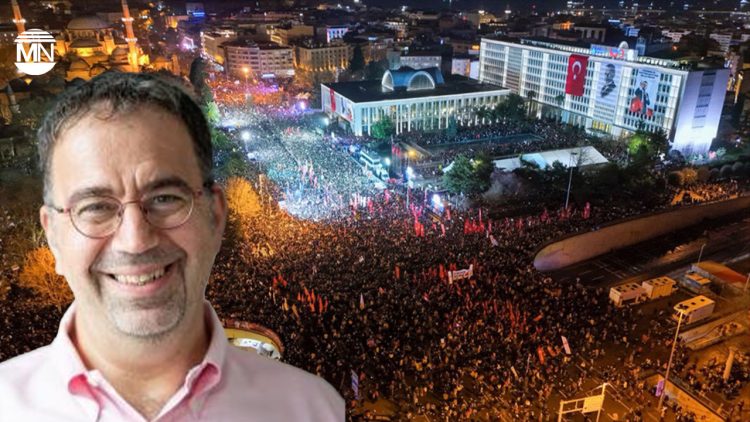
Turkey stands at a geopolitical and democratic crossroads, according to US economist Daron Acemoglu, following the arrest of the Mayor of Istanbul Ekrem İmamoğlu on 23 March 2025.
Acemoglu, a Turkish-American of Armenian descent and Professor of Economics at the Massachusetts Institute of Technology (MIT), argued in a detailed post on X on 28 March that the nation must decide whether to join a democratic European block or align with authoritarian powers like Russia and China, a choice made urgent by recent political turmoil.
Turkish democracy was ailing even before the main contender for challenging (and perhaps winning against) President Erdoğan, the Istanbul mayor Ekrem İmamoğlu was arrested last week on charges that many are arguing to be trumped up.
This by itself is noteworthy. It has become…
— Daron Acemoglu (@DAcemogluMIT) March 28, 2025
He wrote: “Turkish democracy was ailing even before the main contender for challenging (and perhaps winning against) President Erdoğan, the Istanbul mayor Ekrem İmamoğlu was arrested last week on charges that many are arguing to be trumped up.” İmamoğlu, a key figure in the Republican People’s Party (CHP), faces allegations of corruption and links to banned Kurdish groups, widely viewed as politically motivated with the aim of sidelining a rival to President Recep Tayyip Erdoğan. His detention has sparked the biggest protests since the 2013 Gezi Park unrest, with Acemoglu remarking, “It has become more [noteworthy] because it has also triggered widespread protests, which Turkey has not experienced since those surrounding the Gezi Park were put down.”
Acemoglu framed this crisis within a shifting global landscape, suggesting, “The current geopolitical situation has created a new opportunity for Turkey, which the country should not squander.” He pointed to US President Donald Trump’s efforts to “remake the world order”, aligning America with autocrats like Russia’s Vladimir Putin and potentially China, while distancing it from Europe and NATO. “The possibility of a new European block (perhaps joined by Canada), committed to liberal democracy and its own defense, is no longer unthinkable,” said the economist, presenting Turkey with three paths: neutrality, alignment with the US-Russia-China axis, or integration with Europe.
He sees the European option as viable, given Turkey’s role as NATO’s second largest military power and its potential to bolster a European defence pact. “Turkey already has the second-largest ministry in NATO, and would be a crucial partner to Germany, France and other European countries in building a common defense,” he explained. Economically, he highlighted benefits for a nation struggling with stagnant productivity since 2006: “European markets, European capital, and most importantly European technology and joint venture opportunities with European companies could substantially boost Turkey’s productivity potential,” he said, recalling, “The most rapid period of productivity growth in Turkey’s recent past, between 2002-2006, was in the context of the country’s EU accession talks.”
Yet, this path hinges on democratic renewal. “Turkey needs to credibly signal to its European partners that it will try to reverse the downward slide of its democratic institutions,” Acemoglu urged, noting Turkey’s poor global ranking in democratic decline. He called for the government to “accept and even celebrate civil society activity and protests” and for the youth to deepen their political engagement. “It will require the population to see Europeans as partners,” he added.
Uncertainty surrounds President Erdoğan’s willingness to pivot. Acemoglu acknowledged the president’s adaptability, writing, “President Erdoğan has proven over the last several decades that he can change with the times and opportunities.” However, he cautioned, “The change in perspective and institutional approach that is required here may be more radical than trying to bring the Kurds into the fold (which the president is now attempting).” Without this shift, he predicted, “Turkish politics will become more uncertain and more confrontational,” leaving it unclear who might lead the necessary transformation for the country’s future.


