

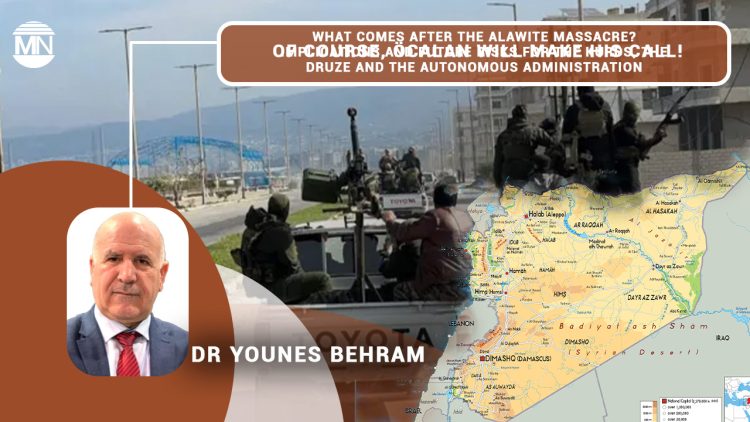
Dr Younes Behram
The attack on the villages of Syria’s coastal region was not merely a battle between opposition factions and the regime; rather, it was an organised crime with a clear sectarian nature. The manner in which the massacre was carried out, the statements made by the perpetrators and their public boasting before cameras, confirm that this was not a conventional military operation, but a deliberate act of genocide against the Alawites. This sets a dangerous precedent for other communities such as the Kurds and Druze, putting them at risk of similar violence in the future.
What happened on the coast reflects a broader reality in Syria, where the Syrian state—both its military and institutions—can no longer enforce its authority. Instead, the country has become a battleground for numerous armed factions backed by regional intelligence agencies, operating outside any legal or military framework.
The factions that carried out the massacre against the Alawite community in Syria, with the endorsement of Hay’at Tahrir al-Sham (HTS), include the Sultan Suleiman Shah Brigade (commonly known as the ‘Amshat’) and the Hamza Division. These are the same groups that have launched attacks against the Syrian Democratic Forces (SDF) on fronts such as the Tishreen (Tişrîn) Dam and the Qara Quzak (Qere Qozaq) Bridge.
Any assumption that these factions will not eventually turn their weapons against Kurdish areas again is a dangerous illusion. Therefore, it is imperative to enhance military preparedness and strengthen proactive intelligence operations.
HTS has failed to protect its own territories
The panicked government of Al-Julani (Al-Sharaa) has failed to protect its own territories, including the coastal region, which was considered one of the most heavily fortified areas. Thus, the idea of aligning with Damascus, without a strong autonomous force capable of protecting the Kurds and other coexisting communities from potential attacks, would be a grave miscalculation. Damascus itself is infiltrated and incapable of confronting regional and factional threats.
The Autonomous Administration of North and East Syria must develop independent strategies that prioritise strengthening internal and external security. Additionally, reinforcing alliances with other vulnerable communities is vital. The recent massacre has demonstrated that extremist factions loyal to the Syrian government do not merely target remnants of the former regime, but specific communities. This places Druze, Kurds, Christians, Alawites and some Arab tribes at risk of future attacks.
Strong and lasting alliances among these communities could serve as a formidable barrier against future acts of genocide and displacement, similar to what was witnessed in Sinjar (Shengal), Afrin (Efrîn), Ras al-Ayn (Serêkaniyê) and Tell Abyad (Girê Spî).
A diplomatic and political opportunity for the Autonomous Administration
The brutal attack on the coastal region has reinforced the Autonomous Administration’s position in the international community, particularly as the only entity offering a model of stable governance in Syria.
The moment should be seized politically and diplomatically to secure broader recognition of the Autonomous Administration and to push for international protection against extremist factions. Pressure should be exerted on major powers such as the United States and Europe to ensure continued military and political support, preventing future massacres in other regions.
Al-Julani’s dilemma
HTS leader Abu Mohammad al-Julani finds himself in a critical predicament after this massacre. If he chooses to punish the factions responsible, he risks an internal rebellion, backed by regional powers, that could threaten his rule. However, if he fails to act, international pressure against him will mount, with sanctions and a lack of recognition posing significant obstacles to his political ambitions.
In either scenario, the future of northwestern Syria remains uncertain, with an increasing likelihood of chaos and internal strife among rival factions.
Could these massacres be repeated elsewhere?
Yes, if these factions are not held accountable, they could commit similar crimes in other areas, including regions controlled by the Autonomous Administration, as well as in [the Druze-majority city of] Suwayda and tribal areas. The current security vacuum, combined with the absence of a central authority, creates an ideal environment for such crimes to be repeated, particularly given the continued regional support these armed groups receive, making them effectively immune to prosecution.
Thus, the Autonomous Administration must take the Alawite massacre as a serious warning of what could occur in its own territories if necessary precautions are not taken. Security and military defences must be reinforced, and preparations must be made for any potential future attacks.
Furthermore, the Kurds, the Druze and other minority groups must coordinate efforts and forge alliances to protect themselves from extremist threats. This moment should also be used diplomatically to pressurise the international community into recognising the Autonomous Administration and imposing severe sanctions on terrorist factions backed by certain regional states, especially after Sunday, when US Secretary of State Marco Rubio condemned the massacre, saying, “The United States denounces the Islamist extremists, including foreign jihadists, who killed innocent people in Syria. The United States stands with the Druze, Alawites, Christians and Kurds.”
Additionally, Germany, France, and the European Union have condemned the massacre and have begun reconsidering their stance on lifting sanctions on Syria. If no action is taken now, future massacres could be even bloodier, and no one will be safe from the chaos fostered by regional intelligence agencies and their affiliated factions—not just in Syria, but potentially in Europe as well.
*Dr Younes Behram, born in 1967 in Rojava-NE Syria, is a political writer with several publications on Kurdish literature in German and in Kurdish. He is actively engaged in diplomatic work and has a significant presence in international forums. He has studied medicine (radiology), as well as political science, sociology and law.


