

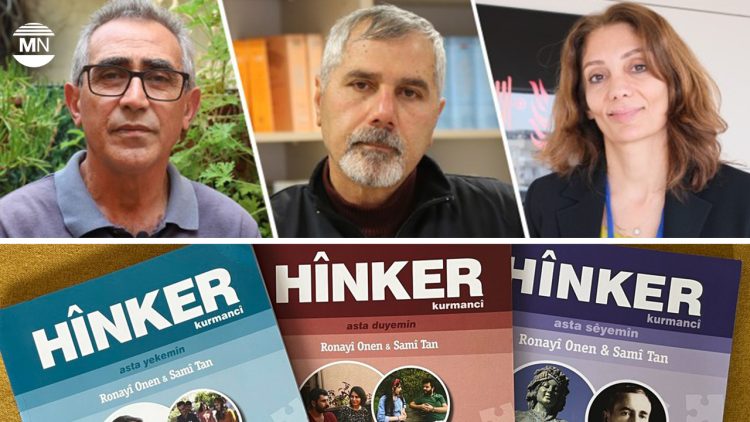
Three Kurdish authors—Mevlüt Aykoç, Sami Tan, and Ronayi Önen—have been detained in Turkey for their involvement in publishing Hînker, a Kurdish language education book released in 2010. The detentions occurred on Wednesday during coordinated raids in Istanbul, Urfa (Riha), and Diyarbakır (Amed), as part of an investigation by the Istanbul Chief Public Prosecutor’s Office.
The authors are accused of ‘membership in a terrorist organisation’ after the book was allegedly found in the possession of a deceased member of the People’s Defence Forces (HPG), the armed guerilla wing of the Kurdistan Workers’ Party (PKK). During interrogations, authorities questioned the authors about the book’s content, visual materials, and layout. Additionally, they were asked about the legal permits required for Hînker’s publication, despite the fact that the book has been officially licensed and available for sale in bookstores and online platforms since 2010.
Kurdish language rights have long been subjected to severe restrictions in Turkey, where linguistic policies have sought to suppress Kurdish education and cultural expression. While Hînker is widely recognised as a pedagogical tool, Turkish authorities have frequently criminalised Kurdish language initiatives. Hînker itself is an ethnological term referring to the act of teaching in Kurdish. It derives from hînbun, the infinitive verb for “learning” in the Kurmancî dialect. Kurdish consists of four main dialects: Kurmancî, Soranî, Zazakî, and Lorî, and within this linguistic structure Hînker is a structured resource designed to facilitate learning.
The arrests have raised concerns over Turkey’s ongoing repression of Kurdish linguistic and educational rights, particularly at a time when the country has entered a political process branded as a historic turning point for peace.
The pro-Kurdish Peoples’ Equality and Democracy (DEM) Party has condemned the arrests, stating that criminalising a Kurdish language textbook directly contradicts the democratic transformation process initiated with imprisoned Kurdish leader Abdullah Öcalan’s ‘Call for Peace and a Democratic Society’.
The pro-Kurdish Peoples’ Equality and Democracy (DEM) Party declared in a statement:
"As Turkey enters a new era with the historic Call for Peace and a Democratic Society, these unlawful and anti-democratic attacks on Kurdish language workers—Ronahî Önen, Sami Tan, and Mevlüt Aykoç—are unacceptable. These operations are designed to weaken hopes for peace. The government and the judiciary under its control must immediately halt these actions. Those detained must be released, and urgent steps towards democratisation must be taken,"
DEM Party Co-Chair Tuncer Bakırhan also criticised the detentions, calling them an outrageous and unlawful decision. He underscored the contradiction between these arrests and the state’s ongoing peace discussions, stating:
"How can the government claim to be in a democratic transformation process while detaining teachers who simply work to advance the Kurdish language? Our teachers Ronahî Önen, Sami Tan, and Mevlüt Aykoç have dedicated their lives to the Kurdish language and made great efforts for its advancement. We strongly condemn this decision. Our teachers must be released immediately, and the path to peace and a democratic society must not be obstructed."

The arrests have raised concerns over Turkey’s restrictions on Kurdish language rights and freedom of expression. Legal proceedings are ongoing, and reactions continue to emerge from various sectors.
For more than a century, Kurdish communities have endured cultural genocide policies, particularly in Turkey, but also in Iran, Iraq, and Syria. While Kurdish education has been officially recognised in the Kurdistan Region of Iraq (KRI) and, over the past decade, in Rojava (Northeast Syria’s autonomous administration), Turkey and Iran continue to impose harsh restrictions on Kurdish learning. In these states, Kurdish remains heavily limited in public education and state institutions, and efforts to promote the language face severe political and legal obstacles.
Related Articles
Kurdish language teacher jailed in Iran for cultural activismKurds demand linguistic rights on International Mother Language Day
The legal proceedings against the detained authors are ongoing, and reactions continue to emerge from various sectors, with human rights organisations and Kurdish institutions calling for an end to policies that criminalise Kurdish language and cultural heritage.


