

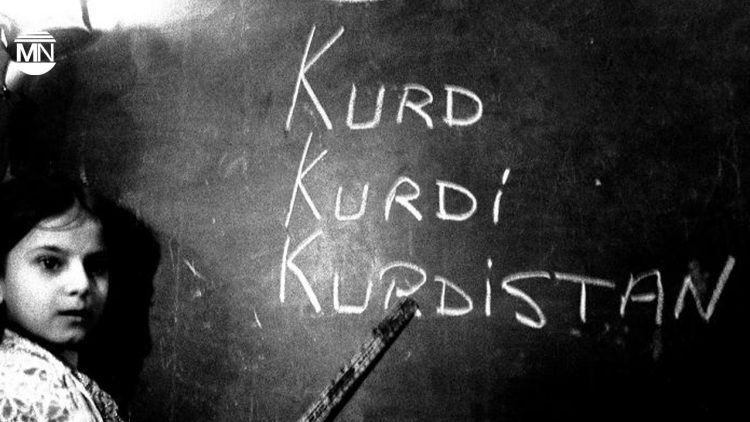
On 21 February, International Mother Language Day, Kurdish organisations in the diaspora, along with Kurdish political parties and parliamentarians in Turkey and Iran—where the Kurdish language remains heavily restricted—issued statements highlighting the urgent need for linguistic rights. They emphasised that the recognition of mother-tongue education, its use in public spaces, and its official recognition are fundamental steps towards fostering social peace and coexistence.
The Kurdistan National Congress (KNK), the pro-Kurdish Peoples’ Equality and Democracy (DEM) Party, and the Kurdistan Free Life Party (PJAK), active in Iranian Kurdistan, reaffirmed that a multicultural and multilingual society is essential for stability and harmony in the Middle East.
In its statement, the KNK drew attention to the systemic oppression endured by the Kurdish people over the past century, stating:
“For over a hundred years, the governments of Iran, Turkey, and Syria have systematically denied the Kurdish people their most basic human rights, including linguistic freedoms. These policies have even led to the imprisonment of Kurdish language teachers, further entrenching the marginalisation of Kurdish as both a language and an identity.”
The KNK urged international human rights organisations to pressure Turkey and Iran into officially recognising Kurdish in public spaces and institutions. It also called on the Kurdistan Regional Government and the Autonomous Administration of North and East Syria (AANES) to implement language policies that unify Kurdish dialects in educational curricula, ensuring the language’s survival and strength.
“Throughout the 20th century, the Kurdish people and their language have been primary targets of systemic violence. The Turkish nation-state has employed social and linguistic engineering to suppress the Kurdish language, culture, and folklore, aiming to assimilate them into Turkish identity. As a result, other minority languages have also suffered under these oppressive policies,” the KNK added.
In Turkey, the DEM Party marked International Mother Language Day with statements stressing the importance of recognising Kurdish and other minority languages as a means of achieving social peace. The DEM Party also cited the theoretical contributions of Abdullah Öcalan, the imprisoned leader of the Kurdish movement, who has long championed a “democratic nation.” Quoting Öcalan, the statement read:
“A man without a language is a dead man.”
The statement concluded with a declaration:
“We reaffirm that multiculturalism and multilingualism are the cornerstones of social peace and coexistence. True peace is not achieved through uniformity but through pluralism rooted in equality. Therefore, we declare: ‘Social Peace is Realised by the Peace of Languages.’ To build this peace, legal barriers preventing all peoples from receiving education in their mother tongues must be dismantled, and public services must be provided in these languages, constitutionally safeguarded under the principles of linguistic freedom and territoriality. On this International Mother Language Day, we renew our commitment to advancing the struggle for linguistic rights, particularly for the Kurdish language. Let us transform the graveyard of languages into a garden of languages. Let us establish peace among languages to ensure social peace.”
Meanwhile, PJAK released a statement condemning the imposition of a single “official language” by Turkey and Iran, describing these policies as emblematic of fascist state systems. Congratulating all oppressed peoples, particularly the Kurdish community, the statement urged every Kurdish household to become a school for the Kurdish language, stressing that linguistic preservation is essential for liberation from national and cultural oppression.
PJAK asserted that the liberation of the Kurdish language is inextricably linked to the broader struggle for the political and cultural freedom of the Kurdish people in Iran and Turkey.
In recent days, representatives of the DEM Party, along with members of the Circassian and Georgian minorities in the Turkish Parliament, have delivered speeches condemning the imposition of a nation-state ideology. They argued that granting all residents of Turkey the right to education in their mother tongue and its use in public spaces is fundamental to achieving lasting social peace.


