

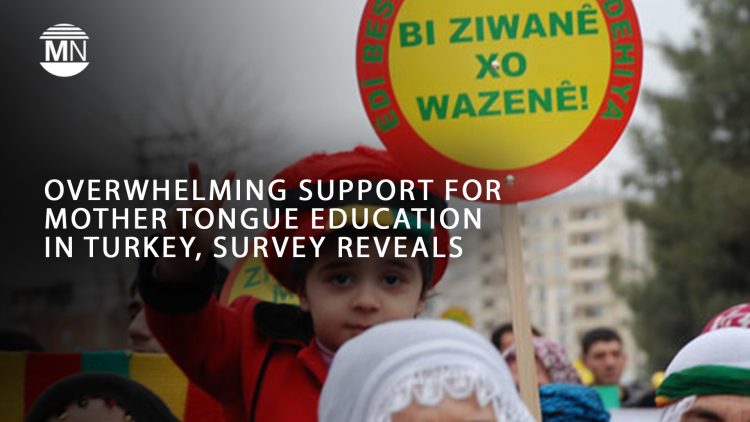
An overwhelming 97.8% of participants in a recent survey conducted by the Sociopolitical Field Research Centre in Turkey, which primarily focused on citizens who identified their ethnic origin as Kurdish, expressed a desire for their children to receive education in their mother tongue, underlining a widespread concern over language loss.
The study, conducted across 22 cities, including İstanbul, Amed (Diyarbakır), Van (Wan), and Mardin (Mêrdîn) observed 1,285 citizens regarding their language use, perceptions, and demands. It found that as younger generations increasingly struggle with their mother tongue, the risk of these languages becoming extinct is growing.
According to the survey results, published just days before 21 February International Mother Language Day, nearly one in five children under the age of 11 no longer regularly speaks their mother tongue, with the rate of fluency decreasing among younger age groups. The majority of respondents attributed this decline to the lack of mother tongue education, assimilation policies, and limited daily exposure.
Of the participants, 80.4% stated that their mother tongue was Kurmanji, 17% Kırmancki/Zazaki, and the remainder Armenian and Circassian. However, only 41.7% reported Kurmanji as the main language spoken at home, while 35.9% spoke Turkish, 14.9% a mix of both Turkish and Kurdish, and the remainder Kırmancki/Zazaki, Arabic, Armenian, and Assyrian.
The survey also revealed that 49% of participants fear their children might face discrimination for speaking their mother tongue, particularly in state institutions. Additionally, 97.7% believe their mother tongue should be preserved and developed, with 31.8% calling for it to become an official language of instruction.
The findings highlight a growing call for legal and institutional measures to support multilingual education in Turkey and protect linguistic diversity for future generations.


